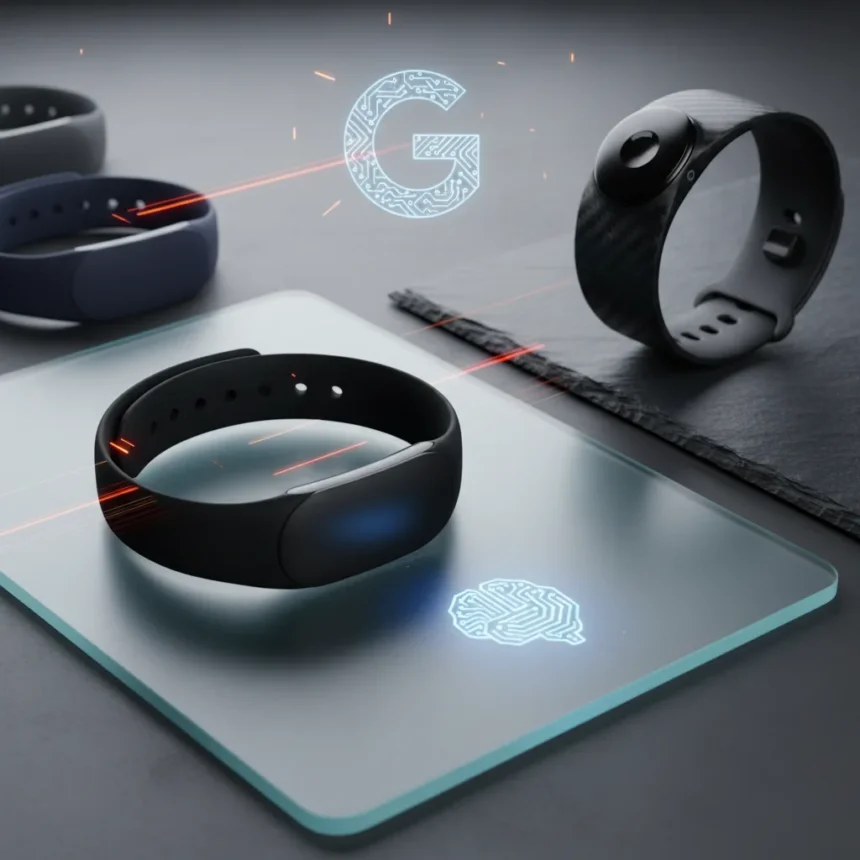
Google’s screenless Fitbit band represents a direct challenge to Whoop’s dominance in the minimalist health tracking space. The device, teased by NBA star Stephen Curry in a sponsored Instagram video, strips away the display entirely to focus on continuous health insights delivered through an AI-powered companion app.
Key Takeaways
- Google’s screenless Fitbit band launches later in 2026, competing directly with Whoop and Oura Ring
- Device features gray cloth design with orange lining; multiple color options expected at launch
- Redesigned Fitbit app includes Gemini AI health coach for recovery, cycle tracking, nutrition, and mental wellbeing
- Google charges upfront for hardware but locks advanced features behind subscription, unlike Whoop’s fully subscription model
- Whoop’s recent $575 million funding round valued the company over $10 billion, signaling investor confidence in subscription wearables
Google’s Screenless Fitbit Band Design and Features
The screenless Fitbit band adopts a minimalist aesthetic that mirrors Whoop’s approach: a simple cloth band without a display, designed to sit invisibly on the wrist. The prototype shown by Curry features a gray fabric construction with orange lining, though Google is expected to offer multiple color options at launch. This design philosophy prioritizes unobtrusiveness over on-device notifications—a direct response to the growing fatigue with smartwatch screens.
What separates this device from traditional Fitbit trackers is its reliance on an AI companion rather than a touchscreen interface. The redesigned Fitbit app integrates Google’s Gemini AI as a personal health coach, delivering insights on mental wellbeing, recovery metrics, cycle tracking, nutrition patterns, and hydration levels. This feature is currently in preview, suggesting Google is still refining how users interact with their health data without a wrist-based display.
How Google’s Approach Differs from Whoop
Google and Whoop employ fundamentally different business models despite targeting the same minimalist audience. Whoop operates on a fully subscription-based model, providing the hardware free or at minimal cost and charging a monthly membership for access to insights and coaching. Google’s screenless Fitbit band reverses this: customers pay upfront for the hardware and then access premium features through a subscription tier.


This hybrid pricing approach reflects Google’s broader ecosystem strategy. While Whoop exists as a standalone subscription service, Google’s band integrates with the Fitbit app, which already has millions of users across Android and iOS. The Gemini AI coach is a competitive advantage Whoop does not currently emphasize—Whoop focuses on physiological data like heart rate variability and strain metrics, while Google is positioning AI-driven behavioral insights as its differentiator.
Whoop has reinforced its market position with a $575 million funding round that valued the company above $10 billion, and the company is reportedly exploring a public listing within the next two years. This capital infusion signals investor confidence in subscription-first wearables, even as Google enters the space with a different monetization model.



When Will the Screenless Fitbit Band Launch?
Google has confirmed the screenless Fitbit band will arrive later in 2026, though no exact date has been announced. The Curry collaboration suggests the launch timeline is reasonably imminent, but the company is likely waiting for the Gemini AI features to move out of preview before a full rollout. The lack of a specific launch window reflects the typical Google strategy of teasing products months in advance to build anticipation without committing to a hard date.
Pricing and subscription tier details remain unconfirmed. Google has not disclosed whether the band will launch at a premium price point to compete with Whoop’s hardware costs or at a lower entry price to attract price-sensitive users. Similarly, the monthly subscription cost for advanced Gemini features is still unknown, leaving questions about the overall value proposition compared to Whoop’s established pricing structure.
Does Google’s Screenless Fitbit Band Make Sense?
For Google, the screenless Fitbit band fills a strategic gap. Pixel smartwatches and traditional Fitbit trackers like the Versa 3 dominate the display-first market, but Google lacks a presence in the growing subscription health coaching segment where Whoop and Oura have built loyal audiences. By adding Gemini AI to a minimalist form factor, Google is betting that users want personalized health coaching without the distraction of notifications and apps on their wrist.
The Curry partnership is telling. Endorsements from professional athletes drive wearable adoption, especially in the fitness-obsessed demographic that gravitates toward Whoop. If Google can replicate Whoop’s athlete-first marketing while offering deeper AI-powered insights, it could accelerate adoption among serious fitness enthusiasts and health-conscious consumers worldwide.



Will the Screenless Fitbit Band Replace Whoop?
Unlikely. Whoop has spent years building brand loyalty among athletes, biohackers, and fitness professionals. Its always-on heart rate sensors capture data every second, offering physiological precision that rivals medical-grade devices. Google’s screenless Fitbit band will need to demonstrate comparable accuracy and reliability before it convinces Whoop’s installed base to switch.
However, the launch creates real competition. Whoop’s recent $10 billion+ valuation assumes continued growth and market dominance. Google’s entry into screenless subscription wearables with AI coaching introduces a credible alternative backed by significant resources and an existing user base. The question is not whether Google will replace Whoop, but whether Google’s approach will fragment the minimalist wearable market and force both companies to innovate faster.
Can You Use the Screenless Fitbit Band Without a Subscription?
Google has not confirmed whether the screenless Fitbit band will offer a free tier with basic health metrics or require a subscription for all features. Given that the Gemini AI coach is being positioned as the device’s primary value proposition, it is likely that advanced insights will be locked behind a paywall, though basic data like steps and heart rate may remain free.
How Does the Screenless Fitbit Band Compare to Oura Ring?
Both devices target the minimalist wearable market, but Oura Ring is a finger-worn device while Google’s band is wrist-worn. Finger rings offer even greater invisibility and comfort for sleep tracking, while wrist bands are more familiar to traditional fitness tracker users. Google’s advantage is the Gemini AI coach integrated into the Fitbit app; Oura’s advantage is a decade of refinement in ring-based health sensing. The choice between them depends on form factor preference and whether users prioritize AI coaching or physiological precision.
When Can You Buy Google’s Screenless Fitbit Band?
The band is expected to launch later in 2026, with no confirmed pre-order date or retail availability details announced. Google typically makes Fitbit devices available through its online store and major retailers like Amazon and Best Buy, so expect similar distribution when the screenless band officially launches.
Google’s screenless Fitbit band signals that subscription-first wearables are no longer a Whoop monopoly. By combining minimalist hardware with AI-powered coaching, Google is betting that users want health insights delivered through conversation rather than screens. Whether that gamble pays off depends on execution, pricing, and whether Gemini can actually deliver the personalized health guidance users expect. The launch later in 2026 will determine whether Google has a genuine Whoop competitor or simply another fitness tracker chasing a trend.
Edited by the All Things Geek team.
Source: T3