






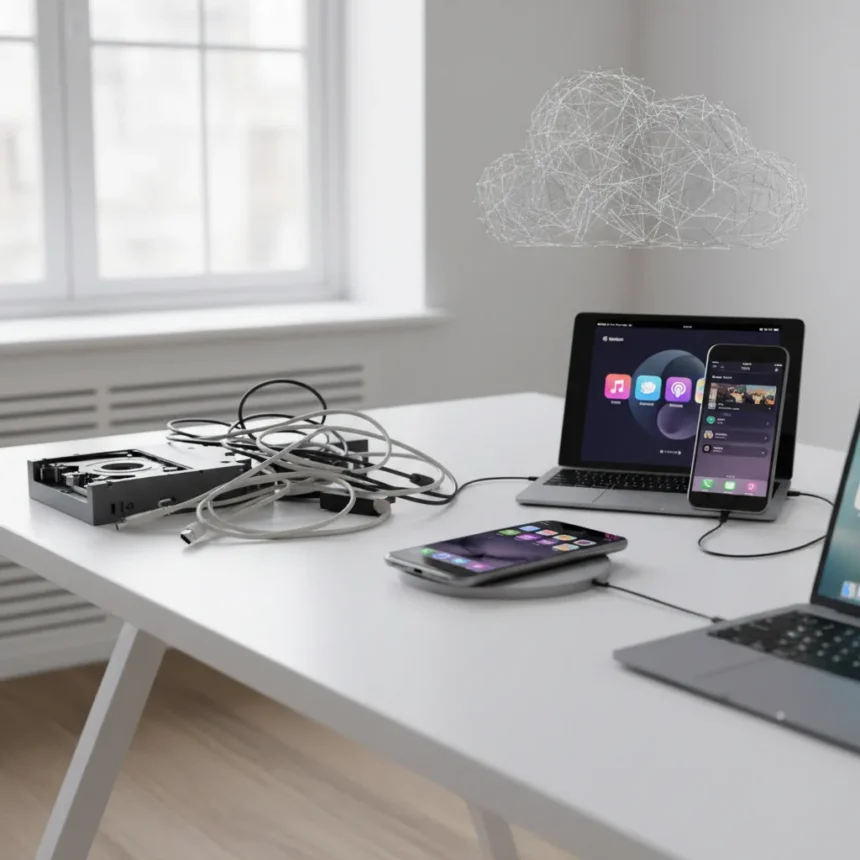
iTunes discontinuation iPhone users represented a watershed moment for Apple’s ecosystem. When Apple finally shut down the bloated software that had dominated music and device management for nearly two decades, it cleared the path for a far more elegant, distributed approach to how iPhones connect to computers and sync content.
Key Takeaways
- iTunes was a monolithic application that combined media player, store, and device management into one unwieldy interface.
- Apple replaced iTunes with three separate apps: Music, Podcasts, and TV, plus native Finder integration on Mac.
- Removing iTunes eliminated performance drag, simplified user workflows, and modernized how iPhones communicate with computers.
- The transition freed Apple to innovate on each service independently without legacy software constraints.
- iTunes discontinuation iPhone management made syncing faster and more intuitive for millions of users globally.
Why iTunes Was a Relic Holding Back iPhone
iTunes started as a music player in 2001, then bloated into a catch-all tool for managing photos, videos, apps, backups, and device firmware updates. By the time Apple killed it off, iTunes had become a performance bottleneck—a single application trying to do too much, serving no user particularly well. The software was slow to launch, unreliable during syncs, and confusing for anyone trying to simply charge their phone without accidentally triggering a backup or app reinstall.
The real problem was architectural. iTunes couldn’t evolve because it was designed around assumptions from the iPod era. Adding new features meant patching a foundation never meant to scale. Users hated it. IT departments dreaded deploying it. Even casual iPhone owners learned to dread the spinning wheel and the cryptic error messages that appeared when something went wrong during a sync.
How Apple Fixed It: Three Apps, One Ecosystem
Apple’s solution was radical in its simplicity. Instead of one monolithic application, iTunes discontinuation iPhone management meant breaking functionality into purpose-built apps: Music for audio, Podcasts for shows, and TV for video content. On Mac, Finder itself became the device management hub, eliminating the need for a separate tool entirely. Each app could now evolve independently, receive updates on its own schedule, and focus on doing one thing well.


This modular approach transformed the user experience. Syncing became faster because each app only handled its own data type. The Finder integration on macOS meant iPhone users could drag and drop files, manage backups, and update their device through the same file browser they used for everything else on their computer. No more launching a separate application. No more waiting for iTunes to load.
iTunes Discontinuation iPhone Users: The Real Winners
The practical benefits rippled across the entire user base. Performance improved immediately—devices no longer had to load a bloated media player and device manager just to sync photos. Reliability increased because the code handling music was no longer tangled with code handling backups. Workflows became intuitive because users could manage their iPhone content through apps and interfaces they already understood.


For power users, the shift opened new possibilities. Developers could build specialized tools around the new architecture. Musicians could use dedicated audio apps instead of fighting iTunes’ limitations. Podcast listeners got an app designed specifically for subscriptions and playback. The ecosystem became modular, extensible, and modern.
Comparison to the Old Model
The old iTunes approach—one monolithic tool for everything—was a relic of an era when devices had limited storage and needed a computer as a hub. Modern iPhones are powerful computers themselves. They sync wirelessly. They manage their own backups. They don’t need a desktop application pretending to be both a media player and a device manager. iTunes discontinuation iPhone management freed Apple to build tools that assumed devices were independent, cloud-connected, and intelligent.
Why This Matters Now
Five years after iTunes shut down, the lesson is clear: breaking a monolithic system into focused, modular applications makes everything better. Performance improves. Reliability increases. Users get clearer interfaces. Development accelerates. Apple proved that sometimes the best way to move forward is to kill the past entirely rather than patch it indefinitely.
Did removing iTunes cause any problems?
Some users with large legacy music libraries initially struggled with the transition, particularly those relying on iTunes’ specific organizational features. However, Apple provided migration tools and documentation to ease the shift. The long-term benefits—faster syncing, better reliability, and modern interfaces—far outweighed the short-term adjustment period.



Can you still sync an iPhone without iTunes?
Yes. Modern iPhones sync wirelessly via iCloud and the companion apps (Music, Podcasts, TV). On Mac, the Finder handles device management and backups. Windows users can access their iPhone through the Finder equivalent or use the dedicated apps directly. iTunes discontinuation iPhone workflows actually made syncing simpler and faster than the old method.
What happened to people’s iTunes libraries?
Apple Music inherited iTunes’ library functionality. Users could migrate their playlists, ratings, and purchase history to the Music app. The transition was designed to be transparent—your music library didn’t disappear, it just moved to a more modern home.
The death of iTunes proves that sometimes the boldest move a company can make is to kill a beloved-but-broken product entirely. Apple didn’t patch iTunes into irrelevance. It replaced it with something better, faster, and more aligned with how people actually use their devices today. That decision shaped the iPhone experience for hundreds of millions of users worldwide.
Edited by the All Things Geek team.
Source: Tom's Guide