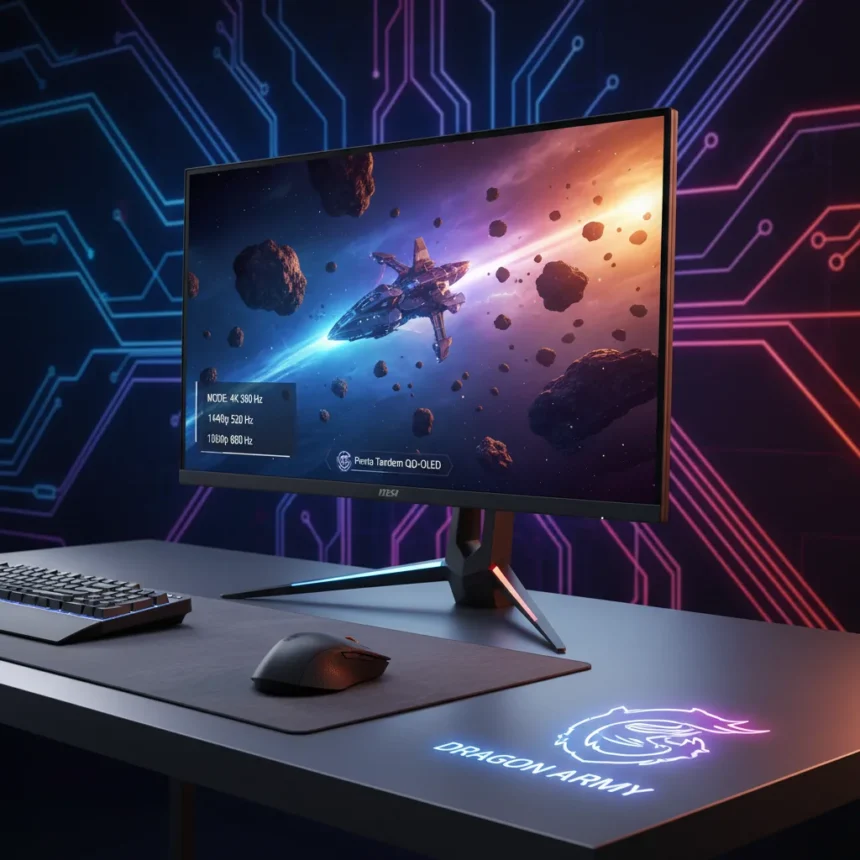
MSI’s new triple-mode OLED gaming monitor is a 32-inch display that fundamentally changes how competitive and immersive gaming coexist on a single screen. The MPG OLED 322URDX36, unveiled at Computex, can switch between 4K at 360 Hz, 1440p at 520 Hz, and 1080p at 680 Hz—eliminating the compromise that dual-mode monitors force on players. Instead of choosing between pixel density and refresh rate, gamers can now have both, toggled instantly.
Key Takeaways
- Triple-mode switching delivers 4K 360 Hz, 1440p 520 Hz, and 1080p 680 Hz on a single 32-inch panel.
- Penta Tandem QD-OLED technology uses five RGB layers to boost brightness and color accuracy.
- RGB stripe subpixels reduce color fringing and keep text sharp compared to traditional OLED layouts.
- DarkArmor film improves black levels by up to 40% and adds scratch resistance.
- DisplayPort 2.1 with 80 Gbps bandwidth handles all three resolution-refresh combinations.
Why the triple-mode OLED gaming monitor matters right now
Gaming monitor design has been stuck in a binary choice: chase framerates at lower resolution, or accept a refresh-rate ceiling for sharper visuals. Most dual-mode OLED monitors force players to pick two fixed modes—usually 4K at 240 Hz or 1440p at 360 Hz. MSI’s approach shatters that constraint. The ability to run competitive shooters at 1080p 680 Hz for maximum responsiveness, then flip to 1440p 520 Hz for strategy games, then shift to 4K 360 Hz for single-player immersion—all without swapping hardware—is genuinely new in the gaming monitor space.
The competitive gaming community has obsessed over 360 Hz, 480 Hz, and even higher refresh rates because input lag and frame-to-frame consistency matter more than pixel count in esports. But that obsession has come at the cost of visual fidelity for everyone else. A triple-mode monitor acknowledges that the same player might want 680 Hz for Valorant at lunch, then 4K for Baldur’s Gate 3 at night. That flexibility is the real innovation here.
Penta Tandem QD-OLED and RGB stripe subpixels explained
The display’s standout technology is its Penta Tandem QD-OLED panel—a fourth-generation Samsung OLED with five distinct RGB layers stacked to improve brightness and color precision. This is not a minor tweak. Traditional OLED panels use a single RGB layer; adding four more allows the panel to emit more light while maintaining color accuracy, critical for OLED displays that historically struggle with brightness compared to LCD.


MSI has also specified RGB stripe subpixels instead of the diamond or pentile arrangements found in many OLED displays. Stripe layouts—where red, green, and blue pixels line up in columns—reduce color fringing on text and fine details, a common complaint on OLED gaming monitors. This choice directly addresses the sharpness concerns that kept many gamers loyal to high-refresh LCD panels. The trade-off is slightly lower subpixel density, but MSI’s choice to use stripes suggests the company is betting that text clarity and color accuracy matter more to its audience than maximizing pixel count.
The panel also includes DarkArmor film technology, which MSI claims improves black levels by up to 40% and adds scratch resistance to the display surface. For an OLED monitor, deeper blacks mean better contrast and more vivid highlights, essential for horror games and dark action sequences where OLED’s strength lies.



Connectivity and certification stack
The monitor supports DisplayPort 2.1 with 80 Gbps bandwidth, enough headroom to push all three resolution-refresh combinations without compression. It also includes NVIDIA G-Sync support and VESA HDR True 600 certification, meaning it can display HDR content with 600 nits of peak brightness in the brightest 10% of the screen. VESA ClearMR 180 certification indicates the monitor meets standards for motion clarity, important for fast-paced gaming.
MSI has also packed in an AI Care sensor and AI Navigator features, though the research brief does not detail what these do specifically. These sound like software conveniences—possibly automatic brightness adjustment or on-screen optimization guides—rather than hardware breakthroughs, but their inclusion suggests MSI is building a complete gaming ecosystem rather than just a raw-spec panel.
How it compares to MSI’s existing OLED lineup
MSI already sells dual-mode OLED gaming monitors: the MPG 321URX QD-OLED runs 4K at 240 Hz or 1440p at 360 Hz, while the MAG 271QPX QD-OLED maxes out at 1440p 360 Hz. The new triple-mode monitor leapfrogs both in flexibility. Players upgrading from the 321URX gain 120 Hz at 4K and a 680 Hz option at 1080p—a significant jump for competitive players. For those on the MAG 271QPX, the 4K option alone is a major upgrade, plus the higher refresh rates at both 1440p and 1080p add responsiveness.
The real competitor here is not another MSI monitor—it’s the psychological barrier that forces gamers to choose between speed and clarity. The triple-mode OLED gaming monitor demolishes that choice.



What we still don’t know
MSI has not disclosed pricing or a firm launch date beyond its Computex reveal. Global availability, regional pricing, and whether this monitor will be region-locked or widely distributed remain unanswered. These details matter enormously: a 32-inch triple-mode OLED at a premium price might appeal only to enthusiasts, while aggressive pricing could disrupt the entire gaming monitor market.
Is the triple-mode OLED gaming monitor worth the wait?
If you are a competitive gamer who also plays story-driven games, yes. The flexibility to optimize for both use cases on a single display eliminates the hardware compromise that has plagued gaming for years. If you are committed to a single playstyle—pure esports or pure single-player—a specialized dual-mode monitor might still make sense economically. But the technology is genuinely innovative.
What does RGB stripe subpixels mean for text clarity?
RGB stripe layouts align red, green, and blue pixels in vertical columns, which reduces color fringing and keeps text sharper than diamond or pentile arrangements. This matters on OLED displays, where subpixel rendering can blur fine details. Gamers who spend time reading UI, subtitles, or in-game text will notice the improvement.
How much brighter is the Penta Tandem panel than standard OLED?
The research brief does not provide brightness measurements comparing the Penta Tandem panel to standard OLED displays, so a direct numerical comparison is not available. MSI’s claim that five RGB layers improve brightness suggests a meaningful gain, but the exact difference awaits independent testing.
MSI’s triple-mode OLED gaming monitor is a rare case of hardware innovation that actually solves a real problem. For years, gamers have been forced to compromise. This monitor refuses to let them.
Edited by the All Things Geek team.
Source: Tom's Hardware