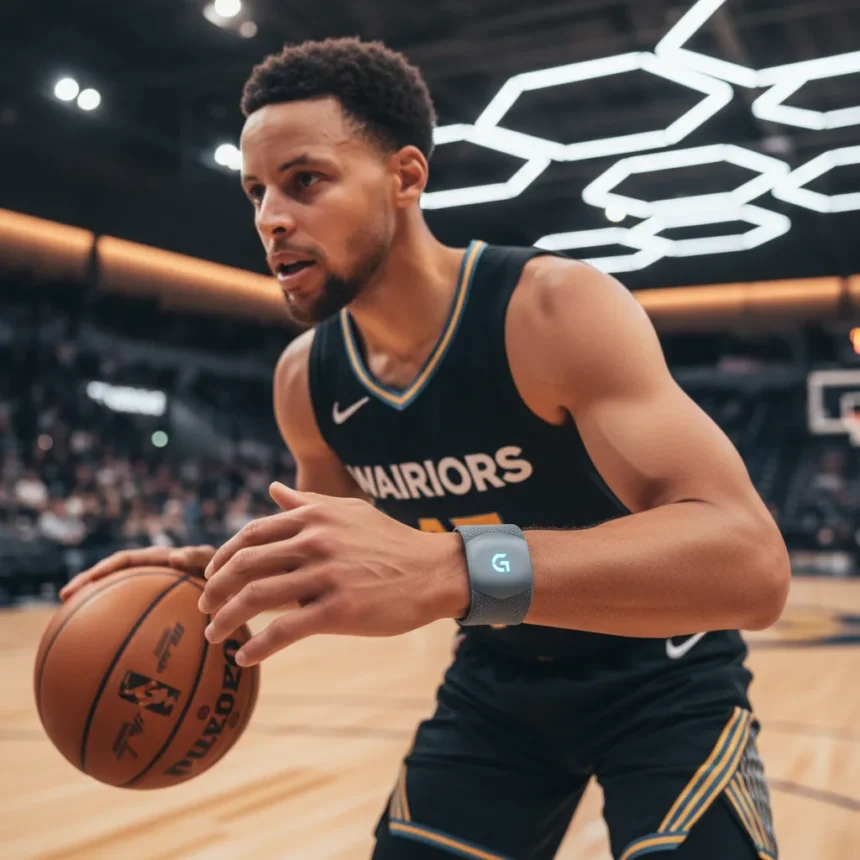
Google is building a screenless fitness band that marks the company’s boldest move yet to compete directly with Whoop, the subscription-first fitness wearable that has dominated the minimalist tracker space. NBA star Steph Curry recently demonstrated the device in public, offering the first tangible glimpse of what Google’s strategy looks like beyond Pixel Watches and traditional Fitbit trackers with screens.
Key Takeaways
- Google confirmed new Fitbit hardware launches in 2026, including a screenless fitness band.
- Steph Curry showed off the device publicly, marking the first official sighting.
- The screenless band competes directly with Whoop’s subscription model and form factor.
- Competitors like Garmin’s rumored Cirqa and Luna Band are also entering the space in 2026.
- No pricing or exact specs have been announced yet.
Why Google Is Betting on Screenless
For years, Fitbit dominated the accessible fitness tracker market with affordable bands and watches featuring small screens. But the category has shifted. Whoop proved that millions of people prefer wearables that get out of the way—no distracting notifications, no battery drain from a display, just pure biometric data fed to your phone. Google’s new screenless fitness band acknowledges this reality and positions Fitbit to reclaim ground it lost to Whoop’s relentless focus on subscription-based coaching and sleep tracking.
The timing matters. Pixel Watches handle Google’s premium wearable ambitions, leaving Fitbit free to pursue a leaner, lighter strategy. By launching a screenless band, Google avoids cannibalizing Pixel Watch sales while directly addressing the Whoop user who wants Google’s ecosystem integration and likely lower subscription costs. This is not a me-too product—it is a deliberate repositioning of Fitbit as the affordable, data-focused alternative to Whoop’s premium positioning.
How It Stacks Up Against Whoop and Rivals
Whoop’s current flagship, the MG model, is a screenless band with a 14-day battery, IP68 water resistance, and sensors for heart rate, ECG, acceleration, and skin temperature. It requires a subscription to unlock coaching insights, which is Whoop’s revenue engine. Google’s screenless Fitbit will almost certainly offer similar sensor arrays, but the company has yet to confirm exact specifications.


Garmin is rumored to launch Cirqa, its own screenless Whoop rival, also in 2026, with a lightweight design and app-fed stats. Meanwhile, Luna Band, revealed at CES 2026, takes a different angle—voice-led guidance instead of data dumps, research-grade sensors, and no subscription requirement. This fragmentation works in Google’s favor. Whoop has owned the screenless space by default. Now it faces competition from three major hardware makers simultaneously, each with different philosophies on how much guidance users want versus raw data.
Google’s Fitbit Charge 6, the current flagship, features a 1.04-inch AMOLED screen, 7-day battery, and comprehensive sensors. The new screenless band will be lighter, thinner, and likely cheaper—positioning it below the Charge 6 for users who find even small screens unnecessary. That is the gap Whoop has filled. Google is finally acknowledging it exists.



What We Don’t Know Yet
Google has not released any official specifications, pricing, or exact launch date beyond the 2026 window. Steph Curry’s public demonstration was a tease, not a product reveal. The company could be months away from formal announcements, or it could launch quietly within weeks. Battery life, water resistance ratings, sensor types, and whether Google will require a subscription remain open questions.
The subscription question is critical. If Google charges for coaching insights like Whoop does, it is matching Whoop’s model. If Fitbit offers basic analytics free and charges only for premium coaching, it undercuts Whoop. If the band ships with no subscription at all, it becomes a different product entirely—a pure data collector for fitness enthusiasts who prefer to interpret their own metrics. Each approach targets a different buyer, and Google has not yet revealed which path it is taking.
Why Steph Curry Matters
Celebrity athlete endorsements in fitness wearables usually feel hollow. But Curry’s involvement signals that Google believes in this product enough to associate it with one of basketball’s most meticulous athletes. Curry is known for obsessive attention to training data, recovery, and performance optimization. Pairing him with a screenless band suggests Google is positioning this device for serious athletes and data-driven fitness enthusiasts, not casual trackers.
This is also a signal to Whoop users. Curry using a Google product instead of Whoop says something about confidence and ecosystem fit. It is marketing disguised as a product demo, and it is effective because Curry’s fitness credibility is genuine.



Is the Screenless Market Big Enough for Everyone?
Whoop has built a cult following, but the screenless fitness band market remains niche compared to traditional smartwatches and fitness trackers with screens. Whoop’s subscription model works because users are willing to pay for coaching and biometric insights. The question for Google, Garmin, and Luna Band is whether they can sustain that willingness without Whoop’s years of brand loyalty.
Google has advantages: Fitbit’s existing user base, Android integration, and the company’s data science resources. Whoop has advantages: a proven subscription model, years of algorithm refinement, and a community. The market is big enough for multiple players, but not for everyone. One or two of these screenless bands will win. The others will become forgotten footnotes in wearable history.
When Will Google Launch the Screenless Fitbit?
Google confirmed new Fitbit hardware in 2026, but the exact month remains unclear. Given that competitors like Luna Band are launching later in 2026 and Garmin’s Cirqa may arrive in spring, Google could launch anytime from Q1 to Q3. The company typically avoids crowded launch windows, so expect either an early-year surprise or a late-summer reveal to sidestep the competition.
Will the Screenless Fitbit Require a Subscription?
Google has not disclosed subscription requirements for the new screenless fitness band. Whoop’s entire business model depends on subscriptions, but Luna Band is launching without one, suggesting the market is moving toward optional or tiered subscriptions rather than mandatory ones. Google could go either direction, but expect the company to undercut Whoop’s pricing if it does charge.
How Much Will the Screenless Fitbit Cost?
No pricing has been announced. Whoop’s subscription costs roughly $30 per month, while the device itself is bundled into that fee. Fitbit’s current Charge 6 retails around the mid-range, and a screenless band would likely cost less. Expect Google to price aggressively to win Whoop converts, but exact figures will not emerge until closer to launch.
Google’s screenless Fitbit is not a revolution—it is a long-overdue acknowledgment that Whoop proved a market exists for minimalist, data-focused wearables. The real battle is not whether Google can build one. It is whether Google can build one compelling enough to convince Whoop users to switch. Steph Curry’s demo suggests the company thinks it can. We will know for certain in 2026.
Where to Buy
Edited by the All Things Geek team.
Source: Android Central