





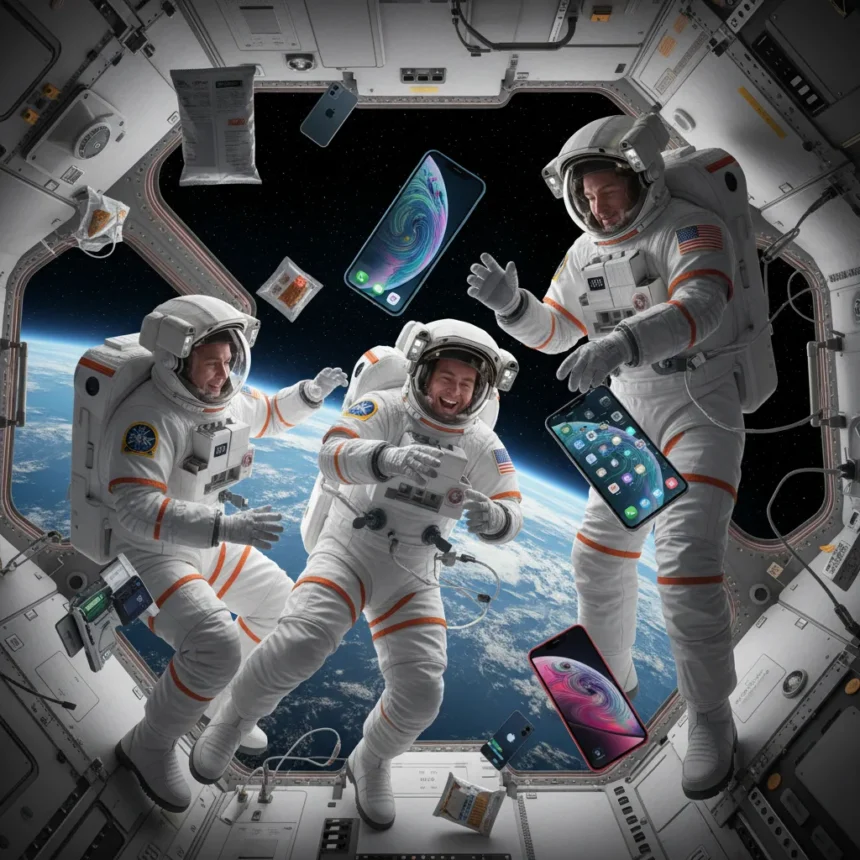
Artemis II smartphones space exploration just entered a new era. NASA’s Artemis II mission represents the first crewed deep space test flight around the Moon and back, and for the first time, astronauts are bringing iPhones and Android phones aboard to operate in zero gravity. The Space Launch System rocket, Orion spacecraft, and the crew of four—NASA astronauts Victor Glover, Christina Koch, Reid Wiseman, and Canadian Space Agency astronaut Jeremy Hansen—arrived at Kennedy Space Center Launch and Landing Facility on March 27, 2026, marking the final countdown to a mission that will fundamentally test deep space exploration capabilities.
Key Takeaways
- Artemis II is NASA’s first crewed deep space test flight, launching the SLS rocket and Orion spacecraft with four astronauts.
- The crew will carry iPhones and Android phones in zero gravity, a first for NASA deep space missions.
- A zero-g indicator mascot called “Rise” floats when engines cut off to signal entry into space.
- NASA received over 2,600 zero-g indicator design submissions from more than 50 countries.
- The mission tests deep space exploration capabilities before future lunar landing missions.
Why Smartphones Matter for Artemis II
Consumer smartphones in space represent a practical shift. Rather than relying solely on specialized aerospace hardware, Artemis II astronauts will use familiar devices that offer flexibility, redundancy, and real-world testing data for future long-duration missions. The decision to permit iPhones and Android phones aboard signals NASA’s confidence in consumer technology durability and also provides valuable insights into how these devices perform in the harsh environment of deep space. This is not a marketing stunt—it is an engineering decision with implications for future missions where astronauts will need reliable, accessible tools.
The zero-g environment itself demands testing. When the Space Launch System’s main engines cut off approximately eight minutes after liftoff, the crew will transition from being pushed into their seats by launch forces to true microgravity. At that moment, any unsecured object—including an iPhone—will float freely. Watching astronauts throw phones around in zero gravity is visually compelling, but the underlying purpose is serious: understanding how consumer electronics behave when gravity no longer constrains them, and whether they remain functional for communication, data capture, and mission support.
The “Rise” Zero-G Indicator and Public Engagement
NASA’s decision to crowdsource the zero-g indicator design was bold and inclusive. The agency opened a design challenge last year and received over 2,600 submissions from more than 50 countries, demonstrating global enthusiasm for space exploration. The winning design, called “Rise,” was created by Lucas Ye, a second-grader from Mountain View, California. The mascot depicts a smiling moon wearing a cap that resembles Earth, complete with a star-covered brim—a visual reference to Apollo 8’s iconic Earthrise moment when astronauts first photographed Earth rising above the lunar horizon.


This choice is more than decorative. By involving a child in the design process and celebrating that contribution on a NASA deep space mission, the agency connected a new generation to space exploration. When Rise floats in the Orion cabin during Artemis II, millions of people worldwide will see a second-grader’s artwork becoming part of human spaceflight history. That emotional resonance matters as NASA builds public support for the Artemis program and the long-term commitment required to return humans to the Moon and eventually explore Mars.
Artemis II Smartphones Space and Deep Space Exploration
Artemis II is not a lunar landing mission—it is a test flight. The crew will orbit the Moon and return to Earth, validating the Space Launch System and Orion spacecraft before NASA commits to landing astronauts on the lunar surface in subsequent Artemis missions. The inclusion of consumer smartphones reflects the program’s maturity and confidence. Earlier space programs operated with rigid, custom-built systems. Artemis II demonstrates that modern space exploration can integrate commercial technology without compromising safety or mission objectives.



The broader context is important: this mission marks a transition point in human spaceflight. As private companies like SpaceX and Blue Origin advance commercial space capabilities, NASA is also evolving its approach to technology integration. Testing iPhones in deep space provides data that benefits not only NASA but the entire spaceflight industry. If consumer smartphones perform reliably in zero gravity and the radiation environment beyond Earth’s magnetosphere, that opens possibilities for future missions where cost, availability, and crew familiarity with the technology become strategic advantages.
What Happens When Engines Cut Off?
The zero-g moment arrives roughly eight minutes after liftoff. For the first eight minutes of flight, the Space Launch System’s main engines accelerate the Orion spacecraft and crew toward escape velocity. During this phase, astronauts experience intense g-forces pushing them into their seats. The moment the SLS core stage engines shut down, those forces cease. Gravity no longer restrains objects. That is when Rise—and the iPhones—float freely in the cabin, visually confirming that the crew has reached space and is on trajectory toward the Moon.
This moment is also when astronauts will conduct informal tests with the smartphones. Throwing an iPhone in zero gravity is not reckless; it is data collection. How does the device respond to tumbling in microgravity? Does the camera stabilization function properly? Can the phone maintain network connectivity through the communication systems aboard Orion? These questions matter for future missions where astronauts will rely on smartphones for photography, data logging, and emergency communication.
How does Artemis II compare to previous crewed missions?
Artemis II differs fundamentally from Apollo and Space Shuttle missions in its use of consumer technology. Apollo astronauts carried specialized equipment designed and tested specifically for spaceflight. The Space Shuttle era introduced more commercial components but still relied primarily on aerospace-grade systems. Artemis II represents a hybrid approach: proven deep space hardware (the SLS and Orion) paired with consumer devices (iPhones and Android phones) that offer flexibility and real-world relevance. This integration reflects decades of advances in commercial electronics reliability and NASA’s confidence in modern manufacturing standards.



When is Artemis II launching?
The Artemis II crew arrived at Kennedy Space Center on March 27, 2026, positioning the mission in its final preparation phase. While the exact launch date was not specified in available mission updates, the crew’s arrival indicates the mission is in active countdown status. NASA typically launches within weeks to months after crew arrival and final vehicle checks.
What will the Artemis II crew do in space?
The four-person crew will orbit the Moon and return to Earth, testing the Space Launch System rocket and Orion spacecraft in deep space for the first time with humans aboard. Beyond the formal mission objectives, astronauts will conduct informal tests with consumer smartphones, observe how the zero-g indicator mascot “Rise” behaves in microgravity, and gather data on how crew perform during a 10-day flight test that will validate systems before future lunar landing missions.
Artemis II represents a inflection point: the moment when consumer technology and deep space exploration converge. Watching astronauts throw iPhones around in zero gravity might seem playful, but it reflects a serious engineering reality. As humanity prepares for sustained lunar exploration and eventual Mars missions, the tools astronauts carry must be reliable, accessible, and proven in the environments where they will operate. Artemis II will provide those answers, and a second-grader’s moon mascot will float silently above Earth, marking the moment when spaceflight entered a new chapter.
Where to Buy
Apple iPhone 17 Pro | Apple iPhone 17 Pro Max | Samsung Galaxy S26 | Samsung Galaxy S26 Plus | Samsung Galaxy S26 Ultra
Edited by the All Things Geek team.
Source: TechRadar




