





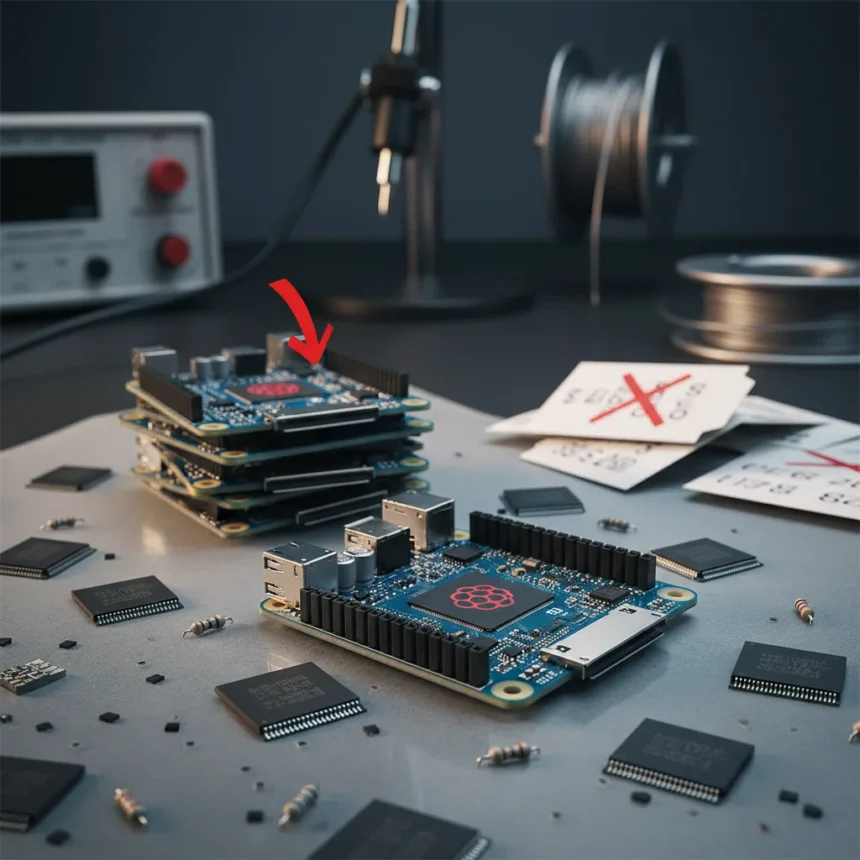
Raspberry Pi price increases are hitting users again in April 2026, marking the third major round of hikes since December 2025, all driven by a global RAM shortage that has doubled memory costs. The Foundation is introducing a new Raspberry Pi 4 3GB variant at $83.75 to help users avoid paying for excess memory they don’t need, but higher-capacity models are seeing sharper price jumps that are making the affordable computing platform significantly less affordable.
Key Takeaways
- Raspberry Pi price increases announced April 2026 affect all 2GB+ RAM models across Pi 4, Pi 5, and Compute Modules
- New Raspberry Pi 4 3GB model ($83.75) designed to balance cost for mid-spec workloads without overpaying for memory
- Higher-capacity models see up to 33% increases; 16GB Pi 5 now £275–£292 in UK (around $365–$389)
- 1GB models remain protected at $35 (Pi 4) and $45 (Pi 5), with Raspberry Pi 400 holding at $60
- DRAM costs doubled due to AI infrastructure competition, with memory shortage expected to persist into 2026
Why Raspberry Pi price increases keep happening
The root cause is straightforward: DRAM prices have doubled as AI companies and data centers compete for memory chips. This is not a temporary blip. Eben Upton, Raspberry Pi’s CEO, acknowledged in April 2026 that memory pricing remains a significant headwind, with the Foundation forced to pass costs to customers across its entire product line. Previous increases in December 2025 and February 2026 failed to stabilize pricing, suggesting the market will remain volatile through 2026.
What makes this latest round particularly painful is the cumulative effect. A Raspberry Pi 4 8GB that cost $75 in 2025 now costs $100 or more, depending on the variant. The 16GB Raspberry Pi 5 has climbed to nearly $365–$389 in the UK market. For hobbyists and small businesses, these are no longer impulse purchases—they are significant capital expenditures that demand justification.
The Foundation has tried to soften the blow by protecting entry-level configurations. The Raspberry Pi 4 1GB remains at $35, and the Raspberry Pi 5 1GB launched in December 2025 at $45. The Raspberry Pi 400, a keyboard-integrated computer, holds at $60 for the 4GB version. But these exceptions highlight the real problem: if you need more than 1GB of RAM for your project, you are now paying a premium that grows exponentially with capacity.



The new Raspberry Pi 4 3GB model and the memory strategy
Recognizing that many users fall between the 2GB and 4GB options, Raspberry Pi introduced a new middle ground: the Raspberry Pi 4 3GB at $83.75. This is engineering work to expand memory-density options, according to the Foundation, aimed at letting users choose exactly what they need without subsidizing excess capacity. On paper, it is a sensible move. In practice, it reflects how constrained the market has become.
The 3GB variant will not solve the underlying cost crisis, but it does signal that Raspberry Pi price increases are now being paired with product strategy changes. Rather than simply raising prices across the board, the Foundation is attempting to offer configurations that match real-world workload requirements more closely. For users running lightweight applications—small web servers, sensor monitoring, media playback—the 3GB model may offer better value than jumping to 4GB or 8GB.


However, this approach also reveals a limitation: the Foundation cannot control DRAM costs, only how it allocates them across its product portfolio. The 3GB model is a band-aid, not a cure. As long as memory costs remain elevated, Raspberry Pi price increases will continue, and users will face difficult choices about whether the platform remains cost-effective for their needs.
Which Raspberry Pi models are most affected by price increases
Not all Raspberry Pi price increases are equal. The Foundation has structured the latest hikes to protect budget options while absorbing more pain at higher capacities. A Raspberry Pi 4 2GB sees a $10 increase, while the 4GB jumps $15–$25 depending on variant. The 8GB rises $30–$50, and the 16GB jumps $60–$100. This tiered approach means users who need serious computing power are bearing the brunt of the DRAM crisis.
The Compute Module 4 and 4S lines also face increases, with 1GB variants up $11.25 and 2GB up $12.50. The Raspberry Pi 500 and 500+ see $50–$150 increases on unit and kit pricing, while the AI HAT+ 2 board jumps $50. The Development Kit for Compute Module 5 rises $25. These are niche products with smaller user bases, but they underscore that no corner of the Raspberry Pi ecosystem has escaped the memory shortage.
Affected products include Raspberry Pi 500/500+ and Pi AI HAT+ 2. The cumulative impact across the entire lineup suggests that Raspberry Pi price increases are now structural, not temporary, and will likely persist as long as AI infrastructure demand keeps DRAM costs elevated.


How Raspberry Pi price increases compare to alternatives
The real question users are asking is whether Raspberry Pi still makes sense at these prices. Mini PCs—small form-factor desktop computers with Intel or AMD processors—are becoming more attractive alternatives as Raspberry Pi price increases compress the value proposition. A mini PC with 8GB of RAM and a faster processor may cost only slightly more than a high-end Raspberry Pi 5, and it offers significantly better performance for general computing tasks.
This is not to say Raspberry Pi is dead for its core use cases. The platform remains unmatched for low-power projects, embedded systems, and applications where GPIO connectivity and community support matter more than raw speed. But for users on the fence—those considering Raspberry Pi for media centers, home automation hubs, or lightweight servers—the cost calculus has shifted. The entry-level 1GB models at $35–$45 remain compelling, but anything above that requires harder justification.
Raspberry Pi’s strength has always been affordability and accessibility. Raspberry Pi price increases undermine both. The Foundation is aware of this tension, which is why it introduced the 3GB model and protected 1GB pricing. But these moves are tactical responses to a strategic problem: the Foundation cannot control DRAM markets, only react to them.
When will Raspberry Pi price increases stop?
The Foundation has signaled that 2026 will remain challenging for memory pricing, with no clear end date for the crisis. DRAM costs are expected to remain elevated as AI infrastructure investment continues to drive competition for chips. This means Raspberry Pi price increases are likely to persist, with potential for additional hikes if memory costs continue their upward trajectory.
The only silver lining is that availability is improving, which may eventually ease cost pressures. As DRAM production ramps up and AI infrastructure buildout moderates, memory prices should eventually stabilize. But that timeline is uncertain, and users should not count on price relief in 2026.
Will the Raspberry Pi 3GB model be worth buying?
The Raspberry Pi 4 3GB at $83.75 makes sense for specific workloads—applications that need more than 2GB but not quite 4GB. For most users, however, the choice will remain between the 2GB at $55 (after the latest increase) or the 4GB at $70–$75. The 3GB sits awkwardly in between, and whether it gains traction will depend on whether real-world projects actually demand exactly 3GB of RAM.
Are 1GB Raspberry Pi models still a good value?
Yes. The Raspberry Pi 4 1GB at $35 and Raspberry Pi 5 1GB at $45 remain genuinely affordable and are protected from price increases. For lightweight projects—GPIO experiments, retro gaming, media playback, simple web services—1GB is sufficient, and these entry-level models represent the best value in the current lineup. The trade-off is performance and multitasking capability, but for focused applications, the 1GB models deliver solid value.
How much have Raspberry Pi prices increased since 2025?
Raspberry Pi price increases have been cumulative across three rounds: December 2025, February 2026, and April 2026. A Raspberry Pi 4 8GB that cost roughly $75 in 2025 now costs $100–$110 or more, depending on retailer and regional pricing. The 16GB Raspberry Pi 5 has jumped from around $140 to $200 or more in some markets, with UK pricing reaching £275–£292 (approximately $365–$389). These are not minor adjustments—they represent significant cumulative increases that have fundamentally altered the platform’s value proposition.
Raspberry Pi price increases are a direct consequence of global DRAM shortages driven by AI infrastructure competition. While the Foundation’s new 3GB model and commitment to protecting 1GB pricing show it is thinking strategically about cost, the underlying problem—doubled memory expenses—remains beyond its control. Users should expect Raspberry Pi price increases to persist through 2026, making entry-level 1GB models the safest bet for affordability and higher-capacity options a harder sell unless your project genuinely requires that much memory.
Edited by the All Things Geek team.
Source: TechRadar