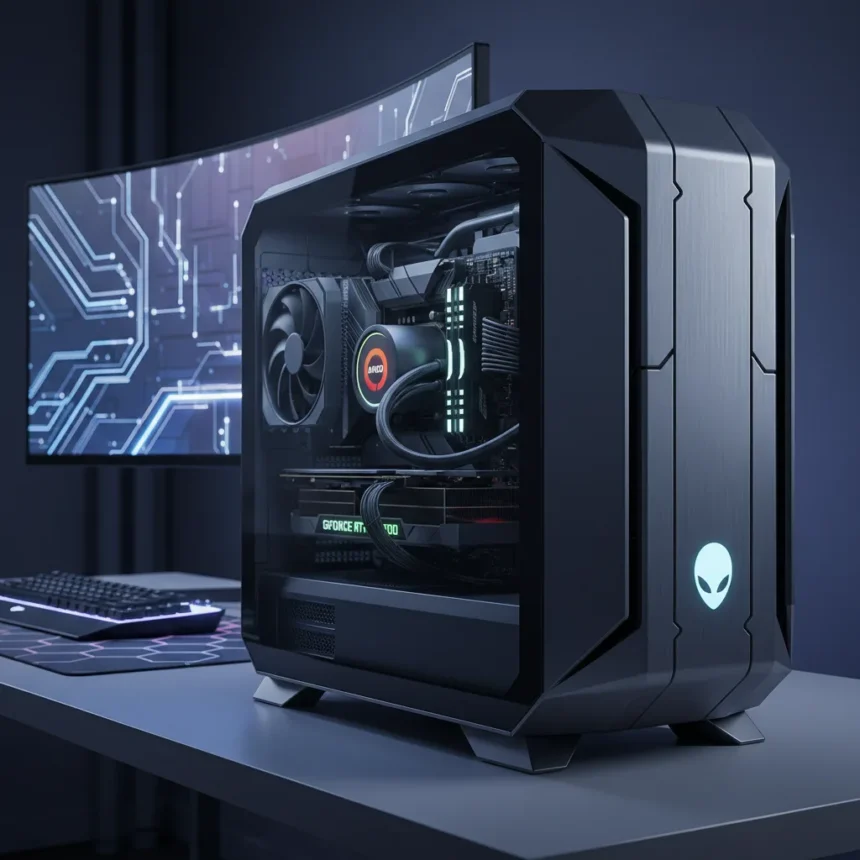
The Alienware Area-51 RTX 5090 gaming PC has become a genuinely compelling alternative to custom-building your own high-end rig. At $4,449.99 after a $1,200 discount, this configuration pairs NVIDIA’s RTX 5090 GPU with AMD’s Ryzen 7 9800X3D processor—a pairing that costs only 17% more than the standalone GPU, making it a rare case where a prebuilt actually saves money.
Key Takeaways
- Alienware Area-51 RTX 5090 configuration now $4,449.99 after $1,200 discount, undercutting custom build costs
- Pairs RTX 5090 (32GB GDDR7) with Ryzen 7 9800X3D, 32GB DDR5 RAM, and 1TB NVMe SSD
- X870E motherboard supports up to 200W CPU and 600W+ GPU power, enabling future upgrades
- 360mm AIO liquid cooler 45% quieter than prior generation with 25% more airflow
- Available now at Dell and Alienware.com with customization options
What Makes This Deal Actually Work
The math here is straightforward but unusual: a standalone RTX 5090 costs roughly $3,800, meaning you’re paying only $650 more for a complete system with a capable processor, 32GB DDR5 RAM, 1TB storage, power supply, cooling, and case. That’s not typical for prebuilts, which usually charge a 30-50% markup over component costs. The Alienware Area-51 RTX 5090 breaks that pattern, likely because Dell is clearing inventory ahead of next-generation architectures or leveraging manufacturing scale to undercut custom builders.
The Ryzen 7 9800X3D is the X3D CPU that actually matters for gaming right now. Its 3D V-Cache architecture reduces CPU-bound performance bottlenecks, meaning you’ll hit GPU limits at higher resolutions instead of waiting on the processor. In 4K gaming scenarios without frame generation, the 9800X3D keeps you in the 70-80 FPS range on demanding titles—a sweet spot where the RTX 5090’s full power comes into play.
Alienware Area-51 RTX 5090 Specs That Justify the Price
This isn’t a barebones system with compromises. The Alienware Area-51 RTX 5090 ships with a 360mm all-in-one liquid cooler, an X870E motherboard that supports up to 200W of CPU power (future-proofing for the Ryzen 9 9950X3D if you upgrade), and an 850W Gold or higher PSU depending on configuration. The case features a positive-pressure cooling system that’s 45% quieter than the previous generation while delivering 25% more airflow—a rare combination of silence and thermal performance.


Connectivity includes dual USB4 Type-C ports with 40Gbps bandwidth and DisplayPort Alt Mode, 2.5G Ethernet, Wi-Fi 7, and 7-zone AlienFX RGB lighting. The tempered glass door and removable dust filters make maintenance straightforward, addressing a real pain point in gaming PCs where dust accumulation tanks thermals over time. At 22.4 x 24.0 x 9.09 inches and 76.1 lbs, it’s large but not absurdly so for an enthusiast system.
How It Compares to Custom Builds and Alternatives
If you were to assemble this yourself—Ryzen 7 9800X3D, RTX 5090, X870E board, 32GB DDR5, 1TB NVMe, 360mm AIO, case, and PSU—you’d spend roughly $4,600-$4,900 before accounting for your own labor and the risk of component incompatibility or dead-on-arrival parts. The Alienware Area-51 RTX 5090 undercuts that with warranty coverage and pre-configured thermal optimization.



Intel’s Core Ultra 9 285K offers a quieter alternative in some configurations and performs better in multimedia tasks, but in pure gaming at 4K, the performance difference is marginal since the GPU becomes the limiting factor. The 9800X3D’s advantage lies in CPU-bound scenarios—lower resolutions, high refresh rate gaming, and frame-rate-dependent titles where the X3D cache matters. For someone committed to 4K gaming, either CPU works, but the 9800X3D is the more specialized choice.
Is This Deal Actually Limited-Time?
The $1,200 discount is live now at Dell and Alienware.com, but there’s no published expiration date in the available information. Promotional pricing on high-end systems can shift weekly, so if you’re considering this configuration, checking stock and confirming the current price directly with Dell is essential. The base RTX 5080 variant starts at $3,849, and fully maxed configurations with the Ryzen 9 9950X3D, RTX 5090, 64GB RAM, and 8TB SSD reach $7,599, so there’s room to customize based on budget.
Should You Buy the Alienware Area-51 RTX 5090?
If you’re building a 4K gaming PC and value your time over saving a few hundred dollars, yes. The Alienware Area-51 RTX 5090 eliminates the risk of incompatible components, provides professional thermal tuning, and includes warranty support. If you’re comfortable with custom builds and want maximum flexibility or a slightly lower price, a self-assembled system is still viable—but the gap has narrowed significantly.
Can you upgrade components in the Alienware Area-51 RTX 5090?
Yes. The X870E motherboard and ATX form factor mean you can swap the CPU, GPU, RAM, and storage after purchase. The PSU is modular, and the case layout supports larger coolers (up to 420mm AIOs). Just verify compatibility before upgrading, as some enthusiast components may require BIOS updates or additional power delivery tweaks.



How does the RTX 5090 compare to the RTX 5080 in this system?
The RTX 5090 delivers substantially more VRAM (32GB vs. 16GB on the 5080) and higher memory bandwidth, which matters for future-proofing and AI workloads. In gaming, the difference depends on resolution and frame-generation settings, but the 5090 is the clear choice if you want maximum headroom at 4K without frame generation.
Does this PC come with Windows 11?
Yes, it ships with Windows 11 Home. If you need Pro or a different OS, you can customize the order before purchase through Dell’s configurator.
The Alienware Area-51 RTX 5090 at $4,449.99 represents a rare window where buying a high-end prebuilt makes financial sense. The combination of the 9800X3D, RTX 5090, and professional cooling in a price that undercuts custom building is not something you see often in the gaming PC market. If you’ve been waiting for a reason to go prebuilt instead of DIY, this is it.
Edited by the All Things Geek team.
Source: Tom's Hardware