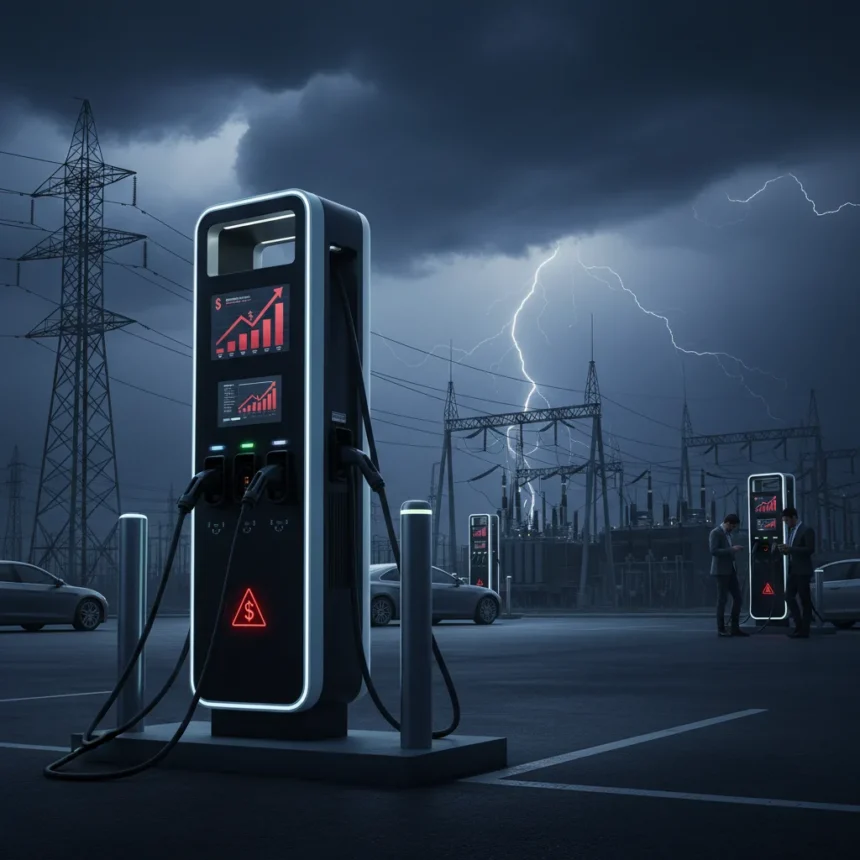
EV charging price increases are becoming inevitable as public charging networks grapple with a hidden cost most drivers don’t understand: paying for grid access capacity they aren’t fully utilizing. As energy costs soar and infrastructure expands faster than demand, charging operators are signaling that price hikes are coming soon, potentially reshaping the economics of EV ownership in 2026 and beyond.
Key Takeaways
- US fast-charging prices hit $0.49 per kWh in Q3 2025, up 1 cent from the prior quarter
- Hawaii has the highest rates at $0.85 per kWh; only 7 states saw price decreases
- Public charging networks pay demand charges that can exceed 90% of monthly operating costs at low-utilization sites
- AC Level 2 charging ports grew 11.5% year-over-year to 172,911 ports as of January 2026
- The US EV charging market was valued at $5.09 billion in 2024, projected to grow over 30% annually through 2030
Why EV Charging Price Increases Are Accelerating Now
Public charging networks face a structural problem that most EV owners never see. They must pay utility companies for grid access capacity whether they use it or not. When utilization is low—which is common at newer stations in less-trafficked areas—demand charges can represent over 90% of a charging site’s monthly operating costs. As energy prices climb and networks expand infrastructure ahead of demand, operators have no choice but to pass these costs to drivers.
The numbers tell the story. US fast-charging prices averaged $0.49 per kWh in Q3 2025, up just a penny from the prior quarter. That modest increase masks a troubling trend: most states are not seeing relief. Only 7 US states experienced price decreases in Q3 2025, while 11 maintained flat rates and the remainder climbed higher. Hawaii, the most expensive market, charges $0.85 per kWh despite a 7-cent drop from the previous quarter—still double the national average. Washington DC and New Jersey follow at $0.63 and $0.62 per kWh respectively.
This is not a temporary squeeze. The US EV charging infrastructure market was valued at $5.09 billion in 2024 and is projected to grow more than 30% annually through 2030. Thousands of additional fast-charging ports are being added in 2026 via both private and public funding. More infrastructure sounds good for drivers, but it also means more idle capacity during off-peak hours and more demand charges for operators to absorb.

The Grid Access Fee Trap for Charging Networks
Unlike retail electricity pricing, which rewards high consumption, grid access works on capacity. A charging network that installs 10 fast-chargers at a highway rest stop must pay the utility for the ability to draw power for all 10 simultaneously, even if only 2 are in use on average. During slow periods—overnight, weekday mornings, winter months—those 8 unused chargers still cost money in demand charges. This is the core complaint from public charging providers: they are being forced to pay for grid access that they simply aren’t using.
The Federal Highway Administration’s NEVI Formula Program, which provides up to $5 billion in funding to build EV charging infrastructure across the US from 2022 to 2026, mandates 97% uptime for funded stations. That reliability requirement drives up costs further, as networks must maintain capacity to meet peak demand even when average utilization remains low. The result: operators shoulder massive fixed costs that scale with the number of chargers, not with actual electricity sold.



AC Level 2 Charging Growing, but at a Slower Pace
While DC fast-charging commands headlines and higher prices, AC Level 2 charging networks are expanding more gradually. Public AC Level 2 ports reached 172,911 as of January 1, 2026, representing an 11.5% increase of 17,791 ports compared to the same date in 2025. AC ports typically output several kilowatts, with a maximum of 19.2 kW at 80 amps on 240V service. They grow slower than DC fast-charging networks because the lower power output and longer charge times yield lower per-session revenue, making the business model less profitable even with lower infrastructure costs.
This disparity matters for EV owners. Fast-charging networks, which are more expensive to build and operate, face steeper demand charge pressures and thus are raising prices faster. Slower, cheaper AC charging remains more affordable but is less convenient for road trips and time-sensitive charging. The gap between the two is widening as operators optimize for profitability.
What This Means for EV Adoption in 2026
EV charging price increases directly threaten adoption momentum. Drivers already skeptical about public charging networks cite cost and reliability as top concerns. When prices climb—especially in already-expensive markets like Hawaii—the cost-benefit calculation for EV ownership shifts. A driver in Hawaii paying $0.85 per kWh for fast-charging faces a fundamentally different economics equation than a driver in a state with lower rates.
The irony is that this cost structure penalizes early adopters in emerging EV markets. A new charging network in a rural area or secondary market must pay full demand charges while utilization ramps slowly. Those costs get passed to early drivers, which slows adoption, which keeps utilization low, which keeps costs high. It’s a vicious cycle that subsidized charging models—where governments, retailers, or automakers absorb costs—can temporarily break, but those subsidies are not sustainable at scale.



Is free EV charging really disappearing?
Free charging subsidized by retailers, automakers, or municipalities does exist, but operators of those networks face the same demand charge burden as paid networks. In fact, free charging models can be more expensive to operate because operators absorb 100% of grid access costs with no revenue offset. This is unsustainable long-term, which is why many retailers and automakers have already scaled back free charging programs or shifted to paid models.
Why are DC fast-charging prices higher than AC Level 2?
DC fast-chargers require significantly more powerful electrical infrastructure, land, and cooling systems than AC Level 2 chargers. They also generate higher per-session revenue because they deliver a full charge in 20-30 minutes versus several hours for AC charging. However, DC networks still face the same demand charge problem as AC networks—they must pay for grid capacity whether it’s in use or not, and that cost is reflected in the higher per-kWh pricing.
Will EV charging prices keep rising in 2026?
Yes. The structural cost drivers—soaring energy prices, demand charges on underutilized networks, and rapid infrastructure expansion—show no signs of reversing. As thousands of new charging ports come online in 2026, utilization will initially remain low at many locations, pushing demand charges higher. Operators will continue raising prices to offset these costs unless policy changes the way utilities charge for grid access or governments increase subsidies. Neither is likely in the near term.
The EV charging market is at an inflection point. Rapid growth in infrastructure is necessary for EV adoption to scale, but that growth is creating a cost structure that makes public charging increasingly expensive for drivers. Unless charging networks find ways to improve utilization or policymakers reform demand charge structures, EV owners should expect to pay more to charge in 2026 and beyond. The question is whether rising prices will slow EV adoption just as the market needs it most.
Edited by the All Things Geek team.
Source: TechRadar