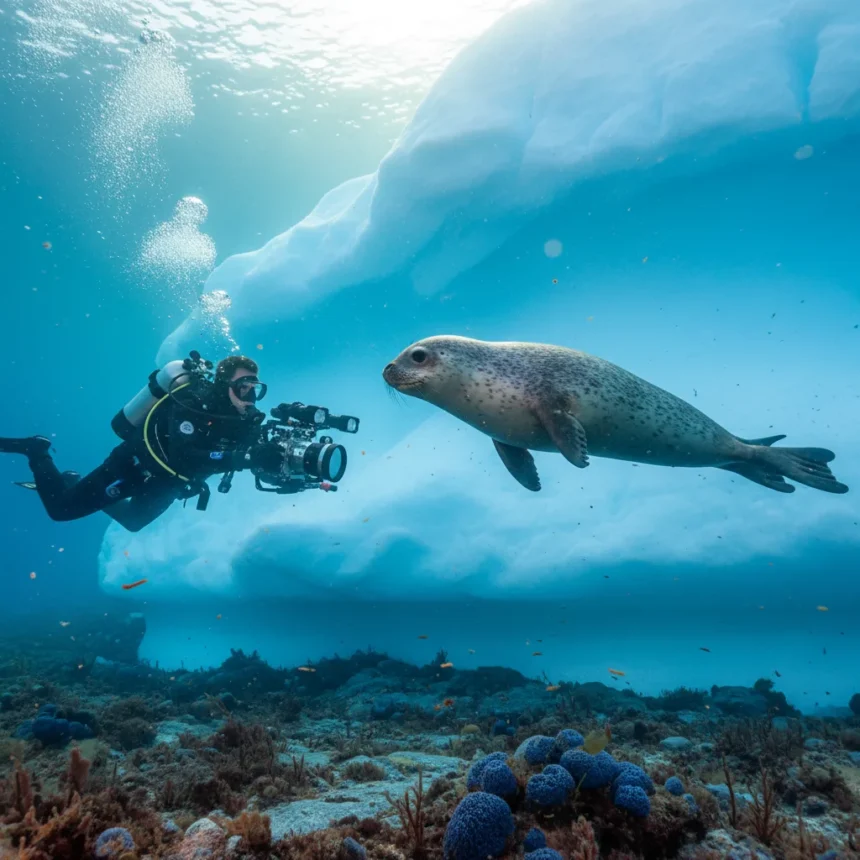
Justin Hofman, a US underwater photographer and marine biologist working as an undersea specialist with Lindblad Expeditions, has captured the first-known Ross seal underwater photos during a National Geographic Resolution expedition to Antarctica. After 15 seasons working in Antarctic waters, Hofman encountered the elusive animal in pack-ice so remote that its life history remains poorly understood.
Key Takeaways
- Justin Hofman captured the first-known underwater images of a Ross seal in Antarctica while aboard the National Geographic Resolution.
- Record-low Antarctic ice levels enabled the ship to penetrate further south than ever before, creating the rare opportunity.
- The Ross seal is the smallest Antarctic true seal, weighing only 2.3 meters long and accounting for roughly 1% of the region’s seal populations.
- In 15 seasons of Antarctic work, Hofman has seen only two Ross seals total, making this encounter extraordinarily rare.
- Fellow diver Ayla Townsend captured complementary video footage of the same seal during the voyage.
How Record Ice Loss Enabled This Historic Encounter
The National Geographic Resolution set a record by penetrating further south into Antarctic waters than any previous expedition, a milestone made possible by all-time low ice levels that opened access earlier than ever before. Climate-driven ice retreat, while devastating for polar ecosystems, created a narrow window for Hofman’s breakthrough documentation. The ship’s southern penetration allowed the team to reach pack-ice habitat that typically remains inaccessible to expedition vessels, bringing researchers into the domain of one of Earth’s most elusive marine mammals.
Hofman’s reaction captures the improbability of the moment. “Never in my wildest dreams did I expect this to happen,” he said. “This animal lives so deep within the Antarctic pack-ice that its life history is not very well understood, and it is not seen very often. In 15 seasons of working in Antarctica, I have seen only two Ross seals, and this is the second one. I didn’t think about it in the way that someone thinks about a goal or a target subject – I never thought that it was an actual possibility”. For a professional who has spent decades in Antarctic waters, encountering a second Ross seal in his career underscores how rarely these animals surface in human observation.
The Ross Seal: Science’s Most Mysterious Antarctic Pinniped
The Ross seal is the smallest Antarctic true seal and the sole member of its genus, Ommatophoca rossii, found only in remote pack-ice regions where it accounts for approximately 1% of Antarctic seal populations. Physically, the animal grows to around 2.3 meters (7.5 feet) long and can live up to 20 years, characterized by distinctively large eyes adapted to its deep-diving lifestyle. Despite its presence in Antarctic waters, the species remains scientifically enigmatic due to its inaccessible habitat and solitary behavior.

The Ross seal’s biology reflects extreme specialization for life in the harshest ocean environment on Earth. Born and bred on dense, hard-to-reach pack-ice, the animal forages in open ocean, diving more than 100 times daily to depths exceeding 300 meters (1,000 feet) in pursuit of squid and fish. This depth-diving capability and remote habitat mean that most of what science knows about the species comes from stranded animals or brief surface observations rather than direct study. Hofman’s underwater images represent a rare window into the animal’s natural behavior, offering researchers visual documentation of a creature that has largely evaded human documentation.
Conservation status presents an interesting paradox: the Ross seal is currently assessed as “Least Concern” on the IUCN Red List, suggesting stable populations despite our limited understanding of the species. This classification, however, reflects the difficulty in monitoring remote Antarctic wildlife rather than certainty about population trends. Climate change and shifting ice dynamics pose unknown threats to a species whose survival depends on pack-ice habitat that is disappearing faster than scientists can study it.



Why These Photos Matter Beyond the Spectacle
First-ever underwater images of any wild species carry scientific weight beyond their visual impact. Hofman’s documentation provides researchers with direct behavioral observations that cannot be obtained through stranding records or satellite tracking alone. The photos reveal how the Ross seal moves, hunts, and interacts with its environment—details essential for understanding its ecological role and vulnerability to environmental change.
The broader context matters as well. Record-low Antarctic ice levels that enabled this expedition are themselves a consequence of climate warming, creating a bittersweet irony: the same forces threatening the Ross seal’s habitat have paradoxically allowed humans to finally observe it in its natural state. As ice continues to decline, future expeditions may find access easier but the seal’s survival harder. Hofman’s images may represent a fleeting opportunity to document a species before its world changes irreversibly.
What Sets This Encounter Apart From Other Antarctic Wildlife Documentation
Antarctic expedition photography typically focuses on more accessible species: penguins, larger seals, and whales that congregate in areas ships can reliably reach. The Ross seal, by contrast, demands extreme remoteness and luck. Townsend’s complementary video footage provides additional documentation, yet even with two photographers capturing the same animal, the rarity of the moment cannot be overstated. Most Antarctic wildlife photographers work entire careers without witnessing what Hofman captured in a single dive.
The encounter also highlights the role of expedition specialists in modern wildlife science. Hofman’s dual expertise—as both a skilled underwater photographer and a trained marine biologist—allowed him not only to capture the images but to contextualize their significance immediately. His 15 seasons of Antarctic experience meant he recognized the animal’s rarity in real time, lending credibility and urgency to the documentation.



Does the Ross seal face extinction threats?
The Ross seal is currently classified as “Least Concern” by conservation authorities, but this status reflects limited data rather than confirmed stability. Its dependence on pack-ice habitat makes it vulnerable to climate-driven ice loss, yet the remote nature of its environment makes population monitoring extremely difficult. Future climate scenarios that continue to reduce Antarctic sea ice could pose serious risks to a species we barely understand.
How often do researchers encounter Ross seals in Antarctica?
Encounters are extraordinarily rare. Hofman, who has worked 15 seasons in Antarctic waters as an undersea specialist, has seen only two Ross seals in his entire career. The species’ solitary nature and preference for dense pack-ice make it one of the least-observed large marine mammals on Earth, despite living in a region frequented by research expeditions.
Why are Ross seals so difficult to photograph underwater?
Ross seals inhabit the most remote, ice-choked regions of Antarctica, far from the open water where most expedition vessels operate. Their small population size, solitary behavior, and preference for deep pack-ice mean that encountering one requires both luck and access to areas that are typically unreachable. Hofman’s photos exist because record-low ice levels opened a window that normally remains closed.
Hofman’s achievement underscores a paradox of modern wildlife science: our most powerful tools for understanding nature often arrive too late, enabled by the very environmental crises that threaten the species we seek to study. These first-ever underwater images of a Ross seal are a triumph of skill and timing, but they also serve as a reminder that some of Earth’s most remarkable animals remain strangers to us, living in places we can barely reach and changing faster than we can document them.
Where to Buy
Edited by the All Things Geek team.
Source: TechRadar