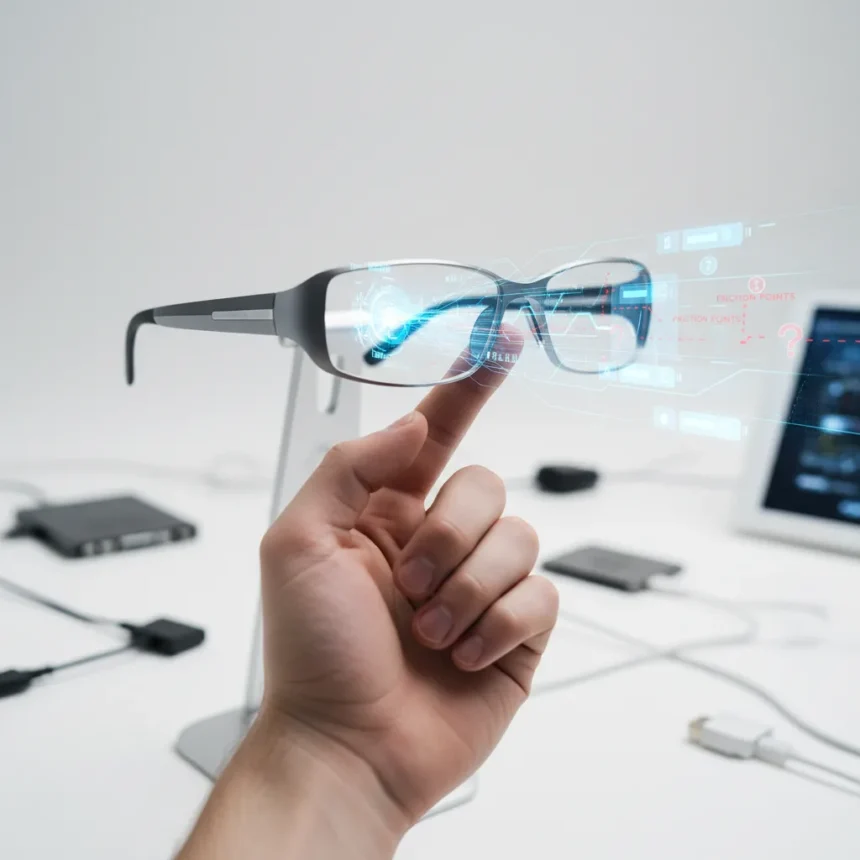
Apple smart glasses gesture controls remain unconfirmed, but the broader smart glasses industry is already wrestling with the fundamental challenge: hand gestures are less reliable than voice or eye tracking in real-world conditions. Apple’s Vision Pro currently relies on eye tracking, voice commands, and hand gestures for control, while Meta’s Ray-Ban Display uses a Meta Neural Band wristband for hand gesture detection. These competing approaches hint at why pure hand gesture control—swiping, pinching, and pointing in mid-air—may not be Apple’s primary input method, even if gesture support becomes part of the package.
Key Takeaways
- Apple’s Vision Pro uses eye tracking and voice alongside hand gestures, not gesture control alone
- Meta’s Ray-Ban Display relies on a wristband for gesture detection rather than hand-based recognition
- Gesture control in smart glasses faces real-world reliability challenges in lighting, occlusion, and precision
- No confirmed specifications exist yet for Apple’s rumored first-generation smart glasses
- Competing devices show the industry is still solving fundamental gesture recognition problems
Why Gesture Control Alone Won’t Work for Apple Smart Glasses
Hand gesture recognition in smart glasses faces a problem that voice and eye tracking avoid: your hands are often occupied or out of frame. When you’re holding a coffee cup, typing, or your hands are in your pockets, gesture-based input becomes useless. Vision Pro’s multi-modal approach—combining eye tracking, voice, and hand gestures—exists precisely because no single input method works in every scenario. Apple smart glasses gesture controls would need to solve this same problem: when should the device listen to your hands versus your voice or gaze?
The Meta Neural Band approach sidesteps some of these issues by detecting muscle signals in your wrist rather than relying on cameras to see your hands. This is more reliable in low light and when hands are occluded, but it introduces a new friction point—you need to wear an additional device. For Apple to compete in the smart glasses market, the company would likely avoid requiring a wristband accessory, which means Apple smart glasses gesture controls would need to match Vision Pro’s multi-input design rather than relying on gesture alone.
What Apple Smart Glasses Gesture Controls Would Actually Need to Do
If Apple introduces smart glasses with gesture controls as a primary input method, the device would need to recognize hand positions and movements in real time while the user is wearing glasses. This requires processing-intensive computer vision running on-device, since cloud processing introduces latency that makes gesture interaction feel sluggish. Apple’s neural engines in recent chips are powerful enough to handle this, but the real challenge is accuracy in variable lighting and with hands at different distances from the face.


The gesture vocabulary matters enormously. Swiping left and right works on a phone screen because the screen is flat and in front of you. In three-dimensional space around smart glasses, swiping becomes ambiguous—are you swiping in front of your face, to the side, or at an angle? This is why Vision Pro relies heavily on eye tracking (precise and fast) and voice (unambiguous) alongside gestures. Any Apple smart glasses gesture controls would likely follow a similar hybrid model, using gestures for specific, high-confidence actions like pinching to select or pointing to navigate, while reserving complex tasks for voice or eye input.
When Will Apple Actually Release Smart Glasses?
Apple has not announced a smart glasses product, let alone confirmed specifications for Apple smart glasses gesture controls. The company has Vision Pro, its premium spatial computing headset launched in 2023, which serves a different market segment than lightweight smart glasses. Industry speculation about Apple entering the smart glasses market is widespread, but without an official announcement, any details about input methods remain unconfirmed. Apple typically waits until a technology is mature enough to deliver a polished user experience before releasing it, which suggests that if Apple smart glasses gesture controls do arrive, the company will have solved—or worked around—the reliability problems that plague competing devices today.



How do Apple smart glasses gesture controls compare to Vision Pro input?
Vision Pro uses eye tracking as its primary input method, supplemented by hand gestures and voice commands. A dedicated smart glasses product would likely follow a similar multi-modal approach rather than relying on gesture control alone. Gesture recognition is useful for specific interactions but becomes unreliable when hands are occupied or out of frame, which is why Apple’s existing spatial computing device combines multiple input methods.
Will Apple smart glasses gesture controls require a wristband accessory?
No confirmed specifications exist for Apple’s rumored smart glasses. Meta’s approach with the Ray-Band Display uses a wristband for gesture detection, but Apple has not announced whether a similar accessory would be required. Apple typically designs products to minimize external accessories, so any Apple smart glasses gesture controls would likely use on-device cameras rather than a separate wristband, though this remains speculation without an official announcement.
What’s the actual difference between hand gesture control and eye tracking?
Hand gesture recognition requires the device to see your hands and interpret their position and movement, which fails when hands are occupied or out of frame. Eye tracking detects where you are looking, which works whether your hands are busy or resting. Vision Pro combines both because they solve different problems—eye tracking for fast, intuitive selection, and hand gestures for confirmation or specific commands. Apple smart glasses gesture controls would likely follow this hybrid model if they arrive.
The smart glasses market is still in its infancy, and competing devices show that no single input method has emerged as the clear winner. If Apple does release smart glasses, the company will likely learn from Vision Pro’s multi-modal approach and avoid betting the user experience on gesture control alone. Until Apple makes an official announcement, all details about Apple smart glasses gesture controls remain speculation—but the industry’s current trajectory suggests that when Apple does enter the smart glasses market, it will combine gestures with other input methods to create a more reliable, intuitive interface than any single technology can provide.



Where to Buy
Apple AirPods 4 | Apple AirPods Pro 3 | Samsung Galaxy Buds 3 Pro | Nothing Ear (a)
Edited by the All Things Geek team.
Source: T3