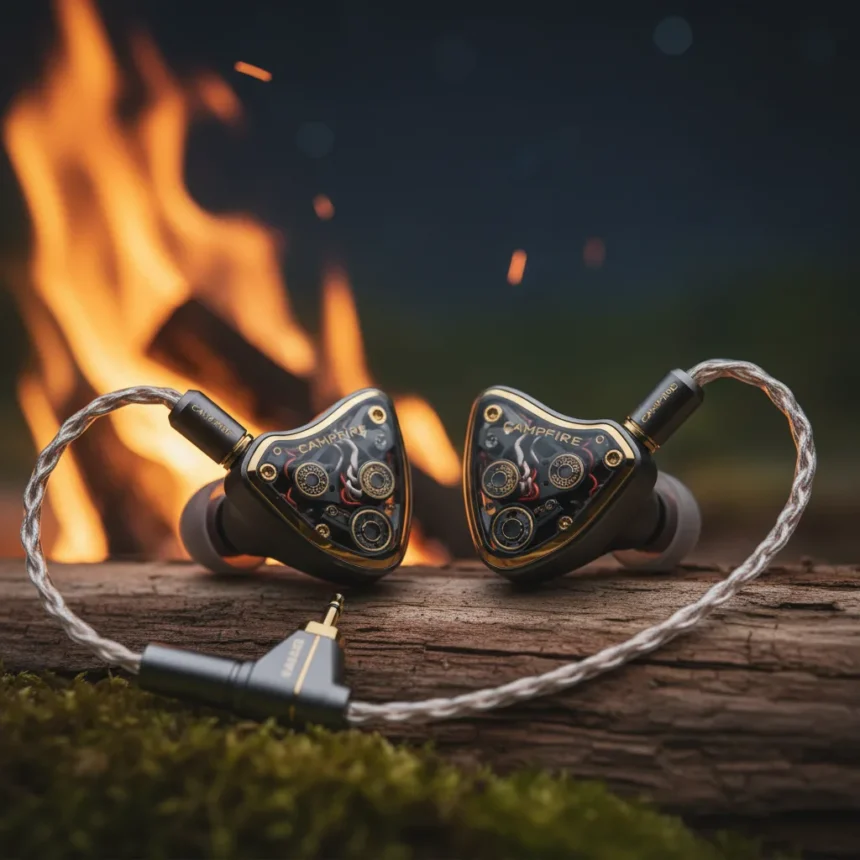
Campfire Audio Chimera represents the company’s most ambitious earphones yet, packing a nine-driver hybrid architecture into a single earpiece that promises vividly detailed sound for serious listeners. The design splits duties across five balanced armature drivers handling mids and highs, paired with four dynamic drivers delivering bass response. This hybrid approach aims to solve a problem that plagues many premium in-ears: achieving both crystalline clarity and genuine low-frequency authority without compromise.
Key Takeaways
- Campfire Audio Chimera features nine drivers per earpiece: five balanced armature plus four dynamic drivers.
- Dual-bore design isolates noise and clarifies bass frequencies for detailed listening.
- Available in standard and custom universal IEM variants with balanced cable options.
- Handcrafted in Portland, Oregon by Campfire Audio.
- Comparable to Empire Ears Odin, which uses eleven drivers in a similar dual-bore configuration.
Campfire Audio Chimera Architecture Explained
The Campfire Audio Chimera’s nine-driver setup uses a hybrid topology that separates frequency responsibilities by driver type. Five balanced armature drivers handle the midrange and treble, where their speed and precision excel at reproducing vocals and instruments with clarity. Four dynamic drivers take over the bass frequencies, where their larger diaphragms can move more air and generate the kind of low-frequency impact that balanced armatures struggle to deliver. This division of labor is not new in premium audio—it is the standard approach in high-end in-ear monitors—but executing it with nine total drivers in a single earpiece requires careful tuning and physical engineering.
The dual-bore design adds another layer of sophistication. By splitting the acoustic pathway into two channels within the earpiece, Campfire Audio achieves noise isolation without passive isolation tips alone, while also clarifying how low frequencies reach the ear. This design choice directly influences how bass notes separate from midrange instruments, a critical factor in whether a complex recording sounds coherent or muddy. The result, according to the company’s positioning, is bass that is described as incredibly deep and powerful alongside highs with sparkle and a dynamic soundscape that preserves instrument separation even in dense arrangements.
How Does Campfire Audio Chimera Compare to Competitors?
The closest competitor in terms of ambition is the Empire Ears Odin, another dual-bore universal IEM that pushes driver count even further with eleven drivers total. The Odin shares the dual-bore philosophy and promises similar goals: unmatched clarity and power in a custom-fit format. Both earphones target the same audience—listeners willing to spend serious money for sound quality and are comfortable with the universal IEM format. The key difference lies in execution: Campfire Audio chose nine drivers, while Empire Ears committed to eleven. Whether more drivers automatically means better sound remains debatable among audiophiles, but the Odin’s extra drivers suggest a different tuning philosophy, possibly prioritizing even more granular frequency separation.


Most mainstream earphones, like the Sony WF-1000XM4 with their 6mm dynamic drivers, operate with far fewer drivers and prioritize features like active noise cancellation and wireless convenience over raw acoustic complexity. The Campfire Audio Chimera abandons that trade-off entirely. It is a wired earphone for listeners who view wireless convenience as a compromise on sound quality, not a feature worth having.
Design and Build: Handcrafted in Portland
Campfire Audio manufactures the Chimera in Portland, Oregon, a choice that signals commitment to quality control and domestic production. Each earpiece is handcrafted, meaning human ears and hands verify assembly at stages where machines alone cannot guarantee consistency. This approach is common among ultra-premium in-ear monitor makers, where driver matching and acoustic tuning require subjective judgment alongside objective measurement.



The Chimera comes in two formats: standard universal in-ear monitors and custom variants. The universal version ships with interchangeable ear tips in multiple sizes, allowing listeners to dial in fit and isolation. Custom versions require an ear impression sent to Campfire Audio, resulting in earpieces molded to each listener’s ear canal. Both formats arrive with balanced cables—2.5mm and 4.4mm options—acknowledging that serious listeners often own multiple digital audio players or amplifiers with different connector types. This cable flexibility is a practical touch that avoids the frustration of owning earphones that only work with one specific connection standard.
Who Should Buy Campfire Audio Chimera?
The Campfire Audio Chimera is built for listeners who already own or plan to invest in a quality source device—a digital audio player, a desktop amplifier, or a smartphone with a high-quality DAC. It is not a casual purchase. The wired format, lack of active noise cancellation, and premium positioning all signal that this is a reference monitor for critical listening at home or in quiet environments. Reviewers noted that the Chimera lives up to its ambitious positioning, delivering on the promise of detailed, dynamic sound that rewards careful listening to well-recorded music.
If you stream exclusively on your phone using wireless earbuds and rarely sit down to listen to full albums, the Campfire Audio Chimera is overkill and will frustrate you with its wired tether. If you own a dedicated music library, use lossless audio formats, and spend time analyzing how instruments are mixed and recorded, the Chimera’s complexity becomes an asset rather than a burden.
Is the Campfire Audio Chimera worth the investment?
The Campfire Audio Chimera justifies its premium positioning through engineering ambition and execution. Nine drivers per earpiece is not a marketing gimmick—it is a genuine attempt to solve the fundamental problem of combining bass power with midrange clarity and treble sparkle in one earpiece. Whether this specific nine-driver configuration outperforms the Empire Ears Odin’s eleven-driver approach depends on personal preference and source quality, but both represent the ceiling of what is currently possible in universal in-ear monitor design. For listeners committed to wired audio and willing to invest in quality, the Chimera delivers on its promise of vividly detailed sound.



What is the difference between balanced armature and dynamic drivers?
Balanced armature drivers are small, fast, and excel at reproducing midrange and treble frequencies with clarity and precision. Dynamic drivers use larger diaphragms and are better suited to bass, where they can generate deeper, more powerful low frequencies. The Campfire Audio Chimera combines both by assigning five balanced armatures to mids and highs, while four dynamic drivers handle bass.
Can I use Campfire Audio Chimera with my smartphone?
Yes, the Chimera works with any device that has a 3.5mm headphone jack or a compatible adapter. However, serious listening with the Chimera typically benefits from a dedicated audio player or amplifier, as the earphones are sensitive enough to reveal the quality—or lack thereof—of your source device.
Do I need a custom fit or universal fit Campfire Audio Chimera?
Universal fits are more flexible and work immediately out of the box with multiple ear tip sizes. Custom fits require an ear impression but offer superior isolation and comfort during long listening sessions. Choose universal if you value convenience and flexibility; choose custom if you listen for extended periods and want maximum isolation and seal.
The Campfire Audio Chimera succeeds because it refuses to compromise. Nine drivers, dual-bore design, balanced cables, and handcrafted assembly all serve a single goal: delivering sound that rewards the listener’s attention. In a market obsessed with features and convenience, the Chimera is a reminder that some listeners still value pure acoustic performance above all else.
Edited by the All Things Geek team.
Source: What Hi-Fi?