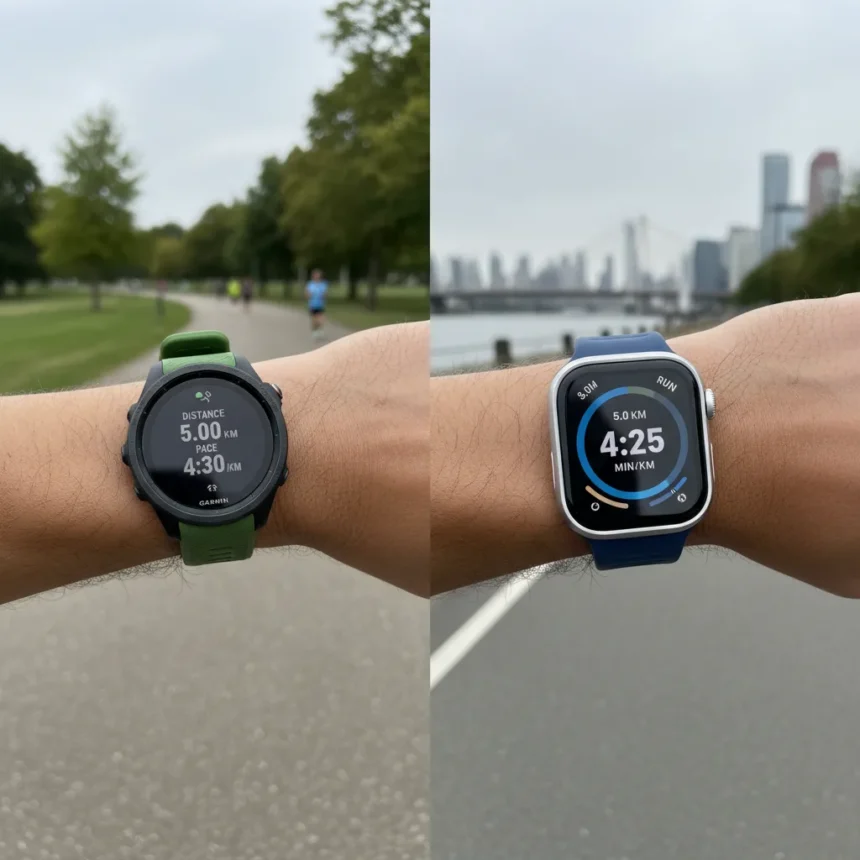
The Garmin Forerunner 570 is a dedicated running smartwatch made by Garmin, designed for serious runners who want deep training analytics without the lifestyle features of a general-purpose smartwatch. The Apple Watch Ultra 3, meanwhile, is Apple’s premium outdoor smartwatch that tries to do everything—fitness tracking, notifications, payments, apps—in one device. Both claim to excel at running. But do they actually perform the same way when you strap them on and hit the road for a 5K?
Key Takeaways
- Garmin Forerunner 570 focuses exclusively on running metrics and training data
- Apple Watch Ultra 3 balances fitness features with general smartwatch functionality
- Direct 5K comparison reveals different strengths in data accuracy and user interface
- Watch choice depends on whether you prioritize running analytics or everyday versatility
- Price and ecosystem lock-in are critical factors in the decision
What the Garmin Forerunner 570 Actually Does Better
The Garmin Forerunner 570 is built for one job: helping you run faster and smarter. It strips away everything else—no app store, no payment system, no news notifications—and pours all that engineering into running metrics that matter to serious athletes. The device excels at capturing granular training data that runners obsess over: cadence, stride length, ground contact time, vertical oscillation. If you care about understanding exactly how your body moves during a run, Garmin’s approach delivers.
The Forerunner 570 also wins on battery life for training. A watch that needs charging every other day becomes a liability when you’re training for a half-marathon and want to track multiple long runs per week. Garmin’s focus on battery efficiency means you can wear the watch for days without worrying about the power icon turning red mid-workout. This matters more than marketing teams admit—a dead smartwatch cannot record your run, no matter how good its algorithms are.
Where the Apple Watch Ultra 3 Pulls Ahead
The Apple Watch Ultra 3 wins on integration and convenience. If you live in Apple’s ecosystem—iPhone, iPad, Mac—the watch becomes an extension of your digital life. You get notifications, calendar alerts, and quick replies without pulling out your phone. For urban runners who want to stay connected while training, that seamlessness is real. The watch also has a larger app ecosystem, meaning you can download training apps, music streaming, and weather tools that simply do not exist on Garmin.


Apple’s interface is also more intuitive for casual users. The Garmin Forerunner 570 requires menu diving and button combinations that feel dated if you are used to touchscreen smartwatches. Apple’s gesture controls and visual design feel modern by comparison. If you are not a data obsessive, Apple’s simpler presentation of metrics—just showing you distance, pace, and heart rate without overwhelming you with aerobic/anaerobic breakdowns—might actually be preferable.
The 5K Test: What Actually Matters
Running a 5K with both watches reveals that the real difference is not in the run itself—both devices track distance and pace accurately—but in what happens before and after. The Garmin Forerunner 570 gives you a detailed breakdown: your exact cadence for each mile, how your pace degraded in the final kilometer, splits that let you analyze pacing strategy. That data lives in Garmin Connect, a platform built specifically for runners, where you can compare this week’s 5K to last month’s, or benchmark against friends running the same route.



The Apple Watch Ultra 3 gives you the essentials: total time, distance, average pace, calories burned. You can see these metrics in the Fitness app or on the watch itself, but the analysis tools are shallower. If you want to understand why your second mile was slower than your first, or how your cadence compares to elite runners, you are looking at third-party apps, not Apple’s native tools. For a casual 5K, this is fine. For training, it feels limiting.
Ecosystem Lock-In Is Real
This comparison ultimately reveals a truth about smartwatches: you are not just buying a device, you are committing to an ecosystem. The Garmin Forerunner 570 pairs with an iPhone, Android phone, or Windows computer, but it is designed for Garmin Connect. The Apple Watch Ultra 3 is built for iPhone users and integrates so deeply with iOS that using it with Android is nearly pointless. Neither is objectively wrong—it depends on what you already own. If you have an iPhone and a Mac, the Apple Watch Ultra 3 feels like the obvious choice. If you are an Android user, or you care more about running data than lifestyle features, Garmin wins by default.
Battery Life vs. Features: The Real Trade-Off
Both watches offer excellent fitness tracking, but they make opposite trade-offs. The Garmin Forerunner 570 prioritizes battery life and running-specific features over general smartwatch capabilities. You get weeks of battery life, not days. The Apple Watch Ultra 3 prioritizes integration and a rich app ecosystem, which means charging every 1-2 days and accepting that running is one of many things the watch does. Neither approach is wrong—it depends on your priorities. A runner training for a marathon might resent charging a smartwatch every night. A city runner who wants to stay connected might not mind.
Should You Buy the Garmin Forerunner 570 or Apple Watch Ultra 3?
Choose the Garmin Forerunner 570 if you are a serious runner who cares about training metrics, battery life, and a platform designed specifically for running. Choose it if you want to analyze your pacing, cadence, and effort across weeks and months of training. Choose it if you are tired of charging smartwatches every night. The Forerunner 570 is a tool for people who run, not a lifestyle device that also tracks running.



Choose the Apple Watch Ultra 3 if you want a smartwatch that happens to be very good at running, but also handles notifications, payments, and apps. Choose it if you are already invested in Apple’s ecosystem and value that integration. Choose it if you run casually and do not obsess over cadence or aerobic training zones. The Apple Watch Ultra 3 is a lifestyle smartwatch that excels at fitness—a different product for a different person.
Is the Garmin Forerunner 570 better for marathon training?
Yes, for marathon training specifically. The Garmin Forerunner 570’s battery life, detailed pacing analytics, and training-focused metrics make it ideal for runners preparing for a long race. The ability to track multiple long runs per week without charging is a practical advantage that matters when you are logging 40+ miles weekly.
Can you use the Apple Watch Ultra 3 with Android?
Technically yes, but it is not recommended. The Apple Watch Ultra 3 is designed for iPhone and integrates deeply with iOS. Pairing it with an Android phone means losing most of the smartwatch features, notifications, and ecosystem benefits. Android users should consider Garmin or other platforms built for Android compatibility.
Which watch is more durable for outdoor running?
Both are built tough. The Apple Watch Ultra 3 has a titanium case and is rated for extreme conditions. The Garmin Forerunner 570 is also rugged and water-resistant. For running, durability is not the differentiator—both will survive years of training. The real question is whether you want a running-specific device or a general smartwatch that also handles outdoor adventures.
The Garmin Forerunner 570 and Apple Watch Ultra 3 are not competing for the same buyer. The Forerunner 570 is for runners who want a tool; the Apple Watch Ultra 3 is for people who want a smartwatch that also runs. Test both if you can, but choose based on what you do most often and what ecosystem you are already locked into. A 5K run will not reveal the full picture—it is the 50th run, the 100th run, and the experience of analyzing months of training data that shows which watch truly fits your life.
Edited by the All Things Geek team.
Source: Tom's Guide