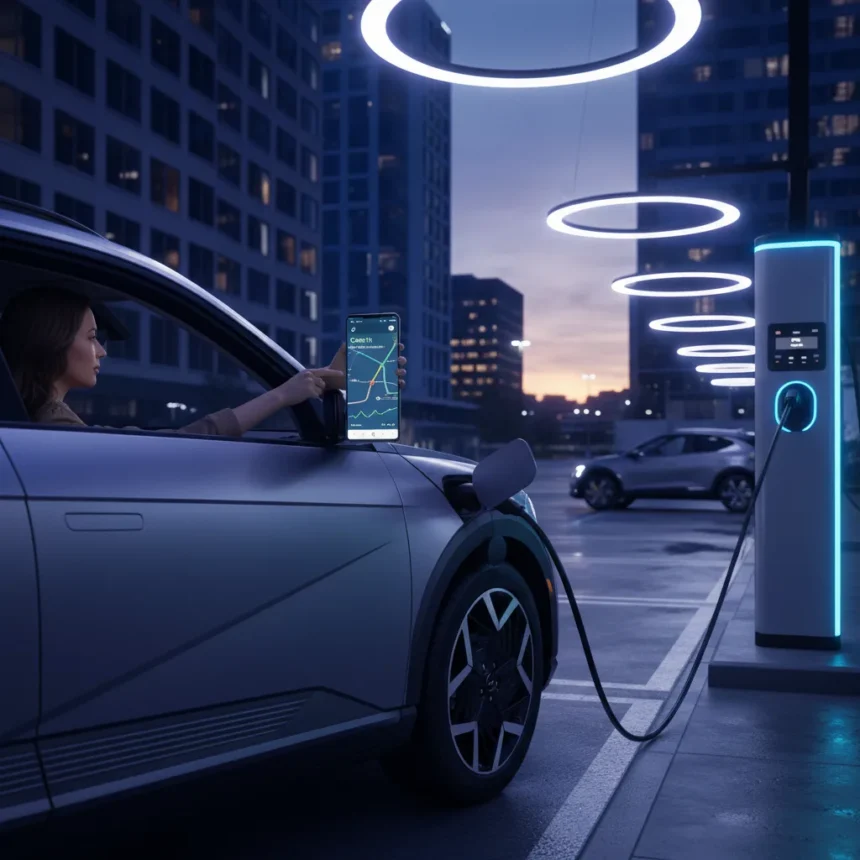
Google Maps EV battery prediction is finally expanding beyond Tesla owners and a handful of premium brands. The feature now covers more than 350 different electric vehicle models across 15 brands, giving millions of EV owners access to AI-powered route planning that accounts for battery drain, elevation, traffic, and weather in real time. For anyone who has white-knuckled a highway drive watching the range ticker drop, this sounds like salvation. But does it actually work?
Key Takeaways
- Google Maps EV battery prediction covers 350+ models across 15 brands in the U.S., available on Android phones with version 25.44 or higher
- The feature calculates routes using road elevation, real-time traffic, and weather data to estimate battery consumption and charging stops
- Users must manually input their EV model and current battery percentage—the system does not automatically sync with vehicle computers
- Battery predictions are estimates only and cannot update during driving without real-time data access
- The feature accounts for charging time in ETA calculations and recommends appropriate charging stops
How Google Maps EV Battery Prediction Actually Works
The feature requires three things: an Android phone running Google Maps version 25.44 or higher, your EV model information entered manually into the app, and your current battery percentage. Once you set those parameters, Google Maps calculates a route based on road elevation, real-time traffic levels, and weather data. The system then estimates when you will need to recharge and recommends appropriate charging stops along your route, accounting for charging time in your overall ETA.
This is not automatic integration with your vehicle’s onboard computer. You cannot glance at your phone and expect the prediction to update itself as you drive. External factors—a roof rack, heavy cargo, aggressive driving—will not be factored in. The feature works as an estimate tool, not a live tracking system. That is a significant limitation, and it matters more than Google’s marketing suggests.
The real advantage here is scope. Previously, only owners of cars with Google built-in—Android-based vehicles with direct integration into Google Maps—could access this level of route intelligence. Now, EV owners driving everything from Chevrolet Bolts to BMW i4s can plan long-distance trips with confidence that the app understands their battery constraints. That is genuinely useful.


Google Maps EV Battery Prediction vs. Dedicated EV Routing Apps
A Better Route Planner (ABRP) has dominated this space for years, and it remains more granular. ABRP requires users to input exact car model, starting charge, weight being hauled, and intended average speed. It pulls live charger status and real-time traffic. But here is the catch: ABRP’s routing abilities need improvement despite its accurate planning and prediction capabilities, according to users who have tested both systems. The interface is clunkier. The subscription model feels dated.
Google Maps strips away that complexity. You enter your model and battery percentage, and the app handles the rest. For casual road trippers, that simplicity wins. For obsessive EV owners who want to squeeze every mile from their battery, ABRP still offers more control. Google Maps is betting that most people fall into the first group.



The Real Problem: Range Anxiety Is Not Just About Range
The headline claims this feature makes you forget about range anxiety. That is overselling it. Range anxiety is not purely a math problem—it is psychological. It stems from uncertainty: Will I find a charger? Will it work? Will I have to wait 45 minutes in the middle of nowhere? Google Maps EV battery prediction solves the math. It does not solve the infrastructure problem.
The feature works only in the U.S. right now, which means international EV owners are locked out. Even within the U.S., charger availability varies wildly by region. Google Maps can recommend a stop, but if that charger is offline or occupied, you are back to white-knuckling it. The app cannot guarantee your charging stops will be available when you arrive.
That said, the feature is a genuine step forward. It transforms route planning from a guessing game into a data-informed decision. You can see upfront whether a 400-mile trip is feasible or whether you need to budget extra time. That knowledge alone reduces anxiety, even if it does not eliminate it entirely.
Should You Switch to Google Maps for EV Routing?
If you own an EV and use Android, yes. The feature is free, it is integrated into an app you already use, and it works. It will not replace ABRP for power users, but for daily driving and occasional road trips, it is the smarter choice than fumbling with a third-party app. The barrier to entry is zero—just update your Google Maps app to version 25.44 or higher and enter your vehicle details.



The one caveat: do not trust the predictions blindly. Treat them as estimates, not guarantees. Monitor your actual battery consumption as you drive. If you are consistently running below the app’s predictions, adjust your charging strategy accordingly. Weather, driving style, and terrain can shift results by 10 to 20 percent.
Will Google Maps EV Battery Prediction Expand Beyond the U.S.?
The feature launched in the U.S. only, but Google rarely keeps major features geographically locked forever. Expect international rollout within the next 12 to 18 months, assuming the company can negotiate charger data partnerships in other markets. That is a real constraint—charger networks vary by country, and data quality matters.
How accurate is Google Maps EV battery prediction in real-world driving?
Accuracy depends on driving conditions. On flat highways with stable weather, predictions are reliable. In mountainous terrain or during rapid weather changes, expect 5 to 15 percent variance from the estimate. The system accounts for elevation and weather in its calculations, but real-time factors like aggressive acceleration or sustained highway speeds at 75+ mph will drain the battery faster than the app predicts.
Can Google Maps EV battery prediction automatically sync with my vehicle’s computer?
Not yet. The system requires manual input of your EV model and current battery percentage. It does not automatically link to your car’s onboard computer or pull live battery data during driving. This is a limitation compared to cars with Google built-in, which have direct integration. For most EV owners without that integration, manual input is the trade-off for accessing this feature at all.
Google Maps EV battery prediction is not magic. It is a smart routing tool that finally brings EV-aware navigation to the mainstream. It solves the planning problem, not the infrastructure problem. For EV owners tired of range anxiety ruining road trips, it is a meaningful upgrade. Just do not expect it to replace human judgment or careful trip planning. Use it as a starting point, not a guarantee.
Edited by the All Things Geek team.
Source: Tom's Guide