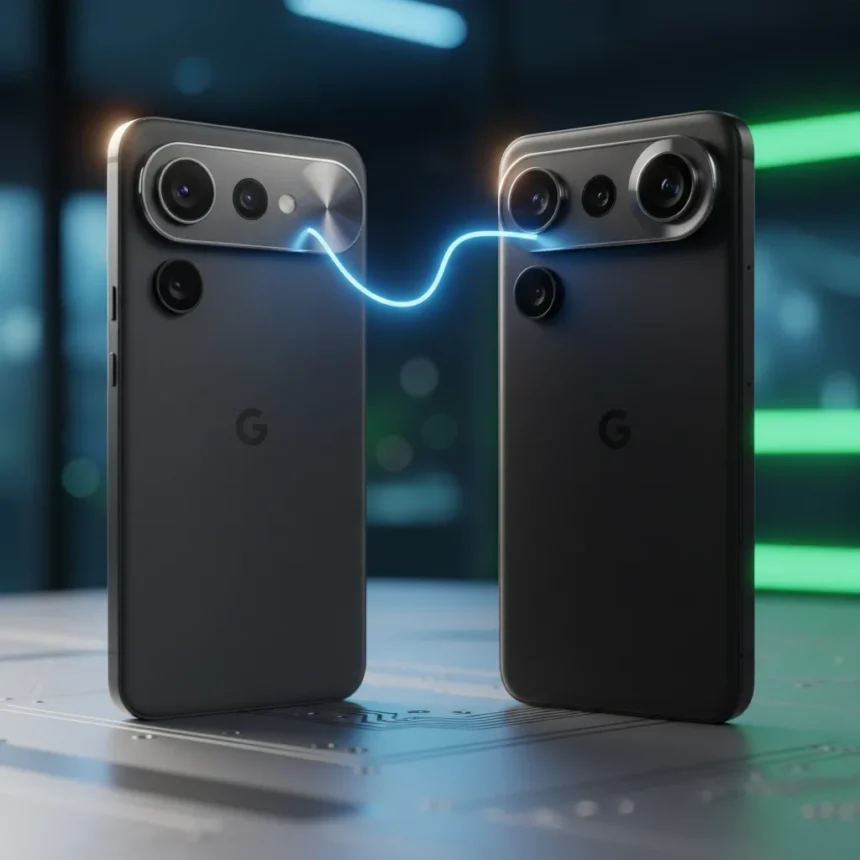
The Google Pixel 10a vs Pixel 10 comparison reveals a smartphone market where the gap between flagship and mid-range has widened, not narrowed. Both phones run the same software and share identical AI features—Gemini, Circle to Search, Call Screen, theft detection, Live Translate, Call Assist, and Pixel Studio. Yet the Pixel 10 introduces a 5x telephoto lens to the base model for the first time, while the Pixel 10a sticks with a dual-camera setup, creating a chasm in zoom capability that software cannot bridge.
Key Takeaways
- Both phones have 6.3-inch OLED displays with 120Hz refresh and identical core AI features like Gemini and Circle to Search.
- Pixel 10 adds 5x telephoto (up to 20x zoom) while Pixel 10a maxes out at 8x digital zoom with dual cameras.
- Pixel 10a has larger 5,100mAh battery; Pixel 10 uses 4,970mAh but includes premium Gorilla Glass Victus 2.
- Pixel 10a saves roughly $200 and suits most users; Pixel 10 justifies cost with telephoto, faster chipset, and premium materials.
- Pixel 10a misses Pixel Screenshots and Magic Cue due to Tensor G4 chipset limits; Pixel 10 gets both with Tensor G5.
Display and Build: Premium Glass vs. Practical Plastic
Both phones sport identical 6.3-inch FHD+ OLED displays with 3,000-nit peak brightness and 120Hz adaptive refresh. The real difference lies in durability. The Pixel 10 uses Gorilla Glass Victus 2 and a glass back, making it feel flagship-grade in hand. The Pixel 10a opts for a plastic backplate with Gorilla Glass 7i and a fingerprint-resistant coating—a trade-off that keeps weight down and price lower. The Pixel 10 is thinner and narrower, though it weighs 204 grams compared to the Pixel 10a’s lighter frame. The Pixel 10a keeps bigger bezels and an optical fingerprint scanner, while the Pixel 10’s ultrasonic scanner sits beneath the display. For daily users who skip cases, the Pixel 10a’s flat camera housing feels more practical; the Pixel 10’s pronounced camera bar supports Google Snap accessories without requiring a case.
Cameras: Where the Pixel 10 Pulls Away
Here is where the Google Pixel 10a vs Pixel 10 comparison gets interesting. Both share an identical 48MP main camera with Quad PD Dual Pixel autofocus and f/1.7 aperture. The Pixel 10a pairs it with a 13MP ultrawide and maxes out at 8x Super Res Zoom. The Pixel 10 adds a 10.8MP 5x telephoto lens with optical zoom at 0.6x, 1x, 5x, and 10x, pushing Super Res Zoom to 20x. For video, the Pixel 10a shoots 1080p at 30 or 60 fps with digital zoom up to 5x. The Pixel 10 adds 24 fps, dual exposure, and Super Res Zoom Video up to 20x. The front-facing cameras also diverge: Pixel 10a uses a 13MP fixed lens, while Pixel 10 offers 10.5MP with autofocus for sharper video calls. If you shoot distant subjects or video regularly, the Pixel 10’s telephoto is the deciding factor.
Performance and AI: Tensor G4 vs. G5
The Pixel 10a runs Google Tensor G4 (4nm process) with 8GB RAM, while the Pixel 10 steps up to Tensor G5 (3nm) and 12GB RAM. Both phones support the same AI suite: Gemini, Circle to Search, Call Screen, theft detection, Live Translate, Call Assist, Gemini Live, and Pixel Studio. However, the Pixel 10 gains Pixel Screenshots and Magic Cue—features locked to the faster G5 chipset. For everyday tasks—email, social media, browsing, messaging—the Pixel 10a handles everything smoothly. The Pixel 10’s extra RAM and newer chipset provide headroom for future updates and multitasking, but the real-world speed difference is subtle. Storage comes in 128GB and 256GB on both; the 256GB Pixel 10 has faster storage speeds, though both 128GB versions are identical.


Battery and Charging: Capacity vs. Speed
The Pixel 10a packs a larger 5,100mAh battery compared to the Pixel 10’s 4,970mAh. In practice, the Pixel 10a should outlast the Pixel 10 on a single charge, especially if you avoid heavy gaming or video. Both support wireless charging, but the Pixel 10 includes Qi2 with Pixelsnap (up to 15W), while the Pixel 10a uses standard Qi-certified charging at 10W. This is a bump from the previous Pixel 10a generation. If wireless charging speed matters to you, the Pixel 10 wins; if all-day battery life is the priority, the Pixel 10a’s larger cell gives it the edge.
Should You Buy the Google Pixel 10a or Pixel 10?
The Google Pixel 10a vs Pixel 10 decision hinges on your priorities. Choose the Pixel 10a if you want the best battery life, a lower price point (roughly $200 less), and are happy with dual-camera zoom up to 8x. It handles everyday photography, video calls, and AI features identically to the Pixel 10. The Pixel 10a is the smarter choice for most people—budget-conscious buyers, casual photographers, and anyone who values battery endurance over premium materials. Choose the Pixel 10 if you shoot distant subjects, record video regularly, care about optical zoom, or want the latest chipset for future-proofing. The 5x telephoto is a genuine differentiator that the Pixel 10a cannot replicate, and the Gorilla Glass Victus 2 back feels more durable over years of use. The Pixel 10 is worth the extra cost if zoom and build quality move the needle for you.


Does the Pixel 10a have wireless charging?
Yes. The Pixel 10a supports Qi-certified wireless charging at 10W, a notable upgrade from the prior Pixel 10a generation. It is slower than the Pixel 10’s Qi2 at 15W, but both phones charge wirelessly without a cable.
Can the Pixel 10a shoot 5x zoom like the Pixel 10?
No. The Pixel 10a maxes out at 8x digital Super Res Zoom using its dual-camera system. The Pixel 10 adds a dedicated 5x optical telephoto lens, enabling optical zoom at 0.6x, 1x, 5x, and 10x, plus up to 20x Super Res Zoom Video. If telephoto is essential, the Pixel 10 is the only choice.
Is the Pixel 10a display worse than the Pixel 10?
Both have identical 6.3-inch FHD+ OLED panels with 3,000-nit peak brightness and 120Hz refresh. The Pixel 10 has slightly brighter sustained brightness and smaller bezels, but the viewing experience is nearly identical. The Pixel 10a’s Gorilla Glass 7i adds a fingerprint-resistant coating, which some users prefer.
The Pixel 10a vs Pixel 10 gap has shifted from processor performance to camera capability. The Pixel 10a remains a compelling mid-range phone with excellent battery life and AI features, but the Pixel 10’s telephoto lens and premium build now justify the premium for users who value zoom and durability. For most buyers, the Pixel 10a is the smarter buy; for enthusiasts, the Pixel 10’s optical zoom makes the extra cost worthwhile.



Where to Buy
$499 at Amazon | $599 at Amazon
Edited by the All Things Geek team.
Source: TechRadar