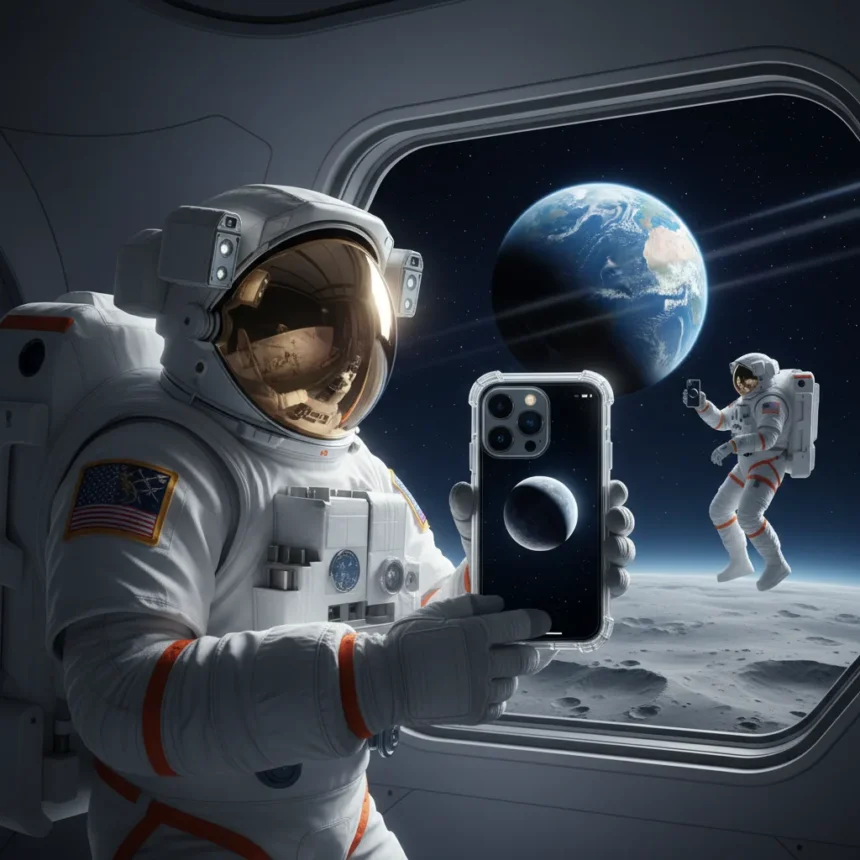
The iPhone 17 Pro Max just proved that consumer-grade smartphones belong in space. During the Artemis II mission launched in April 2026, astronauts equipped with iPhone 17 Pro Max devices captured Earth and the Moon from lunar orbit—and the images are now going viral across social media with calls for Apple to turn them into billboards.
Key Takeaways
- iPhone 17 Pro Max used by Artemis II astronauts to photograph Earth and Moon from lunar orbit in April 2026.
- 8x zoom lens captured detailed Moon crater imagery; 48MP camera with 6.9-inch OLED display rated for 3,000 nits brightness.
- Photos shared via NASA livestream, Flickr, and social media with metadata confirming iPhone 17 Pro Max as the capture device.
- NASA qualified iPhone 17 Pro Max for extended orbital use in February 2026.
- Images demonstrate consumer smartphone capabilities competing with professional space photography equipment.
How the iPhone 17 Pro Max made it to space
NASA does not typically send consumer devices into orbit. The space agency qualified the iPhone 17 Pro Max for extended use in space in February 2026, marking a significant shift in how astronauts document missions. Each of the four Artemis II crew members—Commander Reid Wiseman, Mission Specialist Christina Koch, CSA Astronaut Jeremy Hansen, and one additional astronaut—received an iPhone 17 Pro Max alongside professional cameras like the Nikon D5 and Nikon Z 9. The devices were equipped specifically for personal photography and video, not as replacements for mission-critical imaging hardware.
The decision to include consumer smartphones alongside professional equipment reflects a broader trend in space missions: astronauts want tools that feel familiar. Unlike the bulky professional cameras designed for specific technical requirements, the iPhone 17 Pro Max offered something different—immediate access to a device they already know how to use, without extensive training or cumbersome interfaces.
iPhone 17 Pro Max specs that made space photography possible
The iPhone 17 Pro Max features a 48MP 8x zoom camera, a 6.9-inch OLED display rated for 3,000 nits brightness, and nearly 18-hour battery life—specifications that proved critical for capturing images from lunar orbit. The 8x zoom lens was instrumental in photographing the Moon’s far side, including detailed shots of Chebyshev crater. The front-facing selfie camera captured equally striking images of astronauts like Commander Reid Wiseman and Mission Specialist Christina Koch viewing Earth through Orion spacecraft windows. The 3,000-nit OLED panel ensured images could be reviewed in the bright cabin environment of the Orion spacecraft, where sunlight floods through windows without atmospheric filtering.


Battery life matters in space more than most people realize. The nearly 18-hour endurance meant astronauts could photograph continuously during their lunar orbit phase without worrying about the device dying mid-mission. This reliability advantage over many professional cameras, which often require frequent battery swaps, gave the iPhone 17 Pro Max an unexpected edge.
The photos that broke the internet and sparked billboard talk
Images taken on April 2, the second day of the mission, and during lunar orbit circling showed Earth’s surface with unprecedented clarity from an iPhone. The photographs were shared via NASA livestream, social media platforms, and uploaded to Flickr with metadata explicitly confirming the iPhone 17 Pro Max as the capture device. One particularly striking image of the Moon prompted social media users to remark that it would make an ideal phone wallpaper, sparking speculation that Apple should license these photos for billboard advertising campaigns.



What made these images resonate was not just their visual impact—it was the democratization they represented. Professional space agencies have always produced stunning orbital photography. But seeing those images captured by a device millions of people carry in their pockets shifted the conversation. The iPhone 17 Pro Max was not competing with professional cameras; it was proving that the gap between consumer and professional space imaging had narrowed significantly.
iPhone 17 Pro Max versus professional space cameras
The Artemis II mission carried multiple camera systems: Nikon D5, Nikon Z 9, and GoPro HERO4 Black devices handled high-resolution and technical photography requirements. These professional tools deliver images optimized for scientific analysis, archival quality, and specific mission parameters. Yet the iPhone 17 Pro Max images, described as more personal and immediate in character, generated more public engagement than many of the polished professional shots.
This is not a failure of professional equipment—it is a reflection of how different tools serve different purposes. Professional cameras excel at technical precision and standardized output. The iPhone 17 Pro Max excels at capturing moments that feel authentic and immediate, unfiltered by the technical requirements of space agency documentation. For astronauts sharing personal impressions of their mission, that distinction matters enormously.
What does this mean for Apple’s marketing?
The viral success of these images raises a straightforward question: why hasn’t Apple formally capitalized on them? The company has a history of turning user-generated content into marketing gold, yet these photographs—taken by NASA astronauts from lunar orbit using an iPhone 17 Pro Max—exist in a gray zone between official NASA documentation and consumer marketing. Apple could license these images for advertising, turn them into billboards as social media users suggested, or feature them in product marketing campaigns. The fact that the company has not done so publicly suggests either deliberate restraint or a missed opportunity.



From a brand perspective, these images are nearly priceless. They prove the iPhone 17 Pro Max works in conditions no consumer will ever experience, yet they feel immediate and personal rather than clinical. That emotional authenticity is difficult to manufacture in traditional advertising.
FAQ: iPhone 17 Pro Max space photography questions
Can you buy an iPhone 17 Pro Max right now?
Yes. The iPhone 17 Pro Max is a current consumer device available through Apple and authorized retailers worldwide. The Artemis II mission simply highlighted its capabilities in an extraordinary context—lunar orbit—rather than introducing a new or limited product.
What makes the iPhone 17 Pro Max better at space photography than other phones?
The 48MP 8x zoom camera, 3,000-nit OLED display, and nearly 18-hour battery life gave it advantages for reviewing and capturing images in the bright Orion spacecraft cabin and from lunar distances. Other flagship phones offer similar specs, but the iPhone 17 Pro Max’s combination of zoom reach, display brightness, and endurance proved effective in this specific environment.
Did NASA officially endorse the iPhone 17 Pro Max for space use?
NASA qualified the iPhone 17 Pro Max for extended orbital use in February 2026, meaning the space agency tested and approved it for mission deployment. This is not a casual endorsement—it reflects formal testing and certification that the device could function reliably in space conditions.
The Artemis II mission proved that the line between consumer technology and professional space equipment has blurred. A smartphone you can buy today captured images from lunar orbit that are now sparking global conversations about Apple’s marketing strategy and the future of consumer tech in extreme environments. Whether Apple turns these photographs into billboards or not, the images themselves have already become the most effective advertisement the iPhone 17 Pro Max could ask for.
Edited by the All Things Geek team.
Source: Creativebloq