






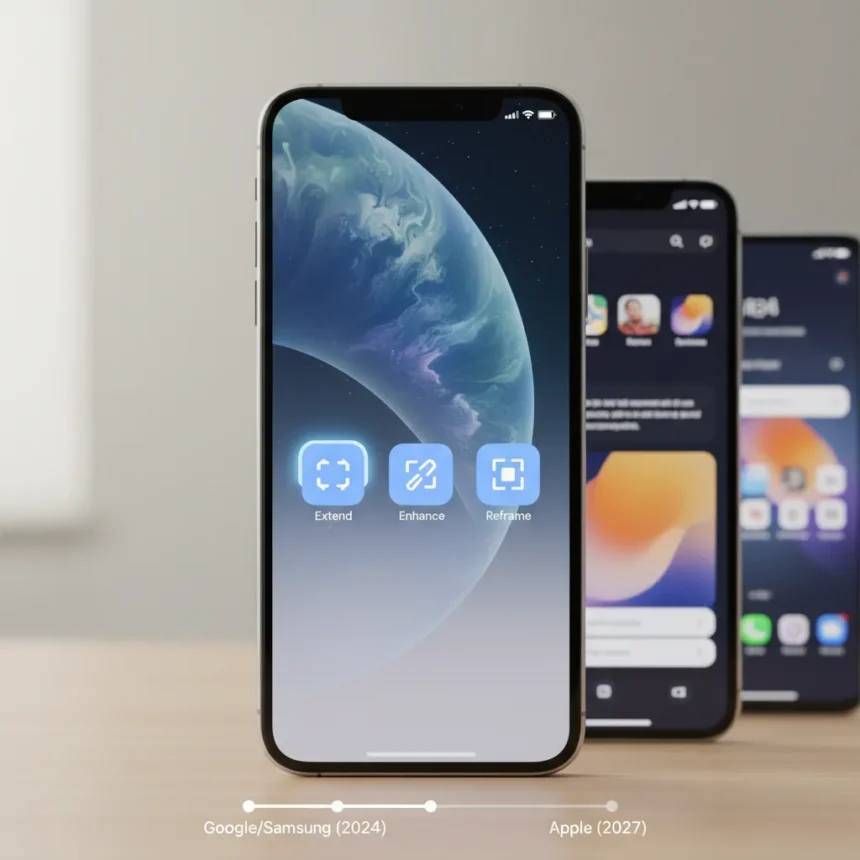
Apple’s Photos AI overhaul is coming to iOS 27, iPadOS 27, and macOS 27 in fall 2026, but the company is playing catch-up rather than leading the charge. Three new AI-powered editing tools—Extend, Enhance, and Reframe—will join the existing Clean Up feature under a new “Apple Intelligence Tools” section, processing everything on-device to protect user privacy.
Key Takeaways
- Apple’s Photos AI overhaul introduces Extend, Enhance, and Reframe tools in iOS 27, launching fall 2026
- Google Pixel’s Magic Editor and Samsung devices already offer comparable AI photo editing features
- Extend and Reframe are currently facing reliability issues during internal testing
- Clean Up feature receives mixed feedback with reported artifacts and texture blurring
- On-device processing differentiates Apple’s approach from cloud-dependent competitors
What Apple’s Photos AI overhaul actually includes
The Apple Photos AI overhaul bundles four AI-powered tools under one section. Extend lets users drag the edges of a photo to expand beyond the original frame, with AI generating and filling missing details—though Bloomberg’s Mark Gurman reports this feature is currently facing reliability issues in testing. Enhance automatically improves color, lighting, and overall image quality with minimal user input, working with a single button press. Reframe shifts the perspective of an existing photo to create a new view from the same image, working particularly well with spatial photos, but also reportedly struggling with stability during internal testing. Clean Up, the existing feature that lets users circle unwanted objects to remove them, will be consolidated into this new tools section after engineers address criticism about artifacts, blurred textures, and inaccurate details in filled areas.
All processing happens on-device, aligning with Apple’s privacy-first positioning. This architectural choice matters: competitors like Google Pixel rely on cloud processing for their Magic Editor, which means image data travels to Google’s servers. Apple’s approach keeps everything local, a genuine differentiator in an era when privacy concerns drive purchasing decisions.
Why Apple is playing catch-up, not leading
Google Pixel users have accessed Magic Editor through Google Photos for years, and users don’t even need a Pixel phone to use it—the tool works across Android devices through the Google Photos app. Samsung Android devices offer comparable AI photo editing capabilities as standard. Adobe Photoshop has featured extend functionality for approximately three years. These tools are not exactly new in the smartphone space, and Apple’s timeline of fall 2026 positions the company as a follower rather than an innovator in computational photography.


This is a strategic pivot. Apple previously stated at its Apple Intelligence announcement that the company would offer limited AI functionality for camera and photos features. The Photos AI overhaul signals Apple recognizing that limitation as a competitive weakness. The company cannot afford to let Google and Samsung define what intelligent photo editing means to consumers. By fall 2026, when iOS 27 launches alongside expected iPhone 18 Pro and Pro Max hardware updates, Apple will have had years to watch competitors refine these tools. That timeline advantage cuts both ways: Apple can learn from their mistakes, but it also means the company is arriving late to a conversation already in progress.
The reliability problem Apple must solve before launch
Both Extend and Reframe are facing reliability issues during internal testing, according to reporting on Apple’s development roadmap. This is not trivial. A photo editing feature that produces unpredictable results trains users to distrust it. Clean Up already suffers from mixed user feedback about artifacts, blurred textures, and inaccurate details when removing objects—problems that undermine confidence in on-device AI processing. If Extend and Reframe ship with similar issues, they become novelties rather than tools users actually depend on.



Apple could scale back or delay these tools ahead of the fall 2026 release if model improvements do not materialize. That possibility reflects the engineering challenge: generating plausible image content at the edge is harder than cloud processing, where computational resources are unlimited. On-device processing is a privacy win and a marketing message, but it is also a technical constraint that may force compromises in reliability or feature completeness.
Broader iOS 27 context: Siri gets a standalone chatbot
The Photos AI overhaul sits within a larger Apple Intelligence expansion. iOS 27 will include a Siri overhaul with a standalone chatbot interface, multi-command support, and third-party AI assistant integration. This suggests Apple is rethinking how AI features integrate across the entire operating system, not just the camera and photos. The company is essentially building a platform to compete with Google’s Gemini and OpenAI’s ChatGPT, with photos editing as one component of a broader intelligence layer.
For users, this means iOS 27 will feel less like incremental feature additions and more like a fundamental shift in how the OS thinks about AI assistance. Whether that shift actually improves the user experience depends entirely on execution—something Apple’s current reliability issues with Extend and Reframe suggest is still uncertain.
Does Apple’s on-device approach actually matter to users?
Apple will emphasize that processing happens locally, not in the cloud. This is a legitimate technical advantage: your photos never leave your device, no cloud account required, no subscription fees for AI features. Google’s Magic Editor, by contrast, processes in the cloud, which raises privacy questions for users concerned about image data being retained, analyzed, or used for training purposes. For privacy-conscious users, Apple’s approach is genuinely preferable.



But for most users, the privacy difference matters less than whether the tool works reliably and produces results they actually want to use. If Extend generates hallucinated details that look wrong, or Reframe shifts perspective in unexpected ways, the privacy advantage evaporates. On-device processing is a feature, not a guarantee of quality.
Will the Photos AI overhaul convince users Apple is serious about AI?
Apple’s track record with AI features has been mixed. Siri has lagged behind Google Assistant and Alexa for years. Apple Intelligence itself launched with limited functionality and heavy reliance on third-party partnerships. The Photos AI overhaul is a chance to prove Apple can execute AI features that users actually want to use daily. If the tools ship reliably in fall 2026, they become a genuine selling point for iOS 27. If they ship with the same reliability issues currently plaguing internal testing, they become another example of Apple overpromising on AI.
What about iPhone 18 Pro camera hardware in fall 2026?
The timing of iOS 27 and the Photos AI overhaul aligns with Apple’s typical hardware release cycle. New iPhone Pro models in fall 2026 will likely include camera improvements that complement the new editing tools. Better sensors and processing chips enable better AI results. The question is whether Apple will position the Photos AI overhaul as a reason to upgrade to iPhone 18 Pro, or as a feature available across all devices running iOS 27. The research brief does not specify, but historically Apple reserves the most advanced computational photography features for Pro models.
FAQ
When will Apple’s Photos AI overhaul launch?
iOS 27, iPadOS 27, and macOS 27 are expected in fall 2026, bringing the new Extend, Enhance, and Reframe tools to the Photos app. This aligns with Apple’s typical annual operating system release cycle.
Will the Photos AI overhaul require a paid subscription?
The research brief does not specify pricing or whether these tools require a subscription. Apple typically includes AI features as part of the operating system rather than behind a paywall, but confirmation will not come until closer to launch.
How does Apple’s Photos AI overhaul compare to Google Photos Magic Editor?
Both offer similar editing capabilities, but Apple processes on-device while Google uses cloud processing. Google’s approach has a head start of several years, and users can access Magic Editor across Android devices without owning a Pixel phone. Apple’s on-device approach offers stronger privacy guarantees but must overcome current reliability issues with Extend and Reframe before launch.
Apple’s Photos AI overhaul is a necessary move, not a visionary one. The company is responding to competitive pressure from Google and Samsung by building tools that users already expect from their phones. Whether Apple executes better than competitors will determine whether this overhaul feels like innovation or obligation. Fall 2026 will tell.
This article was written with AI assistance and editorially reviewed.
Source: TechRadar