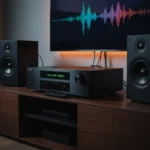
Denon’s new affordable Dolby Atmos receivers—the AVR-X2900H and AVR-X3900H—arrive at a critical moment for home theater builders. Both models support Dolby Atmos, DTS:X, Dolby Vision, 4K/120Hz passthrough, and Variable Refresh Rate (VRR), making them genuinely equipped for next-generation gaming and streaming without forcing you to choose between immersive audio and gaming performance.
Key Takeaways
- AVR-X2900H is a 7.2-channel receiver at 95W per channel; AVR-X3900H is 9.2-channel at 105W per channel
- Both feature HDMI 2.1 (6 inputs), Dolby Atmos, DTS:X, and 4K/120Hz with VRR for PS5 and Xbox Series X
- Dual room correction: Audyssey MultEQ XT standard, Dirac Live available as upgrade
- HEOS multi-room streaming, AirPlay 2, Spotify Connect, and Tidal Connect built in
- AVR-X2900H starts at $999; AVR-X3900H at $1,499
What makes the affordable Dolby Atmos receivers stand out
The AVR-X2900H and AVR-X3900H occupy a specific sweet spot: they are the first Denon affordable Dolby Atmos receivers to ship with a complete HDMI 2.1 suite post-chip shortage. This matters because the gap between entry-level and premium AV receivers has historically been brutal. You either got basic surround sound or you paid flagship prices for Atmos and gaming features. Denon is collapsing that gap. The AVR-X2900H delivers 7.2-channel processing with 95 watts per channel (8 ohms, 20Hz–20kHz, 0.08% THD, 2 channels driven), while the AVR-X3900H scales to 9.2 channels at 105 watts per channel with support for 11.2-channel processing when paired with external amplification. Both include six HDMI 2.1 inputs, which means you can wire your PS5, Xbox Series X, and 4K Blu-ray player without sacrificing any connections to your TV.
The room correction story is equally pragmatic. Both models ship with Audyssey MultEQ XT, Denon’s automatic calibration system, but buyers can upgrade to Dirac Live—a more sophisticated acoustic measurement tool—if they want finer control. This tiered approach lets budget-conscious buyers start immediately without paying extra, while serious acousticians can invest in better tuning later. Neither affordable Dolby Atmos receiver forces you into a single correction philosophy.
Dolby Atmos clarity and dynamics in a reference listening room
I heard both receivers in Denon’s reference listening room in Japan, and the impression was immediate: these are fantastic entry points into Atmos home theater without breaking the bank. The AVR-X2900H and AVR-X3900H handled Dolby Atmos content with impressive clarity and dynamics. Overhead channels were precise—not diffuse or vague—and the crossover between front and surround speakers felt seamless rather than stitched together. Switching between the two models revealed the obvious difference in raw channel count and power, but both punched well above their price point in terms of spatial coherence.



What impressed me most was how the affordable Dolby Atmos receivers handled mixed content. A stereo music track through HEOS sounded clean and detailed. A 4K/120Hz gaming signal passed through without artifacts or color banding. Dolby Vision content on a streaming service rendered with proper contrast and color precision. Denon did not cheap out on the video processing pipeline—a common cost-cutting move that renders affordable AV receivers useless for modern home theater.
How the affordable Dolby Atmos receivers compare to rivals
The Yamaha RX-V6A and RX-A2A occupy similar pricing territory, but Denon’s affordable Dolby Atmos receivers differentiate themselves through HEOS multi-room integration. Yamaha’s MusicCast is functional, but HEOS is more seamless across Denon and Marantz products if you are building a multi-room ecosystem. The Marantz NR1607 is slimmer and cheaper, but it maxes out at 7.2 channels and lacks the gaming-focused HDMI 2.1 features. Onkyo and Pioneer offer AirPlay and Chromecast, but neither delivers the same combination of Atmos support, room correction flexibility, and multi-room audio at these price points.



The real competition is not other affordable Dolby Atmos receivers—it is the temptation to buy a cheap soundbar and a separate amplifier. That approach fragments your ecosystem and forces you to manage separate remotes, calibration tools, and streaming integrations. A single AV receiver with Atmos, HEOS, and HDMI 2.1 is simpler, more cohesive, and ultimately more future-proof.
Specifications and connectivity you actually need
Both the AVR-X2900H and AVR-X3900H ship with six HDMI 2.1 inputs, which is rare at this price. The AVR-X2900H measures 434 × 151 × 339mm and weighs 9.6kg, making it compact enough for tighter AV racks. The AVR-X3900H is slightly taller at 434 × 167 × 339mm and weighs 11.6kg due to the extra amplification. Wireless connectivity includes Bluetooth, Wi-Fi, AirPlay 2, Spotify Connect, and Tidal Connect—the streaming essentials without bloat. Both receivers support Dolby Atmos, DTS:X, Dolby Vision, 4K/120Hz passthrough, and VRR, which covers every modern codec and gaming feature you will encounter.
The AVR-X3900H’s ability to process 11.2 channels with external amplification is worth noting if you plan to expand later. You are not locked into 9.2 forever; you can add a two-channel power amp and reconfigure the receiver to drive additional surround or height speakers. This flexibility is rare in affordable Dolby Atmos receivers and speaks to Denon’s understanding of how real home theaters evolve.
Pricing and where to buy
The AVR-X2900H is priced at $999 (£999 in the UK, AU$1,699 in Australia) and is available now from major retailers including Amazon and Crutchfield. The AVR-X3900H costs $1,499 ($1,499 in the UK, AU$2,199 in Australia) and is also available immediately. Both are shipping globally through Denon dealers, though regional pricing and availability vary. For a 7.2-channel Atmos receiver with HDMI 2.1 and room correction, the AVR-X2900H is genuinely difficult to beat at $999. If you need more channels or plan a larger room, the $500 jump to the AVR-X3900H adds 9.2-channel processing and 10 extra watts per channel—a reasonable upgrade path.



Should you buy the Denon AVR-X2900H or AVR-X3900H?
Yes, if you are building a home theater from scratch and want Dolby Atmos without spending over $1,500. The AVR-X2900H is the smarter choice for smaller rooms or if you are uncertain about surround speaker placement—7.2 channels are plenty for convincing Atmos immersion. The AVR-X3900H is worth the extra money if your room is larger than 250 square feet or if you plan to add height speakers later. Both receivers eliminate the false choice between budget pricing and modern audio-video features. You get Atmos, gaming support, and multi-room audio in one box.
What is the difference between the AVR-X2900H and AVR-X3900H?
The AVR-X2900H is 7.2-channel at 95W per channel; the AVR-X3900H is 9.2-channel at 105W per channel and supports 11.2-channel processing with external amplification. Both share the same HDMI 2.1, Dolby Atmos, DTS:X, and room correction features. Choose the X2900H for smaller rooms or budgets under $1,000; choose the X3900H if you want more channels or plan to expand later.
Do these affordable Dolby Atmos receivers support gaming?
Yes. Both the AVR-X2900H and AVR-X3900H include HDMI 2.1 inputs with 4K/120Hz passthrough and Variable Refresh Rate (VRR) support, making them fully compatible with PS5 and Xbox Series X. You can run your gaming console directly through the receiver without sacrificing frame rate or resolution.
The Denon AVR-X2900H and AVR-X3900H prove that affordable Dolby Atmos receivers no longer mean compromise. You get immersive surround sound, modern gaming support, and multi-room audio integration at prices that make sense for real budgets. If you are tired of soundbar limitations and ready to build a proper home theater, these are the receivers to start with.
Edited by the All Things Geek team.
Source: TechRadar