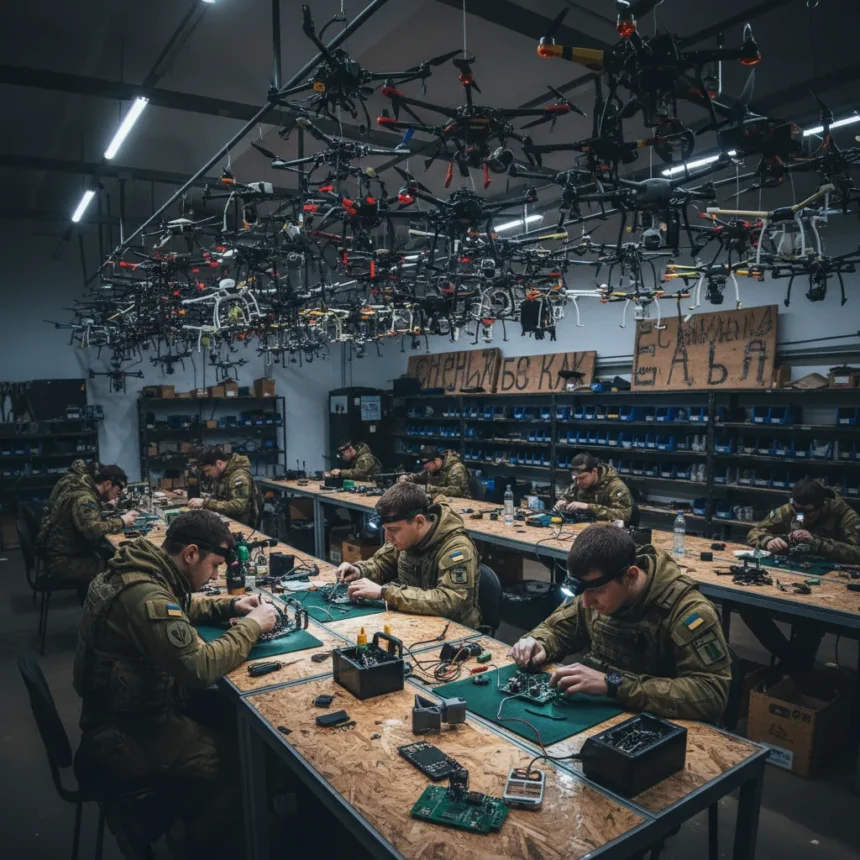
Drone repair sustainability is reshaping how militaries and manufacturers approach hardware lifecycle management. In Ukraine, a growing network of volunteer technicians and specialized teams are rebuilding damaged unmanned aerial vehicles at an industrial scale, turning what was once considered disposable military hardware into a strategic asset. This shift has profound implications for how the defense sector—and eventually consumer tech—thinks about product longevity and waste.
Key Takeaways
- Electronic warfare has disabled thousands of Ukrainian drones, creating a massive repair backlog.
- Volunteer technicians and repair teams are restoring damaged drones to operational status.
- Drone repair sustainability challenges the defense industry’s throwaway hardware model.
- Repair expertise is becoming as valuable as manufacturing capability in modern warfare.
- This movement could influence how commercial drone manufacturers design for repairability.
Why thousands of drones are sitting idle in Ukraine
Electronic warfare has become the silent killer of modern drone fleets. When Russian forces deploy jamming and signal-disruption technology, Ukrainian drones lose their connection to operators and become inert hardware—not destroyed, but disabled. This creates a paradox: the machines are intact but useless without someone who understands how to restore them. The scale of this problem is staggering. Across the conflict, thousands of drones have been rendered non-functional, piling up in workshops and field depots with no clear path back to service.
The damage pattern is different from traditional combat losses. A drone shot down is gone forever. A drone jammed is recoverable—if you have the technical knowledge and spare parts to fix it. This distinction has become the foundation of an entirely new discipline within Ukraine’s defense ecosystem: drone restoration at scale. Unlike manufacturing, which requires factories and supply chains, repair requires something more immediate: skilled hands and deep technical knowledge.
The craftsmen rebuilding Ukraine’s drone fleet
Tom, a volunteer drone specialist, represents a new category of defense worker: the technician who breathes life back into disabled hardware. These are not factory workers following assembly blueprints. They are problem-solvers diagnosing why a Mavic drone lost signal, replacing corrupted components, and testing restored units back to operational readiness. The work is methodical and unglamorous—soldering circuits, replacing damaged receivers, recalibrating flight systems—but it is essential.

The scale of this repair operation has grown beyond what anyone anticipated at the start of the conflict. Teams are now processing thousands of drones annually, with some estimates suggesting repair efforts handle a significant portion of Ukraine’s disabled fleet. This is not a side operation. It is a core part of how Ukraine sustains its drone capability. The repair teams are competing against time, electronic warfare sophistication, and the sheer volume of hardware that needs restoration. Every drone returned to service extends Ukraine’s operational capacity without requiring new manufacturing or fresh imports.
What makes this movement remarkable is that it is driven largely by volunteers and small specialized teams rather than government-backed manufacturing plants. This decentralized approach has advantages: repair teams can respond quickly to new damage patterns, adapt to emerging jamming tactics, and share solutions across the network. It also reflects a harsh reality—there is no traditional supply chain or factory that can scale fast enough to replace losses in active conflict.



Drone repair sustainability and the future of hardware design
The implications of Ukraine’s repair movement extend far beyond the battlefield. For decades, the tech industry has optimized for rapid obsolescence: devices designed to be replaced rather than repaired. Smartphones are glued shut. Laptops have soldered RAM. Drones are built as disposable platforms. This model works in peacetime markets where consumers upgrade every two years. It fails catastrophically in conflict zones where replacement is impossible and every functional unit matters.
Drone repair sustainability is forcing manufacturers to confront uncomfortable questions. If a device can be kept operational through repair, should it be designed for repairability from the start? Should manufacturers provide repair documentation, sell spare parts, and support third-party technicians? The commercial drone industry has largely resisted this shift—it is more profitable to sell new units than to enable repairs. But Ukraine’s experience suggests that repairability is not a luxury feature. It is a strategic capability.
This tension mirrors broader debates in consumer tech. Right-to-repair advocates have pushed Apple, Samsung, and others to make devices easier to fix. Ukraine’s drone repair movement provides a real-world case study: when replacement is not an option, repair infrastructure becomes invaluable. The question is whether defense contractors and drone manufacturers will learn this lesson and apply it to their design philosophies, or whether the military will continue to accept throwaway hardware as the cost of doing business.
What this means for the defense industry
Ukraine’s repair movement is redefining the value proposition of military hardware. Traditionally, defense contractors measured success by production volume and technical specifications. Now, repairability—the ability to keep systems operational through maintenance and component replacement—is emerging as a competitive advantage. A drone that can be restored to service is worth more than a drone that cannot.



This shift has economic implications for the defense sector. Repair operations require less capital investment than manufacturing plants. They create jobs in workshops rather than factories. They reduce logistics strain by keeping hardware in the field rather than shipping new units. For Ukraine specifically, repair capability has become a force multiplier. Every drone restored is one fewer unit that needs to be imported or manufactured.
The broader lesson is that the defense industry may need to rethink its entire approach to hardware lifecycle. Instead of designing for a single operational lifespan and then disposal, manufacturers might need to design for multiple repair cycles, component replacement, and extended service life. This is not revolutionary thinking—it is how military equipment was designed before the era of cheap electronics and disposable consumer tech. Ukraine’s conflict is forcing a return to that older model, but with modern manufacturing and repair techniques.
How does drone repair affect the broader defense supply chain?
Drone repair sustainability reduces pressure on manufacturing and import logistics, allowing Ukraine to allocate resources to other critical needs. By keeping damaged drones in service through repair, the country avoids the need to source replacement units from international partners, which can be slow and politically complicated. Repair also builds domestic technical expertise that strengthens long-term defense capacity.
Could consumer drone manufacturers adopt repair-friendly designs?
The commercial drone industry could benefit from Ukraine’s repair movement by designing for modularity and repairability. If manufacturers like DJI made spare parts widely available and published repair documentation, third-party technicians could extend product lifespans and reduce e-waste. However, this conflicts with the current business model of planned obsolescence and regular upgrades.
What happens to drones that cannot be repaired?
Drones damaged beyond repair become sources of spare parts for other restoration projects. Components like motors, batteries, flight controllers, and camera systems can be salvaged and reused, maximizing the utility of every piece of hardware. This scavenging approach further extends the operational life of Ukraine’s drone fleet and reflects the reality of conflict: waste is a luxury.
Ukraine’s drone repair movement is not just about fixing broken machines. It is about challenging the assumption that military hardware should be disposable. As the conflict continues and repair teams process thousands of drones annually, they are building a model that the defense industry—and eventually consumer tech—may need to follow. The question is not whether repairability matters. Ukraine has already answered that. The question is whether the rest of the industry will listen.
Edited by the All Things Geek team.
Source: TechRadar