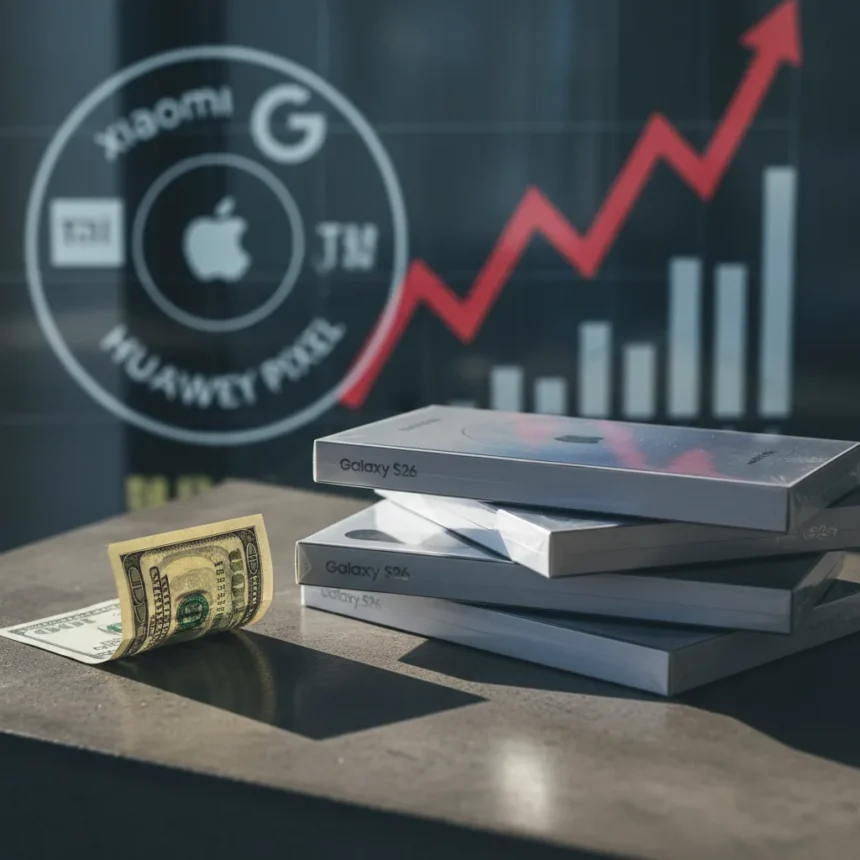
The Galaxy S26 sales momentum is outpacing the Galaxy S25 in early weeks, a rare win for Samsung in a crowded flagship market. Yet beneath the headline numbers lies a troubling contradiction: Samsung appears to be testing whether strong initial demand can survive a reported $100 price hike that may have already begun eroding buyer enthusiasm.
Key Takeaways
- Galaxy S26 is selling better than Galaxy S25 in early launch weeks.
- Samsung raised prices by approximately $100 across the Galaxy S26 lineup.
- Early momentum may not survive the higher price point long-term.
- Competitors are watching to see if premium pricing sticks in 2025.
- The Galaxy S26 faces the classic flagship dilemma: performance gains versus affordability.
Galaxy S26 sales momentum outpaces the S25
Samsung‘s Galaxy S26 is moving faster off shelves than the Galaxy S25 did at launch, according to early sales data cited in industry reports. The stronger start reflects genuine consumer interest in the new generation, driven partly by anticipation around the Ultra model and Samsung’s incremental hardware improvements. This is meaningful because the Galaxy S25 faced a sluggish start last year, making any uptick a psychological win for the company.
The early Galaxy S26 sales momentum suggests that Samsung’s core audience remains willing to upgrade, at least initially. Whether that appetite persists once the full $100 price increase sinks in is the real question hanging over the launch.
The $100 price hike that could kill momentum
Here is where Samsung’s optimism collides with market reality. The Galaxy S26 lineup carries a reported $100 price increase across models compared to the Galaxy S25 generation. In absolute terms, this pushes flagship pricing into uncomfortable territory for many buyers who already question whether annual upgrades justify the expense.


This pricing move reveals Samsung’s confidence in its product, but it also exposes a dangerous assumption: that early enthusiasm will translate into sustained sales at higher prices. Early adopters and enthusiasts may accept the increase. Mass-market buyers rarely do. The gap between launch-week demand and quarter-long sales trends is where pricing friction typically reveals itself.
Can the Galaxy S26 sustain momentum without price cuts?
Samsung faces a critical test: whether Galaxy S26 sales momentum can survive without promotional discounts or trade-in sweeteners that erode margins. The company has room to maneuver—bundle deals, carrier incentives, and regional pricing flexibility are all levers it can pull. But each discount is an admission that the $100 increase was too aggressive.



Competitors like Google, Apple, and OnePlus are watching closely. If Samsung’s price hold succeeds, it validates the entire premium Android market’s pricing structure. If it fails, expect aggressive positioning from rivals who can undercut on price while matching performance. The Galaxy S26 sales momentum of the next 90 days will determine which scenario unfolds.
What the Galaxy S26 price increase means for buyers
For consumers, the $100 hike forces a harder choice. The Galaxy S26 may offer genuine improvements—better cameras, faster processors, refined software—but those gains need to feel worth the premium. Buyers comparing the Galaxy S26 to the Galaxy S25 will ask whether the difference justifies keeping their current phone another year instead. For many, the answer is no.
This is where Samsung’s pricing strategy risks backfiring. Strong Galaxy S26 sales momentum in week one does not guarantee strong momentum in week twelve. The real test begins when the initial rush subsides and price-conscious buyers start calculating the true cost of ownership.
Is the Galaxy S26 worth the price increase?
The Galaxy S26 is worth upgrading to if you own a Galaxy S23 or older device and value the latest camera and processor technology. If you own a Galaxy S25, the improvements likely do not justify the $100 premium unless you specifically need new features the brief does not detail.



How does Galaxy S26 pricing compare to competitors?
Samsung’s Galaxy S26 now sits at a higher price point than the Galaxy S25, making direct comparison with flagship competitors more relevant. The exact positioning depends on regional pricing and carrier deals, which vary widely. What matters is whether buyers perceive the value gap as worth the extra cost.
Will Samsung cut Galaxy S26 prices soon?
History suggests yes. Samsung typically introduces discounts and trade-in bonuses within 4-6 weeks of launch if early momentum softens. The Galaxy S26 sales momentum may be strong enough to delay cuts, but do not expect full-price sales to sustain indefinitely at the $100 premium.
Samsung is betting that Galaxy S26 sales momentum proves durable. The company may be right—but it may also be pushing its luck. A $100 price increase is a heavy ask in a market where flagship fatigue is real and alternatives are plentiful. The next quarter will reveal whether Samsung’s optimism was justified or whether early enthusiasm masked deeper pricing resistance.
Edited by the All Things Geek team.
Source: Android Central