


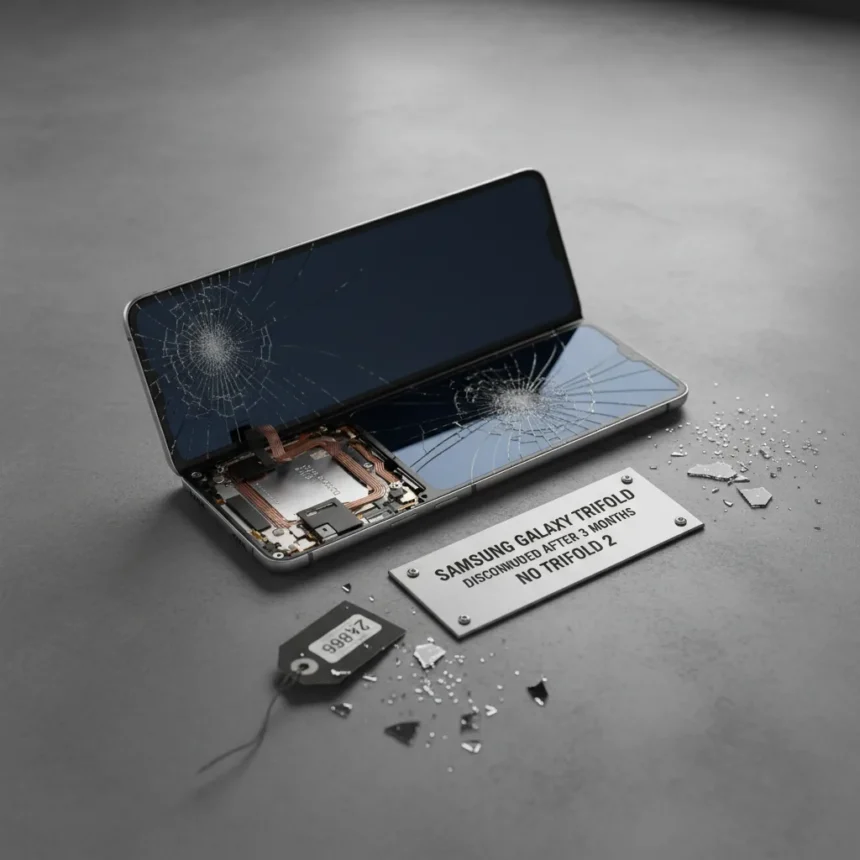
The Samsung Galaxy TriFold has been officially discontinued, less than three months after its South Korean launch in December 2025. The $2,899 tri-fold smartphone, which unfolded to a 10-inch tablet display across three inner sections, is being pulled from shelves in South Korea immediately, with the US and other markets following once remaining inventory clears. Samsung has no plans for a TriFold 2—the device was always positioned as a limited-edition technology proof-of-concept, not a production phone destined for the mainstream.
Key Takeaways
- Samsung Galaxy TriFold is discontinued after just 90 days, with no successor planned.
- The device cost $2,899 and featured a 10-inch unfolded display with two hinges and three inner sections.
- Production was severely limited: only a few thousand units released in batches every couple of weeks.
- High manufacturing costs due to custom OLED panels and complex hinges made the device unprofitable.
- Samsung prioritizes mass-market dual-fold phones over tri-folds for the foreseeable future.
Why Samsung Galaxy TriFold Failed So Quickly
The Samsung Galaxy TriFold was never designed to be a volume product. It was a limited-run technology demonstration—Samsung’s way of proving it could engineer a tri-fold mechanism before committing to mass production. The device featured two hinges, a 6.5-inch cover screen when closed, and unfolded to reveal three inner display sections that combined into a 10-inch tablet-sized screen with minimized creasing. The engineering was impressive. The business model was not.
Production constraints made scaling impossible. Samsung released the TriFold in small batches of just 3,000 to 6,000 units every couple of weeks in a handful of markets, including South Korea and the US. Every batch sold out within days, but the company never increased production runs—a telling sign that demand was never the real problem. The real problem was cost. High production expenses stemmed from custom OLED panel manufacturing, proprietary hinge mechanisms, additional memory requirements, and broader semiconductor price increases. Samsung sold the device at a loss or near-zero profit margin, making scaled production financially untenable.
According to Samsung’s statement to Bloomberg, the company will halt sales in South Korea first, then discontinue business in the US once it clears remaining inventory. As of March 17, 2026, the TriFold is already sold out online in most regions, with limited in-store stock remaining at select Samsung Experience Stores. No restocks are planned, and no regional expansions beyond South Korea and the US ever materialized.
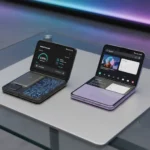

Samsung Galaxy TriFold vs. Dual-Fold Competitors
The TriFold’s discontinuation reflects Samsung’s strategic pivot back toward dual-fold technology. The Galaxy Z Fold series—Samsung’s established bi-fold lineup—already operates in a niche market with modest adoption compared to the standard Galaxy S series. Samsung aims for 7 million foldable units sold in 2026, a fraction of the 20.2 million Galaxy S25 phones the company shipped in the first half of the prior year. A tri-fold device at $2,899 with limited availability was never going to move the needle on those numbers.
Dual-fold phones like the Z Fold represent a more achievable middle ground between innovation and profitability. They use proven manufacturing processes, benefit from economies of scale, and carry lower price points than the TriFold. The tri-fold, by contrast, introduced novel engineering challenges that made every unit expensive and fragile to produce. Samsung’s decision to abandon the TriFold line suggests the company believes dual-fold technology is where the foldable market will grow—not tri-folds.



Will Samsung Ever Release a TriFold 2?
No. Samsung has explicitly stated that no TriFold 2 is in development. The original TriFold was positioned as a limited-edition technology demonstrator, not the first in a product line. Samsung engineered it to prove tri-fold capability, gather user feedback, and test manufacturing feasibility—not to establish a new product category. Now that Samsung has proven the concept works, the company has no commercial incentive to pursue a second generation.
The TriFold’s three-month lifespan was intentional. Samsung released enough units to satisfy early adopters and technology enthusiasts, collected data on real-world usage and reliability, and then exited the market before losses mounted further. This is a calculated retreat, not a failure. Samsung has successfully demonstrated that tri-fold phones are technically possible, which is valuable for the company’s long-term roadmap—even if it does not translate into a near-term product launch.
Expect Samsung to focus on refining dual-fold technology and reducing costs across its Z Fold and Z Flip lines. A tri-fold sequel, if it ever arrives, will be years away and only after dual-fold sales stabilize and manufacturing costs drop dramatically.
What Does This Mean for Foldable Phone Buyers?
If you managed to buy a Samsung Galaxy TriFold, you own a true limited-edition device—one of only a few thousand units that will ever exist. Resale value will likely remain high, given the scarcity and the device’s technological novelty. For everyone else, the TriFold’s discontinuation confirms that latest foldable technology remains expensive and niche. The mainstream smartphone market will continue to be dominated by conventional candy-bar designs and dual-fold variants for at least the next few years.


Can I still buy the Samsung Galaxy TriFold?
Not easily. The device is sold out online and only limited stock remains at select Samsung Experience Stores in markets like Texas and New York. Samsung will not restock or reorder—once existing inventory clears, the TriFold is gone for good. If you want one, check your nearest Samsung store immediately, or prepare to hunt the secondary market.
Why was the Samsung Galaxy TriFold so expensive?
The $2,899 price reflected the extreme engineering complexity and custom manufacturing required. The TriFold used a bespoke OLED display with three separate sections, proprietary dual-hinge mechanisms, and additional RAM to handle the massive unfolded screen. None of these components benefited from economies of scale. Add in semiconductor shortages and rising production costs across the industry, and Samsung had no path to profitability at lower price points.
The Samsung Galaxy TriFold’s swift discontinuation is not a surprise—it is a statement. Samsung proved tri-fold phones are possible, proved they are not profitable, and moved on. The real innovation now lies in making dual-fold phones cheaper and more reliable. That is where Samsung’s foldable future lives.
Where to Buy
Samsung Galaxy Z Fold 7£1,799£1,549ViewSee all prices
Edited by the All Things Geek team.
Source: T3




