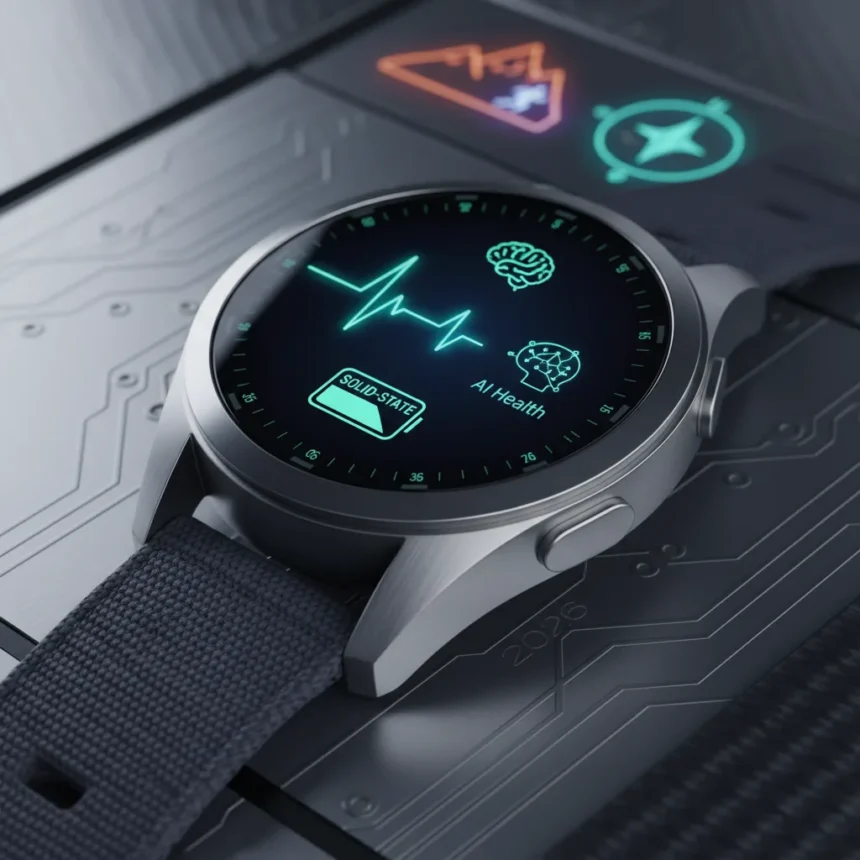
Samsung Galaxy Watch9 development has reportedly wrapped, and the device is now in testing ahead of a summer 2026 launch that could finally give Garmin real competition in the fitness-focused smartwatch space. The reason? Solid-state batteries that promise multi-day battery life—a capability that has eluded Samsung’s watches until now.
Key Takeaways
- Samsung Galaxy Watch9 development complete, expected July/August 2026 release alongside Galaxy Z Fold 8 and Z Flip 8.
- Solid-state batteries announced at CES 2025 promise higher energy density and multi-day battery life versus traditional one-day lithium-ion.
- Potential Snapdragon Wear Elite chipset would be Samsung’s first third-party processor, featuring dedicated Galaxy AI chip.
- Galaxy Watch9 includes 3-in-1 BioActive sensors (optical heart rate, electrical heart signal, bioelectrical impedance) plus temperature and antioxidant index tracking.
- Expected starting price around $349, with 40mm and 44mm aluminum options and always-on display capable of ~30 hours battery life.
Solid-State Batteries Transform the Samsung Galaxy Watch9 Formula
At CES 2025, Samsung Electro-Mechanics CEO Chang Duk Hyun revealed the company is developing solid-state batteries specifically designed for wearables, with mass production targeted for 2026 to align with the Samsung Galaxy Watch9 launch. This is not incremental progress—it is a fundamental shift in how Samsung’s watches handle power. Traditional lithium-ion batteries in current Galaxy Watch models deliver roughly one day of battery life. Solid-state batteries replace the liquid electrolyte with a solid material, enabling higher energy density in the same physical space. The result is multi-day battery life without requiring a larger, heavier watch.
This advancement directly addresses the single biggest complaint about Samsung’s recent watches: they drain faster than Garmin’s dedicated fitness trackers. Garmin’s strength has always been endurance—watches that run for weeks on a single charge. Samsung has prioritized features and display quality over battery longevity. Solid-state technology closes that gap without sacrificing the vibrant AMOLED screen that makes Samsung watches stand out. For fitness enthusiasts who want premium features without constantly hunting for a charger, this is the turning point.
Samsung Galaxy Watch9 Chipset Could Be a Historic First
Rumors suggest Samsung Galaxy Watch9 might ship with Qualcomm’s Snapdragon Wear Elite, marking the first time Samsung has used a third-party processor in a Galaxy Watch. The Snapdragon Wear Elite includes a dedicated Galaxy AI processor, promising faster animations and superior performance compared to Samsung’s historical Exynos W1000 chips. Whether Samsung opts for Snapdragon Wear Elite or sticks with an updated Exynos remains unclear—the company has not confirmed either path—but the very possibility signals that Samsung is willing to rethink its vertical integration strategy if it means delivering better performance.


A dedicated AI processor is not just marketing. Galaxy AI health monitoring features—detecting irregular heart rhythms, analyzing stress patterns, predicting fatigue—require real-time processing. Offloading that work to a dedicated chip keeps the main processor free for navigation, music, and notifications. It is the kind of architectural refinement that separates a feature-rich watch from a genuinely useful one.
Health Sensors Get a Serious Upgrade
The Samsung Galaxy Watch9 will feature a 3-in-1 BioActive sensor that combines optical heart rate monitoring, electrical heart signal detection, and bioelectrical impedance analysis—the same sensor architecture that made the Galaxy Watch8 a standout for health tracking. New additions include temperature sensing and an antioxidant index measurement, which tracks oxidative stress in the body. These are sensors Garmin does not offer on most of its mainstream sports watches, giving Samsung a qualitative edge in health-focused monitoring even if Garmin dominates raw battery endurance.



One UI Watch 9, based on Wear OS 7, will integrate Galaxy AI to synthesize data from these sensors into actionable insights. Rather than just displaying raw metrics, the software will contextualize them—alerting users when stress levels spike, when sleep debt accumulates, or when recovery is incomplete. This is where Samsung‘s ecosystem advantage becomes apparent: Garmin excels at tracking; Samsung excels at interpretation.
Expected Specs and Design Refinements
The Samsung Galaxy Watch9 is expected to arrive in 40mm and 44mm sizes with aluminum cases, continuing the material choice that made the Watch8 durable without feeling heavy. Display sizes should remain in the 1.34-inch to 1.47-inch range, though Samsung may refine the squircle design for slightly larger viewing areas without increasing physical dimensions. Connectivity will include LTE, Bluetooth, 5G, and WiFi 6, giving users options for standalone operation or tethering to their phone.
Fast charging is confirmed, and battery life with always-on display is projected at approximately 30 hours—a meaningful jump from current one-day estimates, though not quite matching Garmin’s week-long endurance. That 30-hour target assumes solid-state battery implementation reaches production quality on schedule. If Samsung can deliver even 24-36 hours with always-on display enabled, it solves the primary pain point that has driven fitness-conscious users toward Garmin despite Samsung’s superior software and design.
When Will Samsung Galaxy Watch9 Launch?
Samsung Galaxy Watch9 is expected to launch in summer 2026, specifically July or August, alongside the Galaxy Z Fold 8, Galaxy Z Flip 8, and Galaxy Watch Ultra 2. This aligns with Samsung’s annual release cadence and gives the company time to ramp solid-state battery production to scale. The standard Galaxy Watch9 is likely to start around $349, matching the Galaxy Watch8’s entry price, though Samsung may introduce higher-end variants with premium materials or expanded storage.



The Galaxy Watch Ultra 2, Samsung’s premium sports-focused variant, is slated for the same window with major enhancements after a longer development cycle. If Samsung commits significant resources to both models, the 2026 lineup could be its most competitive smartwatch generation yet.
Can Samsung Galaxy Watch9 Really Beat Garmin?
The framing of Samsung Galaxy Watch9 as a Garmin-beater hinges on one question: does fitness-focused functionality matter more than battery life? Garmin’s watches are unmatched for multi-week endurance and granular training metrics. They are built for ultramarathoners, triathletes, and outdoor adventurers who treat battery life as a non-negotiable feature. Samsung’s watches are built for users who want a premium daily driver that also tracks fitness. Solid-state batteries narrow the gap, but they do not erase the philosophical difference. A watch that runs 30 hours is not a week-long device. For casual fitness tracking and everyday health monitoring, Samsung Galaxy Watch9 will be superior. For serious athletes, Garmin retains the edge unless Samsung can push solid-state battery life beyond current projections.
Will the Galaxy Watch9 get Galaxy AI features?
Yes. One UI Watch 9 will integrate Galaxy AI for health monitoring, using the 3-in-1 BioActive sensor data to provide AI-driven insights about heart health, stress, and recovery patterns. The exact scope of features has not been detailed, but Samsung’s pattern suggests real-time anomaly detection and predictive alerts will be included.
How much will the Samsung Galaxy Watch9 cost?
Samsung Galaxy Watch9 is expected to start at approximately $349, matching the Galaxy Watch8’s entry price. Premium variants and cellular LTE models will likely cost more, but Samsung has not released official pricing.
What is the battery life improvement over Galaxy Watch8?
The Galaxy Watch8 delivers roughly one day of battery life. Samsung Galaxy Watch9 with solid-state batteries is projected to reach approximately 30 hours with always-on display enabled. This represents a meaningful improvement but falls short of Garmin’s multi-week endurance, positioning the Watch9 as a more practical daily-driver smartwatch rather than a true multi-week adventure device.
Samsung Galaxy Watch9 is shaping up to be the company’s most ambitious smartwatch in years. Solid-state batteries, potential chipset upgrades, and enhanced health sensors address the criticisms that have held Samsung back against Garmin. The device will not dethrone Garmin for serious athletes, but it will give Samsung credibility in the fitness space while maintaining the design and software quality that make its watches compelling for mainstream users. Summer 2026 cannot arrive soon enough.
Edited by the All Things Geek team.
Source: TechRadar