







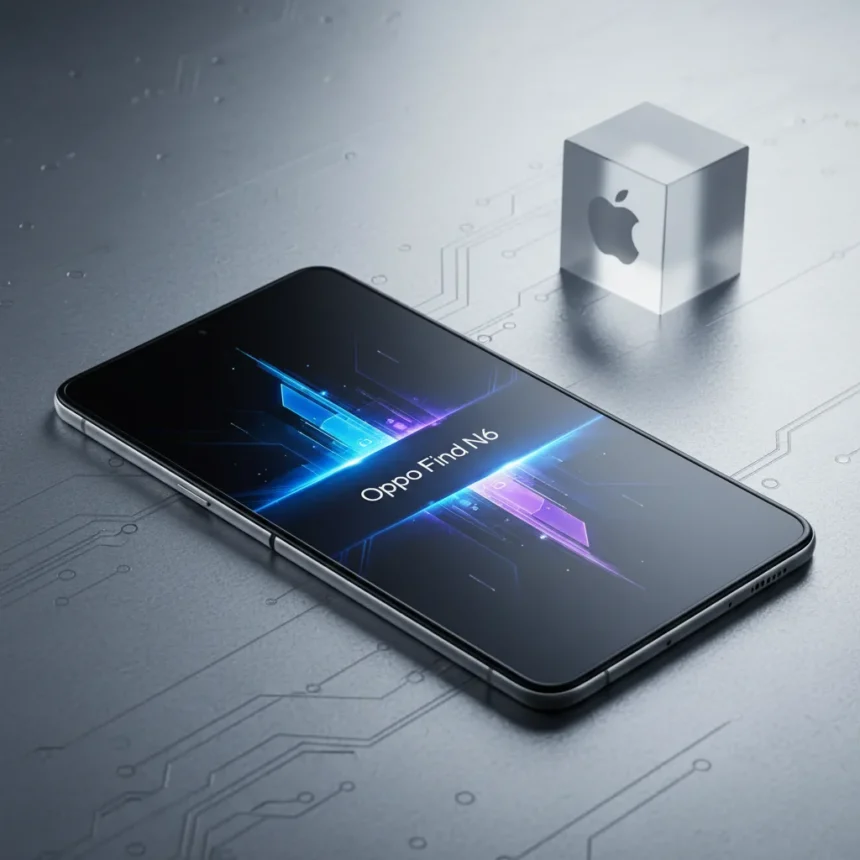
The Oppo Find N6 crease-free foldable phone has redefined what foldable design can achieve, and it’s forcing every competitor—especially Apple—to rethink their approach. The device claims to be the world’s first foldable with a “zero-feel” crease, and after hands-on testing, the claim holds up in real-world use. This is the benchmark the rumored iPhone Fold will need to clear if it wants to compete.
Key Takeaways
- Oppo Find N6 features a 0.05mm crease surface variation, barely noticeable to the touch
- Re-engineered hinge uses laser-scanned titanium parts and 3D-printed liquid polymer to eliminate micro-gaps
- Auto-Smoothing Flex Glass prevents long-term deformation and maintains crease invisibility
- Tested for 600,000 folds, matching durability of competing foldables
- Retains stylus support—a feature competitors have abandoned for thinner designs
Why the Crease Has Always Been Foldable’s Biggest Weakness
Since Samsung launched the Galaxy Z Fold in 2020, the crease has been the single most criticized aspect of foldable phones. It’s not just a visual line running down the center of the screen—it’s a tactile reminder that you’re holding a compromise. Swiping your finger across it feels wrong. Watching videos becomes an exercise in ignoring a permanent dividing line. When you hold a foldable next to a traditional phone, that crease screams “experimental technology,” not “mature product.” The Oppo Find N6 crease-free foldable addresses this head-on by rethinking the entire hinge architecture.
The inner crease has always been a major concern for potential foldable buyers, and for good reason. Previous foldables required a trade-off: you could have a thinner phone or a less visible crease, but not both. Oppo rejected that binary choice. By re-engineering the hinge system with laser-scanned titanium parts and 3D-printed liquid polymer filling micro-gaps, the company achieved a surface variation of just 0.05mm—barely noticeable to the touch. That’s not marketing hyperbole; it’s a measurable engineering achievement.
The Oppo Find N6 Crease-Free Foldable in Real Use
In real-world testing, the Oppo Find N6 crease-free foldable performs exactly as advertised. Most of the time, you won’t see or feel the crease at all. Swiping across the fold feels almost identical to swiping across a flat screen. Text doesn’t distort noticeably. Videos play without the line becoming a visual distraction. The difference only becomes apparent when you place it directly next to any other foldable—then the gap in engineering becomes immediately obvious.


The device also incorporates Auto-Smoothing Flex Glass, which prevents the long-term deformation that has plagued earlier foldables. Over time, repeated folding can cause the screen to develop permanent creases or wear patterns. Oppo’s solution addresses this durability concern, and the phone has been tested for up to 600,000 folds, putting it in line with competitors on longevity. In a sub-9mm body, Oppo also packed a 6000mAh battery and the Snapdragon 8 Elite Gen 5 processor, proving that crease innovation doesn’t require sacrificing other specifications.
What Sets This Apart From the Competition
Most foldable makers have chased thinness. Samsung, Google, and others have progressively slimmed their devices, accepting a more pronounced crease as the trade-off. Oppo took the opposite path: it prioritized the user experience of the fold itself. That philosophical difference shows in every detail. While competitors have discontinued stylus support in the name of thinner designs, the Oppo Find N6 crease-free foldable retains it—a feature that appeals to productivity users and content creators who value precision input.


The question now is whether Apple will follow Oppo’s blueprint when it finally releases the iPhone Fold. If Apple can replicate this engineering on its own device, it will have a genuine competitive advantage. Foldables have been a niche category partly because the crease remains an unresolved problem. Solve that problem, and the entire market dynamic shifts.
Does the Oppo Find N6 Crease-Free Foldable Justify Its Design Philosophy?
Yes. The Oppo Find N6 crease-free foldable proves that foldables don’t have to feel like compromises. By prioritizing the tactile and visual experience of the fold, Oppo has created a device that genuinely feels like the future of mobile design rather than a gimmick. The crease is still there—it’s not magic—but it’s been engineered to the point of near-irrelevance in daily use. That’s a meaningful achievement in a product category that has been defined by its flaws.
Will the iPhone Fold Need to Match This Crease Technology?
Almost certainly yes. Apple’s reputation depends on delivering a polished, refined product. If the iPhone Fold arrives with a noticeable crease while the Oppo Find N6 crease-free foldable has already solved the problem, Apple will face immediate criticism. Consumers have already seen that a better solution exists. The bar is set.
Why Does Stylus Support Matter on a Foldable?
Stylus input enables precise note-taking, digital art, and annotation tasks that touchscreen-only devices struggle with. By retaining stylus support while competitors dropped it, the Oppo Find N6 crease-free foldable appeals to professionals and creative users. It’s a feature that signals confidence in the form factor—Oppo is saying the foldable isn’t just a gimmick, it’s a legitimate productivity device.

The Oppo Find N6 crease-free foldable has raised the bar for foldable phone design. It’s not the thinnest, fastest, or most feature-packed foldable on the market. But it’s the first to genuinely solve the crease problem that has plagued the category since its inception. That achievement alone makes it the benchmark every competitor—including Apple—will be measured against.
Edited by the All Things Geek team.
Source: Tom's Guide




