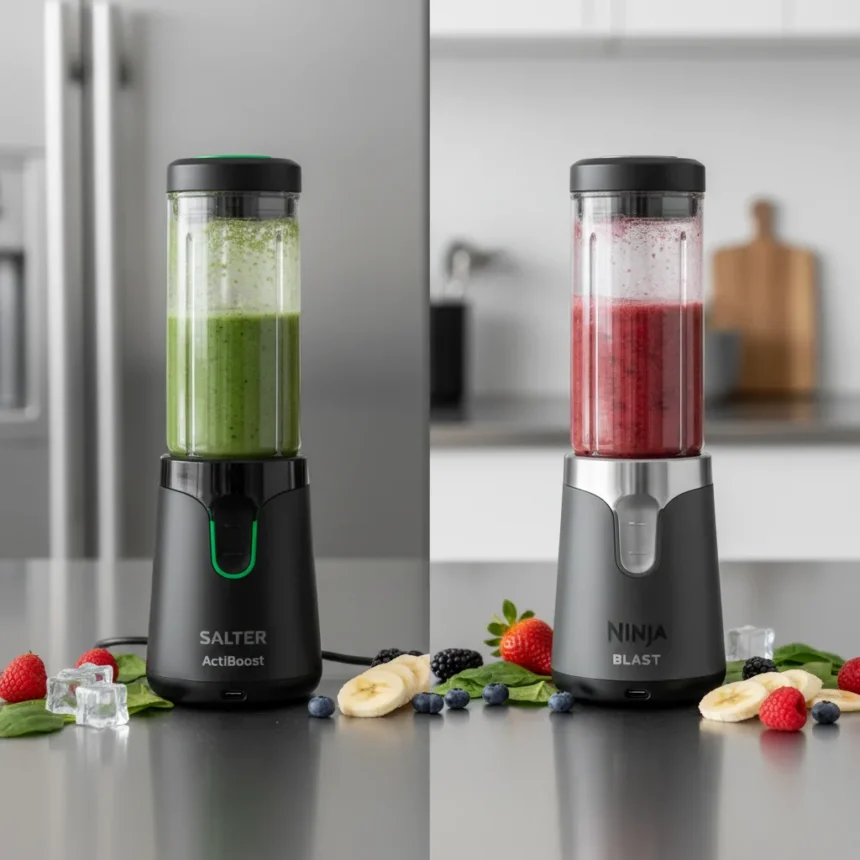
The Salter ActiBoost portable blender is a compact, affordable blending solution designed to challenge established premium brands in the portable blender market. Unlike traditional countertop models, portable blenders prioritize mobility and convenience, making them ideal for smoothies, protein shakes, and on-the-go blending. The ActiBoost enters a category dominated by the Ninja Blast, but at a significantly lower price point that questions whether you really need to spend premium money for portable blending power.
Key Takeaways
- Salter ActiBoost portable blender competes directly with Ninja Blast on performance and price.
- Budget portable blenders are becoming viable alternatives to premium-brand models.
- Salter’s entry into the portable blender space reflects growing demand for affordable kitchen appliances.
- The ActiBoost is positioned as part of Salter’s broader push into premium kitchen categories.
- Portable blenders suit smoothies, protein shakes, and travel use cases.
Why Salter ActiBoost Portable Blender Matters Right Now
The portable blender category has long been Ninja’s playground, with the Blast becoming the default choice for anyone wanting a compact, cordless option. Salter’s entry disrupts that monopoly by offering comparable functionality at a fraction of the cost. This is not just another budget kitchen gadget—it is a signal that affordable brands are willing to compete directly on performance rather than simply undercutting on features. For consumers tired of paying premium prices for portable convenience, the ActiBoost represents a genuine alternative worth considering.
The timing matters too. Kitchen appliance buyers are increasingly skeptical of brand-name markups. Salter has already proven this strategy works with its Kuro Actifusion blender, which T3 called the best value for money option available at £34.99. The ActiBoost appears to extend that philosophy into the portable category, where premium brands have historically had fewer affordable competitors.
Salter ActiBoost Portable Blender vs Ninja Blast
The Ninja Blast has dominated the portable blender conversation for years, largely because it delivers solid performance in a genuinely portable package. However, dominance does not mean there is no room for competition. The ActiBoost challenges this by offering powerful blending in a similarly compact form, but at a price that makes the Ninja option look expensive by comparison. Salter’s broader appliance strategy—which includes taking on Nutribullet and other established brands—suggests the company is serious about performance parity, not just undercutting.


Where the Ninja Blast has benefited from brand recognition and marketing spend, the ActiBoost must prove itself through raw capability and value. For consumers who care less about the logo and more about whether their smoothie actually blends properly, this is a meaningful shift in the market. The real question is not whether the ActiBoost is as good as the Ninja—it is whether it is good enough for the money, and early positioning suggests the answer is yes.
What Makes Portable Blenders Worth Buying
Portable blenders solve a specific problem: they let you blend anywhere without hunting for a power outlet or lugging a full-size appliance. This matters for people who travel, work in offices, or simply want blending convenience without the countertop footprint. Salter’s portable line targets smoothies and protein shakes, the two use cases that drive most portable blender purchases. Unlike full-size models that sit permanently on your counter, portable blenders live in bags, cars, or gym lockers.


The trade-off is always capacity and power. Portable models typically handle smaller batches and lighter blending tasks than their stationary cousins. But for daily smoothie making, that trade-off is acceptable—and increasingly, it is all many people actually need. Salter’s positioning in this space suggests the company believes there is a substantial audience willing to sacrifice some power for portability and price.
Salter’s Broader Kitchen Appliance Strategy
The ActiBoost is not Salter’s first move into premium kitchen categories. The company has already launched a new kitchen appliance range designed to compete across multiple categories, from blenders to other small appliances. This is a deliberate strategy to challenge Ninja, Nutribullet, and other established brands by offering comparable features at lower prices. Rather than staying in the budget-only lane, Salter is moving upmarket and bringing its price advantage with it.
This approach works only if products actually perform. T3’s assessment of Salter’s Kuro Actifusion blender—calling it the most affordable option on the market while still delivering value—suggests the company understands the balance between cost-cutting and capability. The ActiBoost extends that credibility into a new category where Salter has less brand history but potentially more room to disrupt.
Should You Buy the Salter ActiBoost Portable Blender?
If you want a portable blender and cannot justify premium pricing, the ActiBoost deserves serious consideration. It is not a luxury purchase or a status symbol—it is a tool designed to blend things efficiently and affordably. The real decision is whether you prefer paying for the Ninja brand name or whether you are willing to take a chance on Salter’s execution at a lower price. For most users making daily smoothies, that choice is straightforward.



The risk is minimal because Salter has already proven it can deliver value in the blender category. The ActiBoost is not an unknown quantity from an untested brand—it is an extension of a strategy that has already worked. That said, if you are deeply invested in Ninja’s ecosystem or simply prefer the brand, the price difference may not matter enough to switch. But for budget-conscious buyers, the ActiBoost removes the excuse to overpay.
Is the Salter ActiBoost portable blender worth the money?
Yes, if you need portable blending without premium pricing. Salter has demonstrated competence in the blender market, and the ActiBoost extends that capability to a category where affordable options have been scarce. You are not sacrificing quality for price—you are simply avoiding the brand-name markup that comes with Ninja and similar premium options.
How does the Salter ActiBoost compare to the Ninja Blast?
Both are portable blenders designed for smoothies and protein shakes. The Ninja Blast has brand recognition and a longer market presence. The Salter ActiBoost offers comparable functionality at a significantly lower price, making it a genuine alternative rather than a compromise option. The choice depends on whether you value the Ninja name or prefer to save money on a capable alternative.
What can you blend in a portable blender?
Portable blenders handle fruits, vegetables, powders, and liquids for smoothies, protein shakes, juices, and similar applications. They are less suited for heavy-duty tasks like nut butters or hot soups, but for everyday blending needs, they perform reliably. Capacity is typically smaller than full-size models, so batch sizes are limited.
The Salter ActiBoost portable blender signals a shift in the portable blending market. Budget brands are no longer content to occupy the discount tier—they are moving into categories where premium brands have dominated, and they are bringing genuine performance with them. For consumers who have waited for an affordable alternative to the Ninja Blast, that time has arrived. The question is no longer whether you should buy a portable blender, but whether you should overpay for the name on the box.
Where to Buy
Edited by the All Things Geek team.
Source: T3