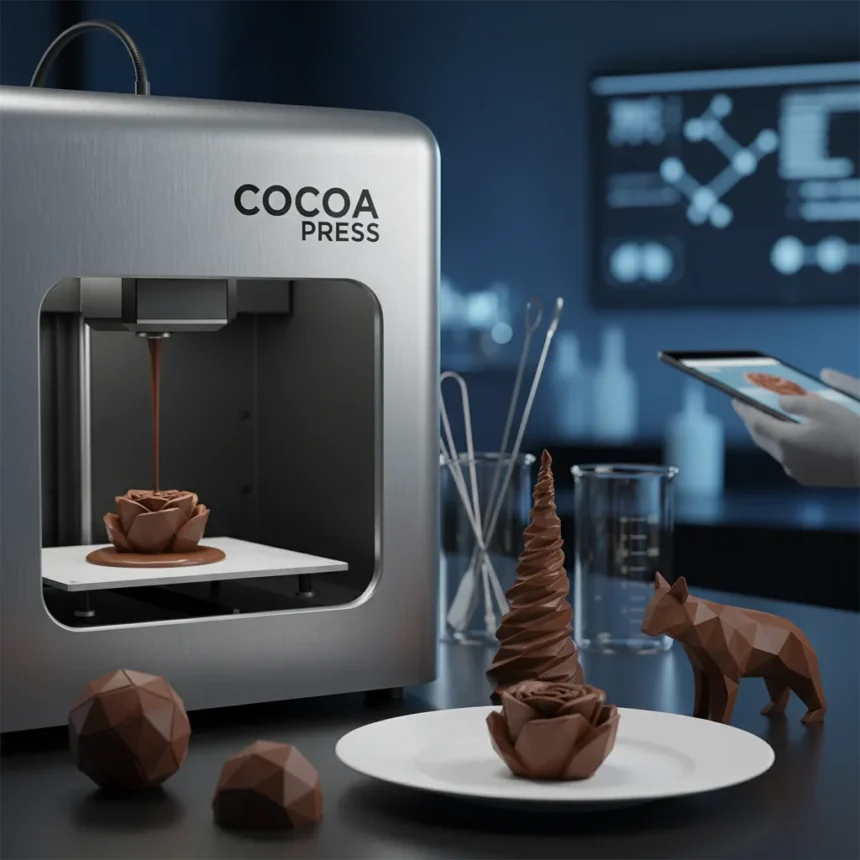
3D printing chocolate is no longer science fiction—it’s a specialized tool reshaping how professional chocolatiers approach their craft. The Cocoa Press represents a new category of equipment designed specifically for confectionery professionals who want to push beyond traditional molding and hand-crafting techniques.
Key Takeaways
- 3D printing chocolate enables chocolatiers to create intricate, custom designs impossible with conventional methods.
- Specialized machines like the Cocoa Press are built specifically for chocolate, not adapted from general-purpose 3D printers.
- The technology opens possibilities for personalized chocolate gifts, architectural designs, and artistic confectionery.
- Chocolate 3D printing represents a growing intersection of food technology and digital fabrication.
- The innovation appeals to high-end chocolatiers and pastry chefs seeking competitive differentiation.
What Is 3D Printing Chocolate?
3D printing chocolate involves using specialized machines to deposit melted or tempered chocolate layer by layer, building three-dimensional structures with precision that manual techniques cannot match. Unlike general-purpose 3D printers adapted for food use, machines like the Cocoa Press are engineered from the ground up to handle chocolate’s unique properties—its melting point, viscosity, and the need to maintain proper tempering throughout the printing process. This precision allows chocolatiers to create designs of extraordinary complexity: delicate lattice patterns, personalized engravings, architectural models, and artistic sculptures that would require hours of hand work or are simply impossible to achieve manually.
The appeal lies not just in novelty but in practical advantages. A chocolatier can translate a digital design directly into chocolate without the intermediate steps of mold-making or hand-sculpting. This reduces production time for custom orders and eliminates the constraint of existing mold inventory. For pastry chefs and confectionery artists, 3D printing chocolate represents a new creative medium—one that rewards digital design skills alongside traditional chocolate knowledge.
How the Cocoa Press Transforms Confectionery Work
The Cocoa Press is purpose-built for chocolate, which distinguishes it from general 3D printers repurposed for food. Chocolate demands precise temperature control to maintain its structure and appearance; too warm and it flows unpredictably, too cool and it clogs the nozzle. The Cocoa Press manages these variables automatically, allowing chocolatiers to focus on design rather than fighting the machine’s limitations. This specialization means faster iteration, more reliable results, and the ability to experiment with designs that would be too risky or time-consuming to attempt with manual methods.

The machine inspires confectionery innovation by lowering the barrier to custom production. A chocolatier can now offer personalized chocolate gifts, intricate wedding favors, or limited-edition designs without investing in custom molds or spending days on hand-work. This capability particularly appeals to high-end chocolate makers and pastry chefs who use customization as a competitive advantage. The technology also enables rapid prototyping—testing a new design in chocolate takes hours rather than days.
3D Printing Chocolate vs. Traditional Chocolate Crafting
Traditional chocolate work relies on hand-molding, hand-painting, and pre-made molds—techniques that require years of skill development and limit design complexity. A chocolatier can create beautiful work, but intricate geometric patterns, personalized text, or architectural details demand either custom molds (expensive and slow to produce) or painstaking hand-work. 3D printing chocolate bypasses these constraints entirely. A design that would take a skilled artisan four hours to execute by hand can emerge from the Cocoa Press in under an hour, with identical precision every time.



The trade-off is that 3D-printed chocolate requires digital design skills and familiarity with the machine itself. A traditional chocolatier trained purely in hand-work must learn CAD software or collaborate with a designer. However, this shift mirrors broader trends in craft industries—digital tools expand creative possibility rather than replace human skill. The chocolatier who masters both digital design and the Cocoa Press gains capabilities that pure hand-workers cannot match.
Why Chocolatiers Are Adopting 3D Printing Chocolate
The adoption of 3D printing chocolate reflects broader shifts in how luxury food is produced and marketed. Consumers increasingly seek personalization and storytelling in premium products—a chocolate bar with a custom name, a wedding favor with the couple’s initials, a sculpture that matches a client’s vision exactly. The Cocoa Press makes these requests economically viable. A one-off custom order that would be prohibitively expensive to hand-craft becomes feasible to produce on-demand.
Beyond personalization, the technology appeals to chocolatiers who view their work as art. 3D printing chocolate allows sculptural ambitions that traditional molding cannot support. An artist can design a chocolate sculpture with undercuts, internal details, and structural complexity that would collapse if cast in a mold. This creative freedom attracts confectionery professionals who see the machine as expanding their artistic vocabulary rather than replacing their craft.
Can You Use Any 3D Printer to Print Chocolate?
No—using a standard 3D printer designed for plastic or resin is inadvisable for chocolate. General-purpose 3D printers lack the temperature control, nozzle geometry, and material handling systems that chocolate demands. Chocolate melts at a lower temperature than most 3D printing materials, and it hardens differently. A standard printer’s heating elements and nozzles are not designed to manage chocolate’s viscosity or to maintain the tempering process that gives chocolate its snap and shine. Attempting to adapt a consumer 3D printer for chocolate typically results in failed prints, damaged equipment, or chocolate that lacks the proper crystalline structure.



Specialized machines like the Cocoa Press are engineered specifically for chocolate’s properties, which is why they cost significantly more than consumer 3D printers but deliver reliable results. This specialization is the reason 3D printing chocolate remained a niche capability until machines purpose-built for the task became available.
Is 3D printing chocolate expensive for small chocolatiers?
Yes, specialized chocolate 3D printers represent a significant capital investment, which limits adoption to established chocolatiers, pastry chefs at high-end restaurants, and confectionery businesses with sufficient order volume to justify the cost. Small home-based chocolate makers are unlikely to purchase such equipment. However, as the technology matures and more machines enter the market, prices may become more accessible. Some chocolatiers are exploring shared-equipment models or outsourcing 3D-printed chocolate components to specialized producers.
What designs work best for 3D printed chocolate?
Geometric patterns, personalized text, architectural models, and sculptural forms all translate well to 3D printing chocolate. Designs with fine details, undercuts, and internal complexity—elements that are difficult or impossible to achieve with traditional molding—showcase the technology’s strengths. Conversely, simple solid shapes may not justify the time and cost of 3D printing when traditional molding is faster and cheaper. The best use cases are custom orders, limited-edition pieces, and designs that demand precision or personalization.
3D printing chocolate represents a genuine shift in confectionery production, not a gimmick. For chocolatiers willing to invest in the technology and learn digital design, the Cocoa Press and similar machines unlock creative and commercial possibilities that traditional chocolate work cannot match. The question for the industry is not whether 3D printing chocolate will remain relevant, but how quickly the technology will move from luxury niche to standard practice in high-end confectionery.
Where to Buy
Elegoo Centauri Carbon 2 Combo | Creality K2 Pro
Edited by the All Things Geek team.
Source: Creativebloq