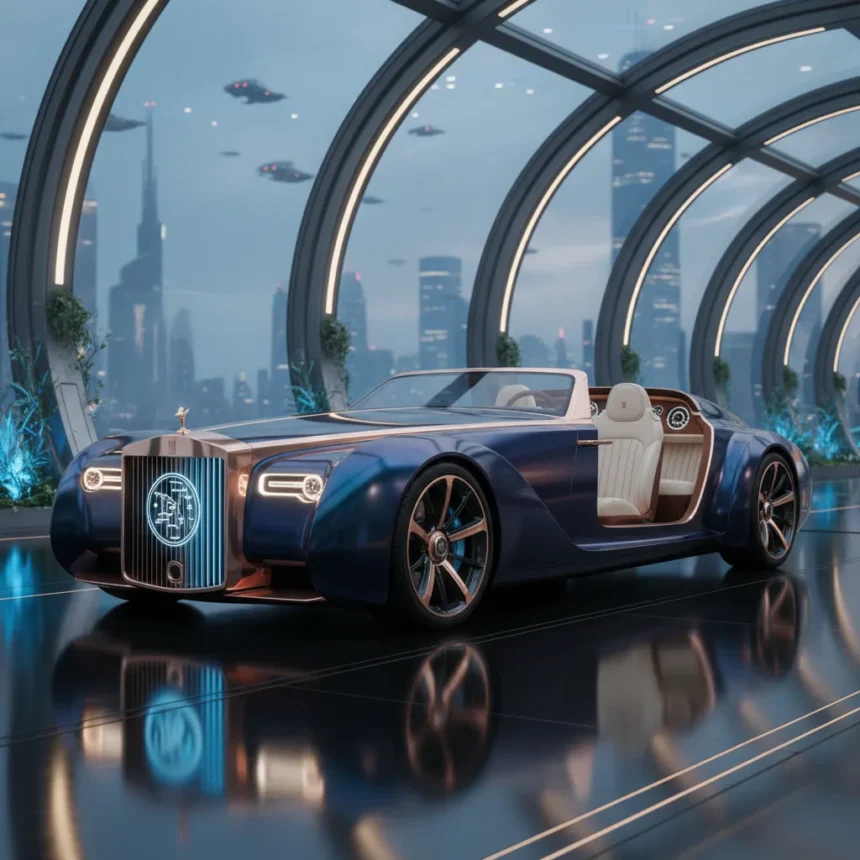
Project Nightingale Rolls-Royce represents the brand’s first venture into its new Coachbuild Collection, a two-seater all-electric vehicle that resurrects 1920s proportions while embracing zero-emission refinement. This is not a production car racing toward dealerships. It is a bespoke concept that signals how Rolls-Royce intends to marry its heritage with an electrified future, one handcrafted commission at a time.
Key Takeaways
- Project Nightingale is the debut of Rolls-Royce’s Coachbuild Collection, a new line of ultra-personalized electric vehicles.
- The design draws from 1920s aesthetics, featuring a monolithic body with smooth, unbroken surfacing and minimal creases.
- Named after Nightingale Road, the original Rolls-Royce factory site in Derby where the legendary Silver Ghost was manufactured from 1908 to 1939.
- The Coachbuild Collection emphasizes bespoke personalization, with clients collaborating on one-off designs rather than selecting from standard options.
- All-electric powertrain prioritizes silence and refinement over performance, aligning with Rolls-Royce’s luxury positioning.
The Heritage Behind the Name
Rolls-Royce did not choose the name Nightingale casually. The nameplate carries deep historical weight, rooted in the company’s Derby origins. Nightingale Road housed Rolls-Royce’s original factory, acquired in 1907, where motor car production began in 1908 and continued through 1939. This was where Henry Royce personally designed the factory layout and where the iconic Silver Ghost took shape. The connection runs deeper still: Royce later built a creative refuge on the French Riviera called Le Rossignol—the nightingale in French—near Villa Mimosa, a space where designers and engineers could think freely away from the factory floor. The naming was a deliberate homage, tethering this electric concept to a century of Rolls-Royce craftsmanship and innovation.
The Marble Hall, constructed on the Nightingale Road site in 1912, once served as the nerve center for critical company decisions and remains Grade II listed today. When Rolls-Royce decided to launch its Coachbuild Collection with an electric vehicle, resurrecting Nightingale as the name was both nostalgic and forward-looking—a statement that luxury does not abandon its roots when it embraces new technology.
Design Philosophy: Monolithic Elegance Meets Electric Architecture
Project Nightingale Rolls-Royce eschews the angular, aggressive forms that dominate modern electric vehicles. Instead, it presents a monolithic body—a single, unbroken sculptural form with smooth surfacing and minimal creases. This design language pulls directly from 1920s proportions, an era when automotive styling emphasized flowing lines and understated grandeur. The two-seater layout is deliberately intimate, rejecting the notion that luxury electric cars must be SUVs or sprawling sedans.

The all-electric powertrain enables a design freedom that combustion engines cannot match. Without a traditional engine compartment, designers gain unprecedented flexibility in proportioning the vehicle. Project Nightingale Rolls-Royce leverages this freedom to create what amounts to a rolling sculpture, where the absence of a grille and the low hum of electric motors allow for a cleaner, more harmonious visual narrative. The emphasis is not on performance metrics or acceleration figures—Rolls-Royce has never competed on those terms—but on the sensory experience of silence, smoothness, and the almost meditative quality of electric propulsion.
The Coachbuild Collection and Ultra-Personalization
Project Nightingale Rolls-Royce is the inaugural model in the Coachbuild Collection, a new program that fundamentally shifts how Rolls-Royce approaches customization. Rather than selecting options from a predetermined menu, Coachbuild clients collaborate directly with Rolls-Royce designers on one-off vehicles. Each commission becomes a bespoke creation, tailored to the client’s vision, aesthetic sensibilities, and lifestyle. This model harkens back to the early days of automotive craftsmanship, when wealthy patrons worked with coachbuilders to create singular works of art.



This ultra-personalization strategy distinguishes Project Nightingale Rolls-Royce from competitors like Pininfarina Battista or Aston Martin Valkyrie Spider, which emphasize performance and limited production runs. Rolls-Royce’s approach is deliberately non-performance-focused. There are no claims of sub-three-second acceleration or track-day capability. Instead, the Coachbuild Collection prioritizes refinement, exclusivity, and the collaborative design process itself. For clients seeking a vehicle that is truly theirs—not merely a configuration of available options—this represents a fundamental reimagining of luxury.
Electric Luxury Without Compromise
The all-electric powertrain of Project Nightingale Rolls-Royce is not a compromise or a grudging nod to environmental concerns. It is the foundation of the vehicle’s luxury proposition. Electric motors deliver power with absolute smoothness, eliminating vibration and the mechanical noise that has always been part of the driving experience. For a brand built on silence and refinement, electrification is a natural evolution, not a departure.
The two-seater configuration reinforces this philosophy. With only two occupants, the vehicle becomes an intimate experience—a conversation between driver and passenger rather than a multipurpose family hauler. The absence of a third row, rear cargo area, or utility focus means every design decision can prioritize the sensory experience of being inside the vehicle. This is luxury distilled to its essence: time, space, and the company of one other person, all moving in near-total silence.
Context Within Rolls-Royce’s Electric Future
Project Nightingale Rolls-Royce arrives as Rolls-Royce commits to full electrification by 2030. The brand already offers the Spectre, a production all-electric sedan that brings traditional Rolls-Royce values to a fully electric platform. However, Spectre is a volume offering—available to any client with sufficient wealth and patience for delivery. The Coachbuild Collection, by contrast, is for the ultra-elite who want not just a Rolls-Royce but a singular creation that no one else will own.



This two-tier strategy allows Rolls-Royce to serve both the expanding luxury EV market and the timeless appetite for bespoke, one-of-a-kind vehicles. Project Nightingale Rolls-Royce signals that the brand will not abandon craftsmanship or personalization in pursuit of volume. If anything, electrification enables deeper levels of customization by removing the constraints of traditional powertrains.
Why the Nightingale Name Matters Now
The timing of Project Nightingale Rolls-Royce is significant. The original Nightingale Road factory was demolished in 2011, and the site has since been redeveloped into housing. By naming this new electric concept after the factory, Rolls-Royce is creating a digital monument to its birthplace. The car becomes a tribute to over a century of heritage, even as the physical location has been erased from the Derby landscape. It is a way of saying that while factories can be demolished, the spirit of what was created there endures.
This is also a moment when luxury automotive brands are grappling with how to remain relevant as the industry electrifies. Some chase performance. Others chase sustainability credentials. Rolls-Royce, through Project Nightingale, chases something older and more durable: the idea that true luxury is about exclusivity, craftsmanship, and the privilege of owning something that reflects your individual taste and vision.
Is Project Nightingale Rolls-Royce actually a production car?
No. Project Nightingale Rolls-Royce is a concept vehicle and the inaugural example of the Coachbuild Collection. While it demonstrates the design language and philosophy of the new program, it is not a production model available for immediate order. Interested clients would work with Rolls-Royce’s Private Office to commission their own bespoke Coachbuild vehicle, with specifications and aesthetics tailored to their preferences.
How much will a Coachbuild vehicle cost?
Specific pricing for Project Nightingale Rolls-Royce or the Coachbuild Collection has not been disclosed. Coachbuild commissions are typically ultra-exclusive and priced well above standard production models, reflecting the bespoke design process and limited production. Interested parties would need to contact Rolls-Royce directly for commission details and pricing.
How does Project Nightingale Rolls-Royce compare to the Spectre?
Project Nightingale Rolls-Royce and the Spectre are both all-electric Rolls-Royces, but they serve different markets. The Spectre is a production sedan available to any qualified buyer, offering traditional Rolls-Royce luxury at scale. Project Nightingale Rolls-Royce is a bespoke, ultra-exclusive two-seater concept that prioritizes one-off personalization and design collaboration over production volume. Spectre is about accessibility within the ultra-luxury segment; Coachbuild is about absolute uniqueness.
Project Nightingale Rolls-Royce represents a bold statement: that electrification need not erase heritage, that luxury is not diminished by silence, and that the future of ultra-premium motoring belongs to those willing to collaborate with craftspeople on vehicles that are truly singular. For Rolls-Royce, it is a reminder that the brand’s greatest strength has never been performance or innovation in the technical sense—it has always been the ability to create machines that transcend transportation and become expressions of individual taste and timeless elegance.
Where to Buy
Edited by the All Things Geek team.
Source: T3