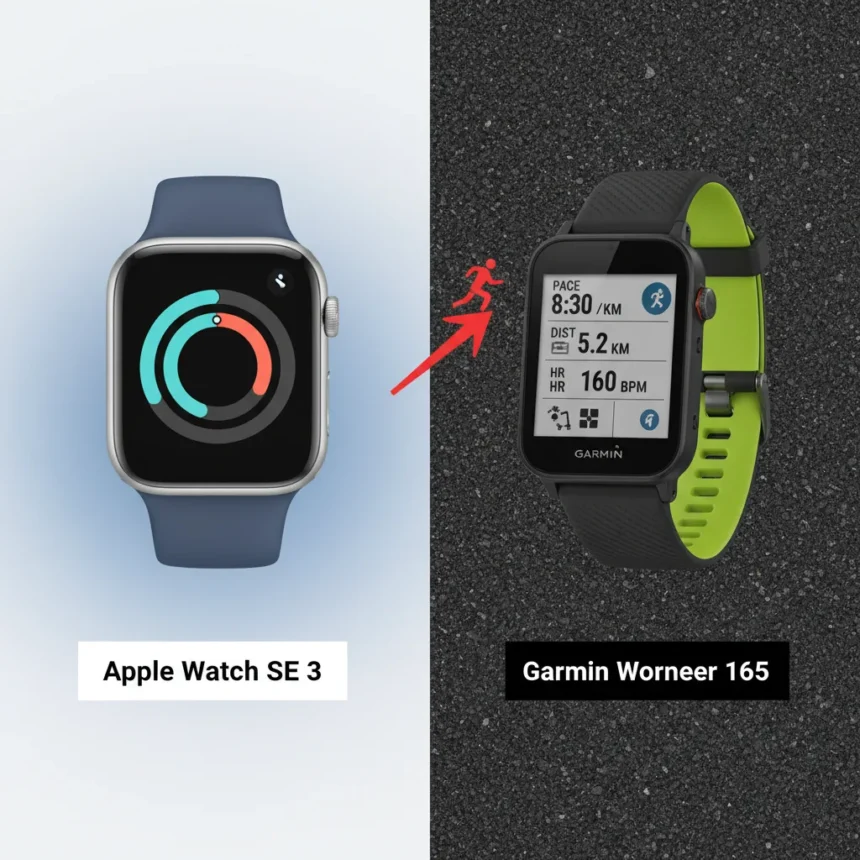
The Apple Watch SE 3 vs Garmin Forerunner 165 debate comes down to one question: do you care more about daily smarts or serious training? Both watches start around $250, but they serve fundamentally different runners and casual users. The Apple Watch SE 3 is a rectangular aluminum smartwatch with a 1.2-inch LTPO OLED display, weighing 26 grams, while the Garmin Forerunner 165 is a circular AMOLED watch at 39 grams with a slightly sharper 460 ppi screen. On paper, they look like equals. In real-world testing, they are not.
Key Takeaways
- Garmin Forerunner 165 lasts 11 days on a charge; Apple Watch SE 3 manages 18 hours in real-world use
- Forerunner 165 outperformed Apple Watch SE by roughly 100 feet in elevation gain accuracy on a 9-mile hike
- SE 3 excels for iPhone users with Siri, Apple Pay, and ecosystem integration; Forerunner 165 targets athletes with training load analysis
- Both watches include GPS, heart rate monitoring, sleep tracking, and multi-sport modes
- Forerunner 165 offers body battery monitoring and recovery insights; SE 3 focuses on daily activity and fall detection
Battery Life Decides the Winner for Most Users
This is where Apple Watch SE 3 vs Garmin Forerunner 165 splits into two categories entirely. The Forerunner 165 delivers up to 11 days of battery life, meaning you charge it once a week. The Apple Watch SE 3 tops out at 25 hours in Apple’s lab testing, but real-world use drops that to around 18 hours. That means daily charging for the SE 3, versus weekly for Garmin. For travelers, outdoor enthusiasts, and athletes on multi-day trips, this difference is not trivial—the Forerunner 165 simply does not die on you.
Apple’s always-on LTPO OLED display is beautiful, but it drains the battery faster than Garmin’s AMOLED approach. If you hate charging your watch every night, Garmin wins outright. If you like waking up to see your watch face glowing on your nightstand, Apple’s trade-off might feel worth it.
GPS Accuracy: Garmin Outperforms Apple in the Field
Real-world testing reveals a critical gap in Apple Watch SE 3 vs Garmin Forerunner 165 accuracy. During a 9-mile hike, the Forerunner 165 measured distance and elevation gain nearly identically to a Pixel Watch 3, while the Apple Watch SE 3 underreported both by roughly 100 feet of elevation. On an 18-mile bike ride, the Forerunner 165 captured elevation gain accurately without the drift that plagued Apple’s sensor suite.


Both watches include GPS with A-GPS, but Garmin’s multi-constellation approach—adding Galileo and Glonass satellites—gives it a significant advantage in dense forests, canyons, and urban areas where single-system GPS struggles. For trail runners and hikers who rely on accurate distance and elevation data to train or navigate, this is not a minor detail. It is the difference between knowing your actual climb and guessing.
Fitness Features: Garmin Dominates Training, Apple Dominates Integration
The Apple Watch SE 3 vs Garmin Forerunner 165 fitness showdown reveals why these watches appeal to different athletes. The Forerunner 165 includes training load analysis, recovery insights, body battery monitoring, exercise tagging, and stroke counting for swimming. These are tools built by a company that has spent two decades obsessing over endurance sports. If you are training for a marathon or triathlon, the Forerunner 165 tells you when you are overtraining, how recovered you are, and what your body can handle.



The Apple Watch SE 3 offers auto activity detection, multi-sport mode, and elevation tracking, but lacks the recovery-focused intelligence that serious athletes crave. Where the SE 3 shines is in iOS ecosystem integration. It works smoothly with Apple Fitness+, Health app data, and Siri voice commands for quick workout starts. For casual iPhone users who want a watch that tracks their daily walks and occasional gym sessions, the SE 3 is more natural. For runners obsessing over training metrics, Garmin is the only choice.
Daily Smarts and Safety: Apple Owns This Category
The Apple Watch SE 3 includes fall detection, irregular heart rate warnings, and voice commands that work flawlessly with Siri. You can pay with Apple Pay, reply to messages, and control your iPhone without pulling it out of your pocket. The Garmin Forerunner 165 offers vibrating alerts and basic notifications, but it is not designed for the daily assistant role that Apple perfected.
For iPhone users deeply embedded in Apple’s ecosystem, the SE 3’s integration feels more natural for daily tasks beyond workouts. For Android users or those who do not need smartwatch notifications, Garmin’s focus on fitness over features is refreshing. This is where the watches truly diverge: Apple is a lifestyle device that happens to track fitness, while Garmin is a fitness device that happens to tell time.
Design: Different Philosophies
The Apple Watch SE 3 is rectangular with a flat aluminum body and silicon strap, measuring 40 x 34 x 10.7 mm and weighing just 26 grams. It looks like a tiny iPhone on your wrist. The Garmin Forerunner 165 is circular at 43 x 43 x 11.6 mm, weighing 39 grams, with a more traditional watch aesthetic. Neither design is objectively better—it is personal preference. The Forerunner 165 looks more like a sports watch. The SE 3 looks more like a tech gadget. Pick the one that matches your wrist and style.



Which Should You Buy?
Choose the Apple Watch SE 3 if you are an iPhone user who wants a smartwatch that handles daily tasks, notifications, and casual fitness tracking without thinking about it. Choose the Garmin Forerunner 165 if you are a runner, triathlete, or hiker who demands accurate GPS, weeks of battery life, and training insights that actually help you improve.
Does the Apple Watch SE 3 work with Android?
No. The Apple Watch SE 3 requires an iPhone to function. It will not pair with Android devices. If you use Android, the Garmin Forerunner 165 is compatible with both iOS and Android, making it the only choice for Android users.
How accurate is the Garmin Forerunner 165 GPS?
The Forerunner 165 uses GPS with A-GPS, Galileo, and Glonass satellite systems, delivering accurate distance and elevation measurements in real-world testing. On a 9-mile hike, it matched a Pixel Watch 3 closely and outperformed the Apple Watch SE 3 by roughly 100 feet of elevation.
Can the Apple Watch SE 3 track multiple sports?
Yes. The Apple Watch SE 3 includes multi-sport mode and auto activity detection, allowing you to track running, cycling, swimming, and other activities. However, it lacks the advanced training analytics and recovery insights that the Garmin Forerunner 165 offers.
The Apple Watch SE 3 vs Garmin Forerunner 165 choice ultimately depends on your priorities. If you live in Apple’s ecosystem and value daily integration, the SE 3 is solid. If you are a serious athlete who wants accurate data and a watch that lasts a week, Garmin is the clear winner. Neither is a bad buy at $250—they just serve different people.
Edited by the All Things Geek team.
Source: Tom's Guide