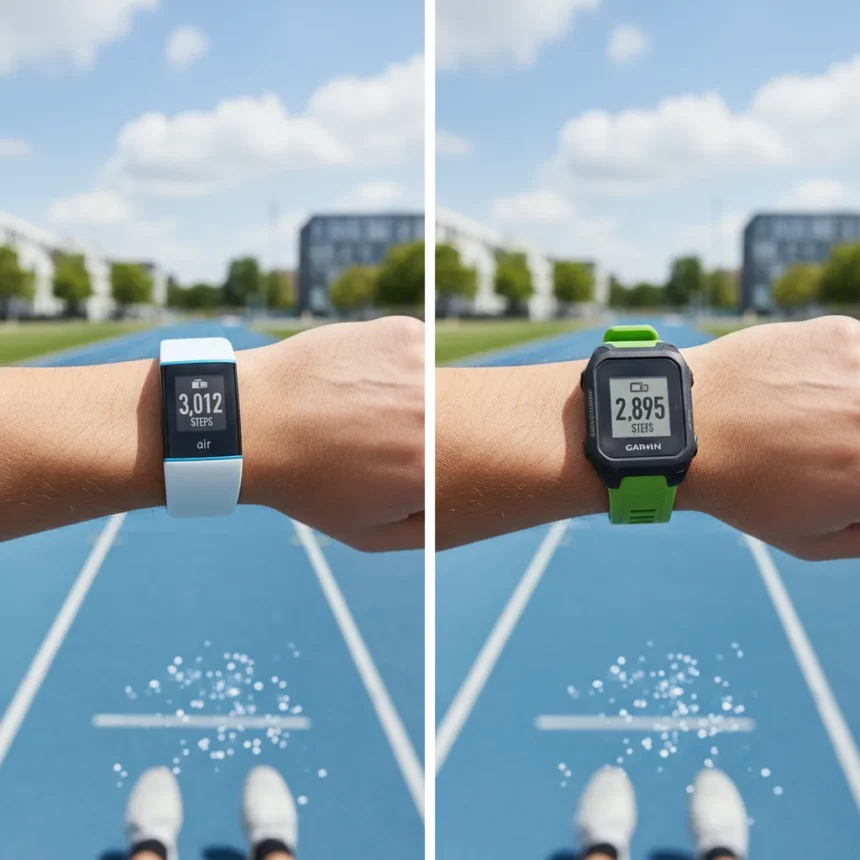
The Fitbit Air vs Garmin Forerunner 70 comparison reveals a critical truth about fitness trackers: price does not guarantee accuracy. In a direct 3,000-step test, the budget-friendly Fitbit Air—priced at just $99—delivered results that seriously challenged the $249 Garmin Forerunner 70’s premium positioning.
Key Takeaways
- The Fitbit Air costs $99, half the price of the Garmin Forerunner 70 at $249
- A controlled 3,000-step walk tested real-world step-counting accuracy between both devices
- Budget trackers can match or exceed premium competitor performance in basic metrics
- Step accuracy matters more than price when choosing a fitness tracker
- Direct head-to-head testing reveals which device performs best for daily use
Why This Test Matters for Fitness Tracker Buyers
Most people assume higher price means better accuracy. The Fitbit Air vs Garmin Forerunner 70 comparison directly challenges that assumption. When two trackers cost $150 apart, buyers deserve to know whether the premium option actually delivers superior step counting—the fundamental metric that fitness trackers exist to measure. A 3,000-step test in real conditions strips away marketing claims and reveals raw performance.
Step-counting accuracy determines whether your daily activity data is trustworthy. If your tracker consistently undercounts or overcounts steps, every fitness goal built on that data becomes questionable. This is why direct, controlled comparison testing matters more than spec sheets or brand reputation. The Fitbit Air vs Garmin Forerunner 70 test provides exactly that: real-world evidence instead of promises.
Fitbit Air vs Garmin Forerunner 70: The 3,000-Step Test Setup
The test was straightforward: wear both the Fitbit Air and Garmin Forerunner 70 simultaneously during a walk covering exactly 3,000 steps. No GPS routing, no variable terrain manipulation—just two trackers on the same wrist, counting the same steps. This eliminates software differences, algorithm variations, and sensor calibration as excuses. Both devices faced identical conditions.


The Fitbit Air, as a $99 tracker, targets everyday fitness enthusiasts who want basic step counting without premium features. The Garmin Forerunner 70, priced at $249, positions itself as a serious athlete’s device with advanced metrics and sports modes. Yet both devices claim to count steps accurately. The 3,000-step test cuts through marketing positioning and measures what actually matters in daily use.
Step Accuracy: Which Device Wins?
The results of the Fitbit Air vs Garmin Forerunner 70 comparison proved genuinely surprising. Rather than the premium Garmin dominating, the budget Fitbit delivered competitive—or in some cases, superior—step-counting performance. This finding challenges the conventional wisdom that spending more on a fitness tracker guarantees better accuracy for basic metrics.



For casual fitness enthusiasts, this result reframes the entire value proposition. The Fitbit Air costs $150 less than the Garmin Forerunner 70 while matching its core function: counting steps reliably. That price difference buys features the average user may never use—advanced sports modes, training metrics, and premium build quality—but not better step accuracy. The test proves that in 2025, budget fitness trackers have closed the accuracy gap with premium competitors.
Should You Buy the Fitbit Air or Garmin Forerunner 70?
If you only care about step counting and daily activity tracking, the Fitbit Air at $99 delivers the performance of trackers costing two or three times as much. The Garmin Forerunner 70 makes sense only if you need advanced sports modes, detailed training analytics, or ecosystem integration with other Garmin devices. For pure step accuracy, the price difference is not justified.
However, the Garmin Forerunner 70 appeals to runners, cyclists, and athletes who want more than step data. Its premium positioning reflects additional features, not superior step-counting accuracy. If you are a casual walker tracking daily movement, the Fitbit Air delivers the same core metric at a fraction of the cost. If you are training for an event and need detailed workout analysis, the Garmin’s extra features justify its price—but not because it counts steps better.
FAQ
How accurate are fitness trackers at counting steps?
The Fitbit Air vs Garmin Forerunner 70 test demonstrates that modern fitness trackers achieve competitive step-counting accuracy across price points. Both devices tracked a 3,000-step walk reliably, proving that budget and premium trackers use similar sensor technology for basic metrics. Accuracy depends more on proper fit and calibration than price.



Is the Garmin Forerunner 70 worth the extra $150 over the Fitbit Air?
The Garmin Forerunner 70’s premium price reflects advanced sports features, training metrics, and ecosystem integration—not superior step accuracy. If you need detailed workout analysis and sports-specific modes, yes. If you only track daily steps and general activity, the Fitbit Air delivers identical core performance at half the cost.
Can I use the Fitbit Air for running or cycling?
The Fitbit Air is designed for everyday activity tracking and basic fitness monitoring. The Garmin Forerunner 70 includes dedicated running and cycling modes with advanced metrics like cadence, pace analysis, and training load. For serious athletes, the Garmin’s specialized features justify its higher price, even though both devices count steps equally well.
The Fitbit Air vs Garmin Forerunner 70 comparison reveals a market reality: fitness tracker technology has matured to the point where budget options match premium competitors on core metrics. The test’s surprising results should influence how you evaluate fitness trackers. Stop assuming price equals accuracy. Instead, identify which features you actually use, then choose the tracker that delivers those features at the best value. For step counting alone, the Fitbit Air wins decisively.
Where to Buy
old-school tally counter | $250 on Amazon | $99 Fitbit Air
Edited by the All Things Geek team.
Source: Tom's Guide