





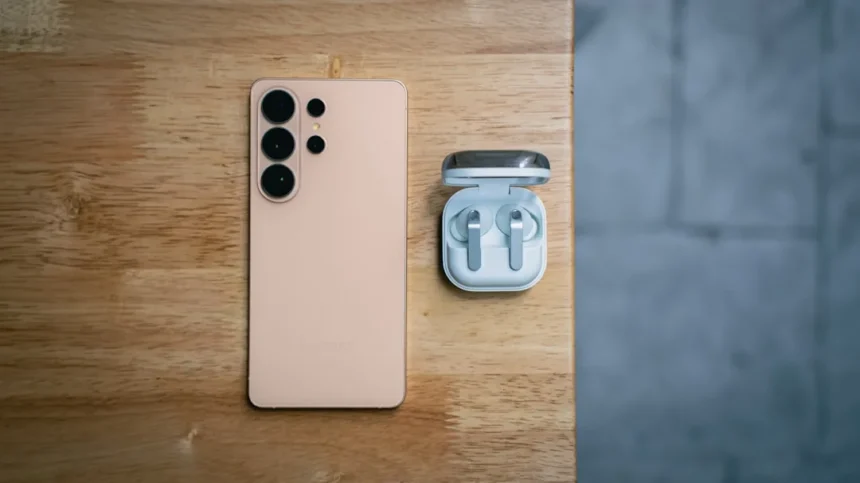
The Galaxy S26 Ultra is Samsung’s clearest statement yet that the smartphone industry is moving away from raw processing power toward AI-first architecture. Launched at Samsung Unpacked 2026, the device pairs a customized Snapdragon 8 Elite Gen 5 processor with a 6.9-inch Dynamic LTPO AMOLED 2X display, 12GB or 16GB RAM, and a 5,000mAh battery—but the real story is what Samsung prioritizes and what it downplays.
Key Takeaways
- Snapdragon 8 Elite Gen 5 customized for Galaxy delivers 39% faster AI performance versus the S25 Ultra
- World’s first mobile Privacy Display shields on-screen content from side viewing angles
- 6.9-inch QHD+ display reaches 2,600 nits peak brightness with Corning Gorilla Armor 2 protection
- 200MP main camera with f/1.4 aperture and 0.6µm sensor handles detail at scale
- Largest Vapor Chamber yet improves thermal management for sustained AI workloads
Galaxy S26 Ultra: AI performance gains dwarf CPU improvements
The processor upgrade tells you everything about Samsung’s direction. The Galaxy S26 Ultra’s NPU (neural processing unit) runs 39% faster than the S25 Ultra’s, while the GPU improves 24% and the CPU only 19%. That hierarchy is intentional. Samsung is betting that AI workloads—image generation, voice processing, on-device reasoning—matter more than marginal gains in raw compute. The Snapdragon 8 Elite Gen 5 is a custom silicon variant built specifically for Galaxy, not a generic Qualcomm chip. That customization targets AI inference, not gaming or video encoding, which is where most flagships traditionally compete.
This approach differs sharply from the Galaxy S26 and S26+, which use the Exynos 2600 processor in non-Ultra markets. The Ultra model’s Snapdragon exclusivity signals that Samsung reserves its premium tier for AI-forward users who want the fastest neural processing available. It is a gamble—consumers still care about camera speed, app load times, and gaming—but it reflects where the company believes the market is heading.
Privacy Display and thermal management reshape the feature set
Two hardware innovations stand out as less obvious but more consequential than spec sheets suggest. The Privacy Display is the world’s first on mobile. It shields the screen content from side viewing angles, addressing a genuine privacy concern that traditional displays ignore. You can hold the phone at an angle without worrying that someone beside you sees your banking app or email. This is not a gimmick—it is a category-first feature that competitors will chase.


The thermal management story is equally telling. The Galaxy S26 Ultra houses the largest Vapor Chamber Samsung has ever fit into a phone. Vapor Chambers dissipate heat far more efficiently than traditional copper heat pipes, which matters enormously when running sustained AI inference tasks. Gaming and video editing generate heat in bursts; AI workloads can run continuously. By investing in cooling infrastructure, Samsung signals that it expects users to run demanding on-device AI features for extended periods. The 5,000mAh battery supports this with 31 hours of video playback and 60W wired charging that reaches 75% in roughly 30 minutes.
Display and camera: excellence without revolution
The 6.9-inch Dynamic LTPO AMOLED 2X screen hits the benchmarks you would expect from a 2026 flagship: QHD+ resolution (1440 x 3120 pixels), 505 PPI, 1-120Hz adaptive refresh, and peak brightness of 2,600 nits. Corning Gorilla Armor 2 protection adds durability. These numbers are competitive but not groundbreaking—the Galaxy S26+ matches the resolution and refresh rate on a 6.7-inch panel. The Privacy Display feature is what sets the Ultra apart, not raw brightness or pixel density.


The camera system leans on megapixel count and aperture rather than computational innovation. The 200MP main sensor with f/1.4 aperture and 0.6µm pixel size captures enormous detail, paired with optical image stabilization. A 50MP ultra-wide, 50MP telephoto, and 10MP 3x telephoto round out the rear, with a 12MP front-facing camera. Samsung calls this the ProVisual Engine, though the brief provides no independent testing of image quality or processing speed. Without hands-on review data, it is difficult to assess whether the megapixel jump translates to meaningful real-world improvement over the S25 Ultra.
How does the Galaxy S26 Ultra compare to the S26 and S26+?
The Ultra model’s Snapdragon 8 Elite Gen 5 is exclusive to the top tier. The standard S26 uses a 6.3-inch display, weighs 167g, and relies on the Exynos 2600 in most markets. The S26+ splits the difference with a 6.7-inch screen, 12GB RAM, and the same Exynos chip. If you need the fastest AI performance and Privacy Display, the Ultra is the only choice. If you prioritize thinness, the S26+ measures 7.3mm thick versus the Ultra’s 7.9mm. The Ultra’s larger Vapor Chamber and customized processor justify the premium for AI-heavy workloads, but the S26+ is the smarter choice for most users.
Is the Galaxy S26 Ultra worth buying in 2026?
The Galaxy S26 Ultra makes sense if you care about on-device AI performance and privacy features. The 39% NPU boost and Privacy Display are category-leading innovations that justify the price premium over the S26+. The design is mature, the battery is solid, and the thermal management is thoughtful. However, the camera and display are excellent but not revolutionary—if you own an S25 Ultra, the GPU and CPU gains alone do not warrant upgrading.
Does the Galaxy S26 Ultra have a stylus?
Yes. The Galaxy S26 Ultra includes a built-in S Pen, making it the only smartphone in Samsung’s 2026 lineup with integrated stylus support. This feature appeals to productivity users and digital artists but adds no weight advantage over the S26+.


The Galaxy S26 Ultra represents Samsung’s clearest pivot toward AI-first mobile design. The customized Snapdragon processor, Privacy Display, and oversized Vapor Chamber all point toward a future where on-device intelligence matters more than benchmark scores. Whether that future arrives depends on whether developers build compelling AI features that justify the hardware investment—and whether users actually want them. For now, the Ultra is a well-executed flagship that bets on a direction the industry is only beginning to explore.
Where to Buy
Edited by the All Things Geek team.
Source: Android Central




