






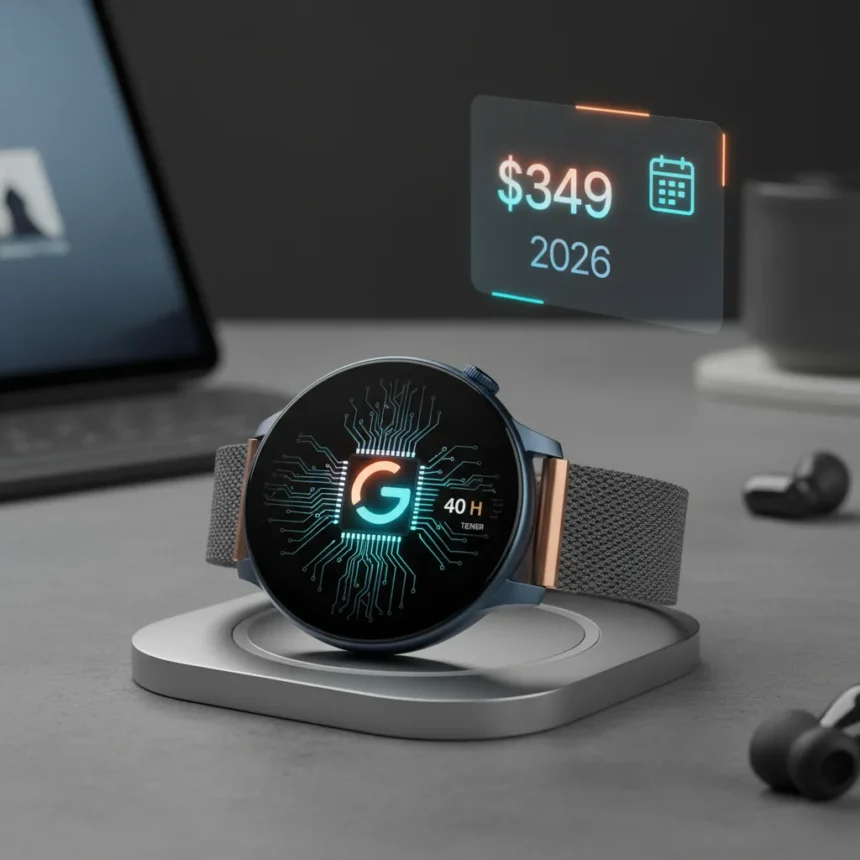
Google Pixel Watch 5 rumors are intensifying as we approach late 2026, with leaks suggesting the company is preparing a significant upgrade to its wearable lineup. The next-generation smartwatch is expected to ditch Qualcomm’s Snapdragon chip in favor of a custom in-house Tensor processor, marking Google’s most ambitious push into wearable silicon to date.
Key Takeaways
- Google Pixel Watch 5 expected to launch in late 2026 with custom Tensor chip codenamed NPT
- Battery life estimated at 40 hours (45mm) or 30 hours (41mm) with fast 15-minute charging to 50%
- Starting price projected at $349 with 32GB storage standard
- Display brightness could reach 3,000 nits, up from current generation
- Advanced AI fitness features and improved Fitbit integration anticipated
Google Pixel Watch 5 Specs and Performance
The Google Pixel Watch 5 will reportedly feature a custom Tensor chip codenamed NPT, replacing the Snapdragon W5 Plus Gen 1 found in the Pixel Watch 3. This move mirrors Google’s broader strategy of controlling its hardware stack, similar to what the company has done with Pixel phones. The custom chip is expected to deliver better power efficiency and enable tighter integration with Google’s AI services, particularly for on-device fitness tracking and health analytics through Fitbit.
Storage capacity appears locked at 32GB, a practical increase for users who store music and workout data locally. The display is rumored to reach 3,000 nits of brightness, a substantial jump that would make the watch far more readable in direct sunlight compared to current smartwatches. Charging speed has also been optimized—reaching 0 to 50% charge in just 15 minutes represents a meaningful quality-of-life improvement for daily users.
Battery Life and Charging Speed
Battery endurance is where the Google Pixel Watch 5 makes its strongest case against competitors. The 45mm model is expected to deliver up to 40 hours of battery life, while the smaller 41mm version targets 30 hours. These figures, if accurate, would significantly outpace the current Pixel Watch 3 and rival the Galaxy Watch 8’s multi-day performance claims. Fast charging to 50% in 15 minutes means users can grab a quick top-up before leaving home without waiting for a full charge cycle.


For context, current-generation smartwatches typically manage two to three days of continuous use. The Google Pixel Watch 5’s projected battery life would genuinely change how users interact with wearables—less frequent charging anxiety, more reliable all-day tracking, and less dependence on charging docks during travel.
Price and Availability
The Google Pixel Watch 5 is expected to start at $349, matching the pricing strategy of its predecessor. This positions it competitively against Samsung’s Galaxy Watch lineup while maintaining Google’s premium positioning in the smartwatch market. A late 2026 launch window, likely October, aligns with Google’s typical hardware announcement schedule and gives the company time to refine WearOS 5, the operating system expected to power the device.


The timing also suggests Google will have several months to optimize the custom Tensor chip for wearable workloads before mass production. This is critical—rushing a custom processor to market is a recipe for thermal throttling, battery drain, and software instability. Google’s measured approach here suggests confidence in the design, though real-world performance will be the true test.
AI and Fitness Features
The Google Pixel Watch 5 is anticipated to introduce advanced AI-powered fitness capabilities, leveraging tighter integration with Fitbit’s health tracking infrastructure. Google acquired Fitbit in 2021 and has been gradually merging its health platform with Wear OS. The custom Tensor chip enables on-device machine learning for workout recognition, heart rate analysis, and personalized fitness recommendations without relying on cloud processing.
This represents a meaningful shift from the current Pixel Watch 3, which handles most AI tasks server-side. On-device processing improves privacy, reduces latency, and works smoothly even when offline. Expect smarter sleep tracking, stress detection, and adaptive workout suggestions that learn from your habits over time.
How does the Google Pixel Watch 5 compare to the Galaxy Watch 8?
The Galaxy Watch 8 uses Samsung‘s Exynos chip and offers a rotating bezel interface, while the Google Pixel Watch 5 will rely on a custom Tensor processor and touchscreen controls. Samsung’s watch typically delivers comparable battery life but relies more heavily on Samsung Health for fitness features, whereas Google’s approach integrates Fitbit’s broader health ecosystem. Both are premium smartwatches, but they cater to different ecosystems—pick based on whether you’re invested in Samsung or Google services.


When will the Google Pixel Watch 5 launch?
The Google Pixel Watch 5 is expected to launch in late 2026, most likely October, aligning with Google’s typical hardware announcement schedule. This gives the company time to refine the custom Tensor chip and ensure WearOS 5 is fully optimized before release. Exact availability dates and regional rollout details have not been confirmed in leaks.
Will the Google Pixel Watch 5 support older Wear OS apps?
While not explicitly confirmed in leaks, Google has maintained backward compatibility across Wear OS versions historically. The Google Pixel Watch 5 running WearOS 5 should support most existing apps from the Play Store, though developers may need to optimize for the new custom Tensor architecture. Performance improvements could actually unlock better app experiences on the platform.
The Google Pixel Watch 5 represents Google’s most ambitious wearable effort yet—a custom chip, extended battery life, and deeper AI integration signal that the company is serious about competing in smartwatches beyond software. If the leaks prove accurate, late 2026 cannot arrive soon enough for users tired of smartwatches that barely survive a day on battery.
Edited by the All Things Geek team.
Source: Tom's Guide




