





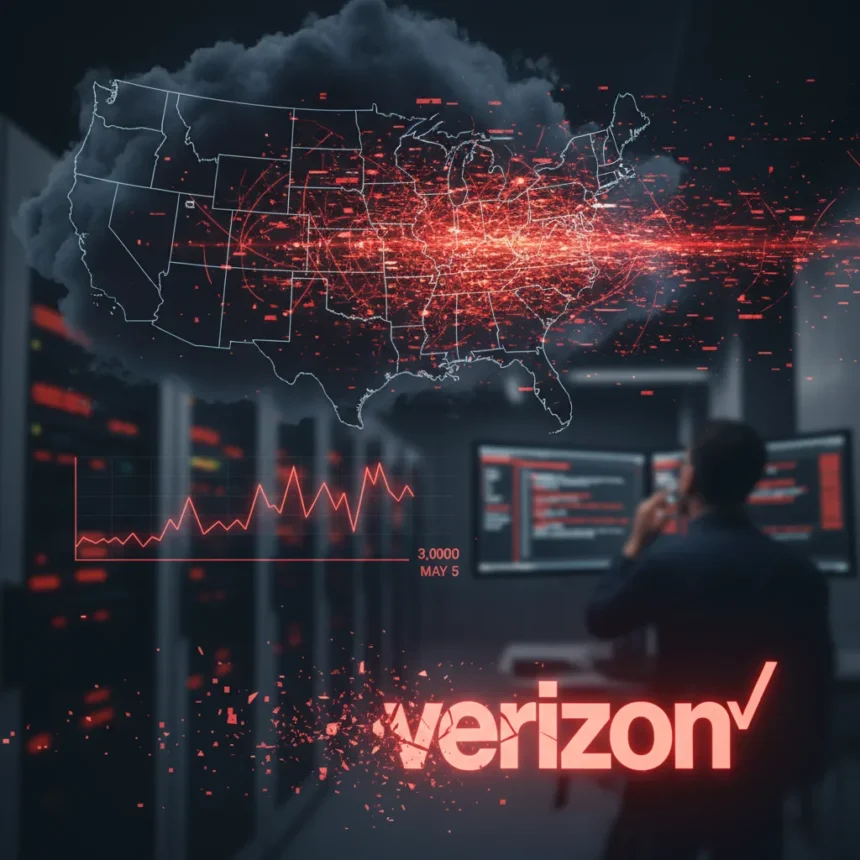
A Verizon network outage disrupted data service across parts of the US on May 5, with the incident affecting thousands of users primarily on the East Coast. The outage began around 2 p.m. Eastern Time, triggering a spike of approximately 3,000 user reports on DownDetector at its peak. While the majority of complaints came from East Coast regions, some users on the West Coast also reported issues.
Key Takeaways
- Verizon network outage on May 5 peaked at 3,000 DownDetector reports around 2 p.m. ET
- Data service was the primary issue; voice calls remained largely unaffected
- Outage resolved by late afternoon with reports dropping to under 500
- Verizon provided minimal public acknowledgment, directing users to DM support on X
- Part of a pattern: second significant outage in weeks affecting major US metros
What Happened During the Verizon Network Outage
The Verizon network outage on May 5 primarily impacted mobile data connectivity rather than call functionality. Reports spiked rapidly after 2 p.m. Eastern Time, with DownDetector capturing the surge in real time. The geographic footprint centered on the East Coast, though scattered complaints emerged from West Coast users, suggesting either regional propagation or unrelated connectivity issues. By late afternoon, the situation stabilized—user reports dropped from the initial 3,000 peak to 1,644, then 1,112, and eventually around 500, indicating the service was returning to normal.
Verizon’s response was sparse. The carrier did not issue a public statement acknowledging the outage through traditional channels. Instead, the company’s support team on X directed affected users to send direct messages to the support account to discuss their issues. This minimal transparency contrasted sharply with how carriers typically handle widespread service disruptions, leaving many users without real-time confirmation of what was happening to their connections.
Verizon’s Status Page and Timeline Issues
Verizon’s own status page added confusion to the incident. According to the information available through DownDetector, the status page listed the outage start time as May 13—despite the disruption occurring on May 5. This date discrepancy raised questions about whether the status page was accurately tracking the incident or pulling data from an unrelated event. The page did note that a fix was in progress, but the conflicting timeline undermined user confidence in the company’s situational awareness. By 4 p.m. Pacific Time, the status page referenced resolution, aligning with user reports that showed the outage had largely cleared.


Part of a Broader Pattern of Verizon Disruptions
This May 5 incident was not an isolated event. Reports indicate a second significant outage occurred within weeks, with a spike of approximately 1,538 DownDetector reports at 1 p.m. ET, affecting major metros including New York City, Atlanta, Los Angeles, and Chicago. Some Florida service issues during that period were tied to Hurricane Milton’s infrastructure impact rather than network failures. The frequency of these disruptions has reignited reliability concerns, according to broader industry analysis.
Verizon’s track record includes a major January 14, 2026 outage that dwarfed the May 5 event in scale. That incident peaked at 115,000 to 180,000 DownDetector reports, primarily affecting the East Coast, and lasted until 9:30 p.m. ET. In that case, Verizon acknowledged the problem on X and promised service credits to affected customers. A November 14, 2024 outage stemmed from a fiber cut in Ohio, Pennsylvania, and West Virginia, generating over 1,000 DownDetector reports. The accumulation of these events suggests systemic vulnerabilities in Verizon’s infrastructure or network management.



Why Verizon Outages Matter
Network outages disrupt not just personal communication but business operations, emergency services coordination, and daily routines. A data service outage prevents users from accessing email, navigation, messaging apps, and cloud services—essentially crippling modern smartphone functionality. For Verizon, which serves millions of US subscribers, even a few hours of regional disruption affects productivity across multiple sectors. The lack of transparent communication during these incidents compounds user frustration and erodes trust in the carrier’s reliability messaging.
How This Compares to Other US Carrier Outages
Major US carriers—AT&T, T-Mobile, and Verizon—have all experienced significant outages in recent years. The pattern of regional disruptions followed by larger-scale incidents suggests that infrastructure vulnerabilities are not unique to Verizon, though the frequency and scale vary. What distinguishes Verizon’s May 5 outage is the minimal public communication and the status page date error, which raised additional concerns about operational transparency and technical accuracy in incident tracking.
What Users Should Know Going Forward
For Verizon customers, these recurring outages underscore the importance of having backup connectivity options. Users relying solely on Verizon for critical communications should consider having a secondary carrier option or access to WiFi calling. Monitoring DownDetector and Verizon’s X account during suspected outages can provide faster situational updates than waiting for official status page information. The company’s pattern of minimal public acknowledgment means affected users often must seek confirmation from community reports rather than carrier statements.
Is Verizon experiencing outages frequently?
Yes. Verizon has experienced multiple significant outages in recent months, including the May 5 incident, a second outage within weeks affecting major metros, and a major January 2026 event that peaked at 115,000 to 180,000 DownDetector reports. The November 2024 fiber cut in Ohio, Pennsylvania, and West Virginia added to the pattern. While no carrier is outage-free, the frequency of Verizon disruptions has drawn industry attention to reliability concerns.


How long did the May 5 Verizon network outage last?
The May 5 Verizon network outage began around 2 p.m. Eastern Time and resolved by late afternoon. DownDetector reports dropped from the 3,000 peak to under 500, indicating the service had largely stabilized within a few hours. Verizon’s status page referenced 4 p.m. Pacific Time as the resolution window.
Why didn’t Verizon announce the outage publicly?
Verizon provided minimal public acknowledgment of the May 5 outage, instead directing users to DM the support account on X. The company did not issue a formal statement or press release, relying on its status page and social media responses rather than proactive communication. This approach left many users without official confirmation and forced them to rely on third-party platforms like DownDetector to track the incident.
The May 5 Verizon network outage exemplifies a troubling trend: major carriers experiencing recurring service disruptions while offering limited transparency to affected users. Until Verizon and its peers demonstrate more robust infrastructure resilience and clearer communication protocols, customers should expect these incidents to continue and plan accordingly.
Edited by the All Things Geek team.
Source: Tom's Guide




