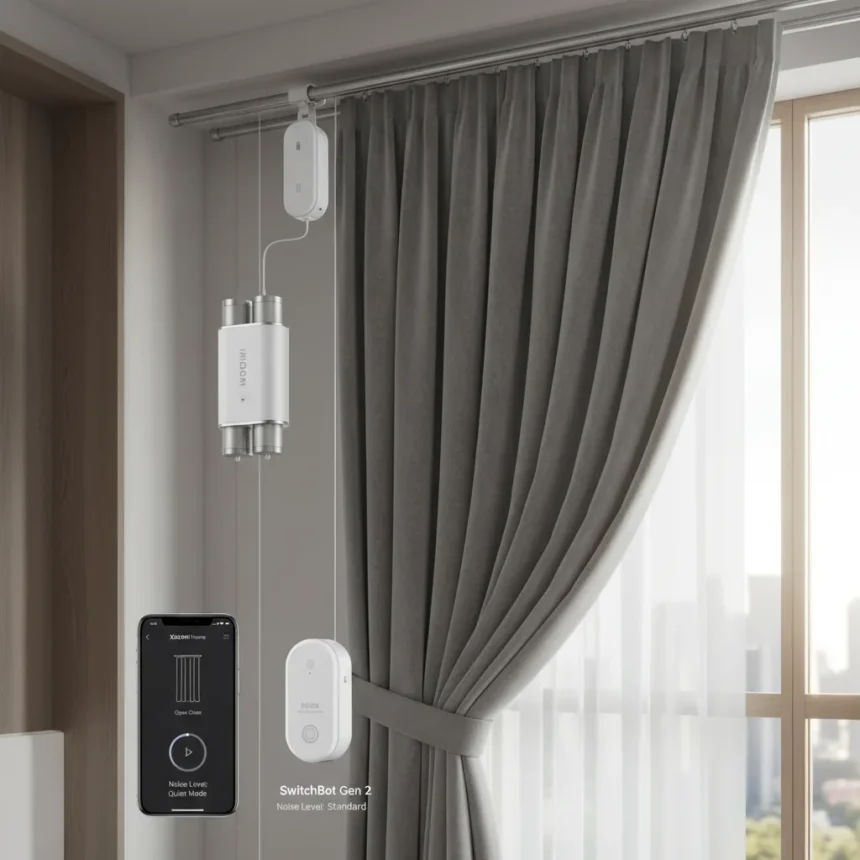
Xiaomi’s new smart curtain opener is entering a market long dominated by SwitchBot, and it’s bringing something the competitor struggles with: genuine quiet operation. The Xiaomi Mijia Smart Curtain 3 Pro uses dual brushless DC motors to cut noise while supporting curtains up to 60 kg—about 132 pounds—giving it a significant edge over lighter-duty alternatives.
Key Takeaways
- Dual brushless DC motors deliver quieter operation than SwitchBot and competing smart curtain openers
- Supports curtains weighing up to 60 kg with independent left and right control
- Smart wake-up mode gradually opens curtains over approximately 35 minutes
- Multiple control methods: app, voice commands, schedules, remote, and manual tug detection
- Integrates with Xiaomi ecosystem and HyperOS Connect for broader smart home automation
Why Xiaomi’s Smart Curtain Opener Matters Now
The smart curtain opener category has grown quieter and more capable over the past three years, but SwitchBot still dominates through brand recognition rather than technical superiority. Xiaomi’s entry changes that calculation. Where SwitchBot relies on standard motors that produce audible hum during operation, the Xiaomi Mijia Smart Curtain 3 Pro’s dual brushless architecture eliminates that noise entirely. For anyone who’s been woken by a curtain opener grinding to life at dawn, this is the difference between a useful automation and an annoying one.
The 60 kg weight capacity matters too. Most smart curtain openers max out around 12-20 kg, which means heavy blackout curtains, thermal drapes, or multi-panel setups require either multiple units or a workaround. The Xiaomi handles this in a single device, reducing both cost and installation complexity.
Smart Curtain Opener Control and Automation Features
The Xiaomi smart curtain opener’s real strength lies not in raw hardware but in how you interact with it. You can control it via the Xiaomi app, voice commands through compatible assistants, schedules, a physical remote, or even a manual tug—the device detects when you pull the curtain within about 10 centimeters and responds accordingly. This flexibility means you’re never locked into a single control method, and if the app fails or your internet drops, the device still works.


The app itself allows stepless speed adjustments from 10 to 100 percent, so you can slow the curtain to a crawl during movie time or snap it open at full speed on lazy mornings. You can also set independent open and closed points, which is crucial for asymmetrical windows or when you want partial coverage for privacy while maintaining light.
Independent left and right curtain control is a feature SwitchBot charges extra for through additional hardware. Xiaomi includes it in the base unit, letting you manage each side of a large window separately—useful for controlling light and privacy independently.



Wake-Up Mode and Smart Automation
Xiaomi’s smart curtain opener includes a phased wake-up mode that gradually opens curtains over roughly 35 minutes around a set time, such as 7 AM on weekdays. Unlike curtains that slam open at a preset hour, this gradual approach mimics natural sunrise and eases you out of sleep rather than jolting you awake. The app lets you customize the time and days, integrating with your weekly schedule.
The device also integrates with Xiaomi’s broader smart home ecosystem through HyperOS Connect, meaning you can trigger curtain opening as part of larger automation routines—opening blinds when you unlock your door, closing them when a security alarm activates, or adjusting them based on time of day.
How Xiaomi’s Smart Curtain Opener Compares to Alternatives
SwitchBot’s curtain opener is simpler and more portable, but it’s also louder and heavier on your wallet when you need multiple units for larger windows. Aqara, another Xiaomi ecosystem player, offers the Curtain Motor B1 for standardized tracks with app timers, automations, and sensor integration, but it tops out at lighter curtain weights and requires more manual configuration.
The Xiaomi Mijia Smart Curtain 2, an earlier model, launched at around 849 yuan—roughly 110 euros—and included app control, timers, remote access, and integration with Xiaomi’s wake-up and sleep modes. The Smart Curtain 3 Pro builds on this foundation with the quieter motors and higher weight capacity, positioning it as a more serious alternative to SwitchBot for anyone already invested in Xiaomi’s ecosystem.



Xiaomi also offers a Roman Rod version with no-drill installation on Roman rods and U or I-shaped tracks, Bluetooth Mesh connectivity, a 6400 mAh battery lasting around 6 months per charge, and light sensor automation—making it ideal for renters or those avoiding wall-mounted hardware.
Setup and Installation Considerations
Installation varies by model. The track-mounted variant installs on standardized DT82 tracks and requires you to reset the motor, connect via the Mi Home app to a Xiaomi gateway, and let the device learn your track size by fully opening and closing the curtains. The Roman Rod version skips the drilling entirely, attaching to existing rod hardware.
What you need before buying: a Xiaomi ecosystem device (gateway, hub, or compatible smart speaker), knowledge of your curtain weight and track type, and about 30 minutes for setup. The app walks you through configuration, but the learning curve is steeper than SwitchBot’s simpler interface.
Is the Xiaomi smart curtain opener quieter than SwitchBot?
Yes. The dual brushless DC motors in Xiaomi’s device eliminate the audible hum that SwitchBot’s standard motors produce. If noise during early morning or late evening operation is a dealbreaker, Xiaomi’s approach is meaningfully quieter.
Can the smart curtain opener handle heavy blackout curtains?
The Xiaomi Mijia Smart Curtain 3 Pro supports curtains up to 60 kg, making it suitable for heavy thermal drapes and blackout panels where lighter alternatives would struggle. The Roman Rod variant maxes out at 12 kg, so check your specific model’s capacity before purchasing.
What happens if the smart curtain opener loses internet connection?
You can still control it manually by tugging the curtain, using the physical remote, or triggering schedules that were pre-configured in the app. The device does not depend on cloud connectivity for basic operation, though remote access and voice commands require an active connection.
Xiaomi’s smart curtain opener fills a real gap in the market—it’s quieter than SwitchBot, heavier-duty than most alternatives, and cheaper than buying multiple units for large windows. If you’re already using Xiaomi smart home devices, it’s a logical addition. If you’re committed to another ecosystem, the setup friction might outweigh the hardware advantages.
Where to Buy
Edited by the All Things Geek team.
Source: T3