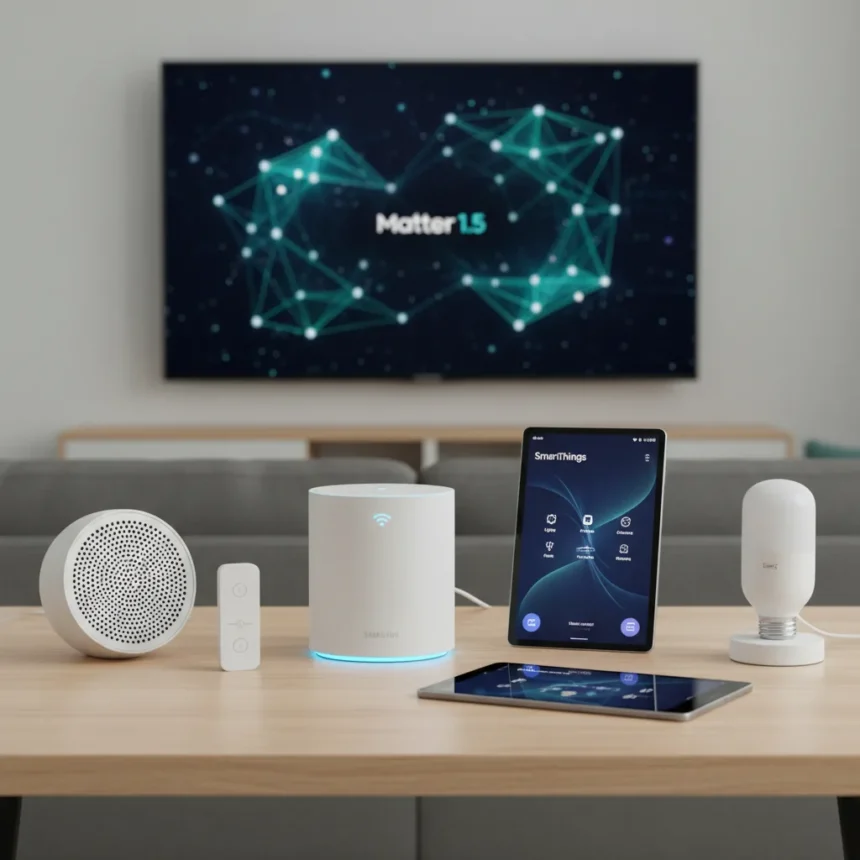
Samsung SmartThings Matter integration has reached a critical milestone: IKEA smart home devices now connect smoothly across the Samsung ecosystem, marking a fundamental shift toward interoperable smart homes. The upgrade, powered by Matter 1.5 support rolled out globally in December 2025, transforms how users automate their living spaces without vendor lock-in.
Key Takeaways
- Matter 1.5 support enables IKEA devices to work directly with Samsung SmartThings app and hubs via over-the-air updates.
- AI-driven routine creation assistant generates automations from simple voice commands like “turn off all lights when I leave.”
- Apple Watch widget allows wrist-based control of lights, routines, and tasks without reaching for a phone.
- Samsung Health integration adjusts sleep environments automatically using Galaxy Watch or Ring data.
- Philips Hue partnership certifies 155 products as ‘Works With SmartThings’ for plug-and-play lighting control.
Why Samsung SmartThings Matter integration matters now
The smart home market has long suffered from fragmentation. Users buying IKEA lights, Samsung TVs, and third-party locks faced the nightmare of managing three separate apps. Samsung SmartThings Matter integration solves this by positioning Matter as the universal translator between ecosystems. Jaeyeon Jung, Corporate Vice President and Head of SmartThings at Samsung Electronics, stated: “Matter is the future, giving consumers extensive choice and smart device compatibility at scale. Today marks the most significant milestone yet toward mass smart home adoption”.
What makes this update significant is Samsung’s comprehensive embrace of Matter across its entire product line—phones, TVs, watches, and appliances. This isn’t a half-hearted integration limited to one device category. It’s a strategic bet that interoperability drives adoption. When consumers know their IKEA purchases won’t become obsolete if they switch to Samsung, they buy more confidently.
New automation features that reshape daily routines
Samsung SmartThings Matter integration brings AI-driven routine creation that cuts through the complexity of traditional smart home setup. Instead of manually configuring seventeen conditions and triggers, users simply speak or type: “turn off all lights when I leave the house.” The routine creation assistant translates this natural language into working automations.


Beyond voice commands, the platform now supports weekly, monthly, and annual schedules. Want your smart lights to shift to warm amber every December for the holidays? Set it once, and it recurs automatically. SmartThings-connected speakers add another layer: real-time voice broadcasts let you call the family to dinner or announce appointments without walking through the house.
The integration with Samsung Health represents a subtler but powerful addition. Your Galaxy Watch or smart Ring tracks sleep patterns. SmartThings uses that data to adjust your bedroom environment—dimming lights at bedtime, raising blinds at wake-up—without manual intervention. This transforms the smart home from a novelty into a genuinely responsive living space.


How Samsung SmartThings compares to other platforms
Competing platforms like Philips Hue and Arlo have long offered robust ecosystems, but they required manual setup and lacked true interoperability. Philips Hue now partners with SmartThings, certifying 155 products as ‘Works With SmartThings,’ enabling seamless lighting control without user configuration. Arlo is adding AI security features—two-way audio and object detection from Arlo Secure 5—directly into the SmartThings app, arriving in spring.
The broader landscape has shifted: all major 2025 smart home platforms now require Matter compatibility for future-proofing. This means switching between ecosystems becomes viable rather than catastrophic. You’re no longer trapped in a Samsung-only world; IKEA devices, Philips lights, and Arlo cameras coexist without friction.
Expanded reach and real-world impact
Samsung SmartThings Matter integration has expanded automatic onboarding to 58 countries, with improved detection and registration of eligible Samsung products. This democratizes smart home setup. New users no longer need to hunt through settings; compatible devices appear ready to use within minutes.
The practical effect is measurable: users in markets from North America to Europe to Asia now face lower barriers to entry. An IKEA customer in Germany can buy a Tradfri bulb, add a Samsung SmartThings hub, and have working automations before dinner. The friction that once deterred casual adoption has collapsed.


Future direction: Motion sensing and habit learning
Samsung’s roadmap hints at even deeper integration. SmartThings plans to transform connected appliances and devices into motion sensors via a “Home AI” system that learns household habits. Imagine your coffee maker detecting you’ve woken up and starting a brew, or your lights brightening gradually as your sleep data shows you’re transitioning to wakefulness. This moves smart homes from reactive (you trigger an action) to predictive (the home anticipates your needs).
Is Samsung SmartThings Matter integration worth setting up?
Yes, particularly if you own or plan to buy IKEA smart devices alongside Samsung products. The setup friction has dropped dramatically, the AI routines actually save time, and Matter ensures you’re not locked into a single ecosystem. If you’re starting fresh, SmartThings is a sensible choice. If you already use Philips Hue or Arlo, the certified partnerships mean your existing investment works smoothly.
Can I use IKEA devices without a Samsung hub?
IKEA devices work with any Matter-compatible hub, not exclusively Samsung. However, SmartThings integration and the AI routine assistant are Samsung-specific advantages. A Samsung hub unlocks the full feature set; other hubs provide basic Matter connectivity.
What devices does Matter 1.5 support?
Matter 1.5, rolled out in December 2025, expands beyond lighting and locks to include cameras, blinds, sensors, and video doorbells. This broadens interoperability across security, privacy, and environmental control—the full spectrum of smart home needs.
Samsung SmartThings Matter integration represents the moment the smart home industry stopped fragmenting and started converging. IKEA devices no longer feel like isolated purchases; they become threads in a unified mix. For anyone tired of juggling apps and worrying about vendor lock-in, that shift is overdue and welcome.
Where to Buy
Edited by the All Things Geek team.
Source: T3