





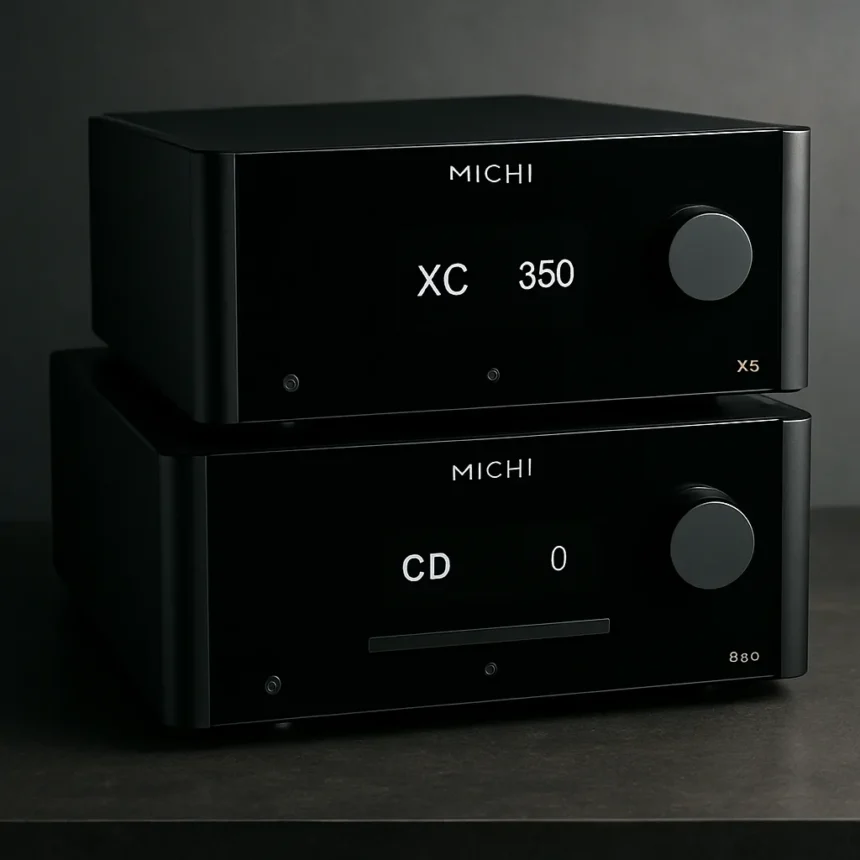
The Rotel Michi Prestige Series marks a deliberate return to high-end audio territory, reviving a 1990s prestige line with two flagship models designed for serious listeners: the X3 integrated amplifier and Q430 CD player. After more than 58 years of audio engineering, Rotel is betting that premium industrial design, hand-selected components, and robust Class AB amplification still matter in a streaming-dominated world.
Key Takeaways
- Rotel Michi Prestige Series launches with X3 amplifier delivering 350W/ch into 4 ohms and Q430 CD player with premium DAC
- X3 features 13 inputs including XLR balanced, USB up to 384kHz/24-bit, optical, coaxial, and Bluetooth for modern connectivity
- Class AB design with THD below 0.008% and damping factor of 350 across the audio band
- Roon Tested certification confirms integration with high-resolution streaming ecosystems
- Series includes higher-spec X5 model with 600W/ch and moving-coil phono input for vinyl enthusiasts
What Makes the Rotel Michi Prestige Series Stand Out
The Rotel Michi Prestige Series targets a specific listener: someone who owns vinyl, streams high-resolution audio, and wants a single integrated amplifier to handle everything without compromise. The X3 is the entry point, but it is hardly stripped-down. At 350 watts per channel into 4 ohms (200W continuous into 8 ohms), the Class AB design delivers the kind of dynamic reserve that makes both classical orchestras and rock albums breathe. This is not lean or efficient—the X3 pulls 500 watts at idle and sits in a chassis weighing 28.9 kilograms—but that mass and power consumption buy you something: a damping factor of 350 across the 20Hz-20kHz band, which means the amplifier grips your speakers with authority.
The industrial design deserves mention. Rotel has clearly invested in the aesthetics here, with a front panel that balances minimalism against functionality. The high-resolution display offers 12-band EQ and peak meter options, which feels almost retro in an era of invisible DSP, but it also gives you tangible control without reaching for a smartphone app. That matters if you value tactile feedback in your listening space.
Connectivity That Covers Every Source You Own
The Rotel Michi Prestige Series X3 integrates 13 inputs, a count that seems excessive until you actually own a turntable, a CD player, a streaming device, and a USB DAC. You get one XLR balanced input, three RCA analog inputs, three optical, three coaxial (supporting up to 192kHz/24-bit), a PC-USB input capable of 384kHz/24-bit resolution, MM phono, and aptX/AAC/HD Bluetooth. The USB path supports DSD and DoP formats, meaning you can feed it DSD files from your music server without conversion. There is also a preamp output, which lets you add a power amplifier later if you decide to biamp your speakers.



The AKM premium 32-bit/768kHz DAC handles digital-to-analog conversion across all these inputs, and Rotel has earned Roon Tested certification, confirming that the X3 integrates cleanly with high-resolution streaming ecosystems. If you care about the technical pedigree of your DAC, this matters. The Q430 CD player pairs with the X3 as a dedicated transport, featuring THD below 0.0006% and frequency response of 20Hz-20kHz with channel balance within ±0.5dB, supporting high-res playback.
Where the X3 Fits in Rotel’s Hierarchy
Rotel positions the X3 as the foundation of the Michi Prestige Series, but the line extends upward. The X5 integrated amplifier delivers 600 watts per channel into 4 ohms, adds a moving-coil phono input for serious vinyl collectors, and includes enhanced DAC specifications. If you are not yet committed to moving-coil cartridges or do not need the extra power headroom, the X3 handles MM phono and delivers more than enough current for typical loudspeaker loads. Think of the X3 as the pragmatist’s choice and the X5 as the maximalist’s. Neither is a compromise; they are different answers to the same question: how much amplifier do you actually need?



Compared to Rotel’s earlier Michi P5/S5 pre-power combination, which earned EISA Award recognition, the new X3 consolidates everything into a single chassis. This simplifies cabling and reduces the footprint in your listening room, though it sacrifices the flexibility of separates if you ever want to upgrade the preamp independently. The trade-off is deliberate: Rotel is betting that an integrated amp with this much input flexibility and DAC quality meets the needs of modern listeners better than a pre-power split.
Does the Rotel Michi Prestige Series Justify Its Prestige Positioning?
The specifications tell a story of careful engineering. THD below 0.008% across the audio band, a signal-to-noise ratio of 102dB IHF A-weighted, and channel separation exceeding 75dB suggest that Rotel has not cut corners on the analog signal path. The frequency response extends from 10Hz to 100kHz (±0.4dB), which is wider than necessary for human hearing but reflects a design philosophy that prioritizes transparency. When you are paying for prestige, you are paying for this kind of precision.
The catch is that specifications alone do not tell you how the X3 sounds. What they do tell you is that Rotel has engineered this amplifier to minimize distortion and phase shift across the entire audio spectrum, which is the engineering foundation for a neutral, detailed sound signature. Whether that translates to your listening room depends on your speakers, your room, and your source material—variables that no specification sheet can predict.
Should You Buy the Rotel Michi Prestige Series?
The Rotel Michi Prestige Series X3 makes sense if you have a diverse source collection and want a single amplifier to handle it all without buying a separate USB DAC or phono preamp. The 13 inputs and Roon Tested certification mean you are not locked into one ecosystem. If you are a vinyl-first listener with moving-coil cartridges, the X5 is the smarter choice, though it costs more. If you stream exclusively and have no plans to add analog sources, a smaller integrated amplifier or a dedicated streaming amplifier might serve you better.



The prestige positioning is earned through engineering depth, not marketing hype. Rotel has been making amplifiers for 58 years, and that experience shows in the component selection and the signal path design. The Michi Prestige Series is not a trendy product; it is a deliberate statement that high-end audio still values precision, connectivity, and the ability to drive demanding speakers with authority.
What is the power output of the Rotel Michi X3?
The X3 delivers 350 watts per channel into 4 ohms (maximum) and 200 watts per channel into 8 ohms (continuous). This Class AB design provides dynamic headroom for peaks while maintaining stable operation at typical listening levels.
Can the Rotel Michi Prestige Series handle high-resolution audio files?
Yes. The X3 USB input supports up to 384kHz/24-bit resolution, DSD, and DoP formats. The Q430 CD player also supports high-res playback, and all digital inputs connect to the AKM premium DAC, which is rated for 32-bit/768kHz processing.
Does the X3 have a phono input for turntables?
The X3 includes an MM phono input for moving-magnet cartridges. If you use a moving-coil cartridge, you will need the X5 model, which adds a dedicated MC phono stage.
The Rotel Michi Prestige Series is a reminder that integrated amplifiers can still be serious audio tools. The X3 does not try to be invisible or trendy; it is built for listeners who know what they want and expect their amplifier to deliver it without compromise. Whether that aligns with your own audio priorities is the only question that matters.
Edited by the All Things Geek team.
Source: What Hi-Fi?




