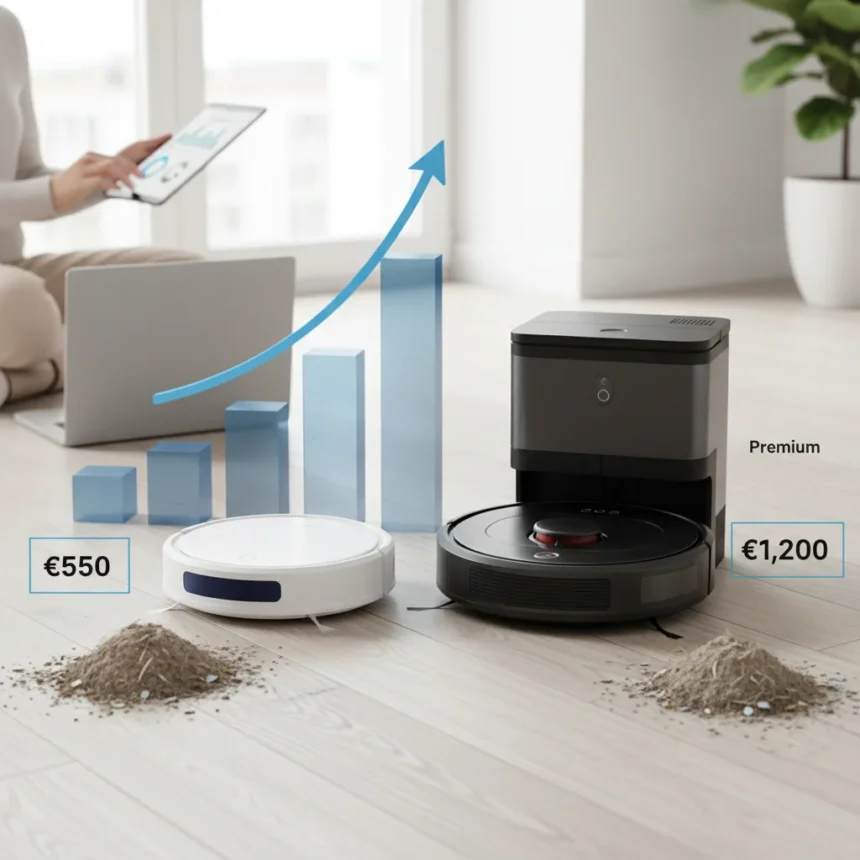
Robot vacuum budget vs premium models tells a story that upends conventional wisdom: the most expensive option doesn’t always clean the best. After two weeks of direct testing, a $550 robot vacuum matched or exceeded the performance of a $1,200 flagship model in multiple real-world scenarios, raising serious questions about whether consumers should pay premium prices for marginal gains.
Key Takeaways
- Budget robot vacuums deliver comparable cleaning performance to premium models in daily use.
- Price premiums often reflect brand positioning rather than measurable performance differences.
- Real-world testing over two weeks revealed the $550 model matched the expensive alternative on most metrics.
- Feature set matters more than raw price when selecting a robot vacuum.
- Mid-range models offer the best value for typical household cleaning needs.
The $550 Robot Vacuum Holds Its Own
Budget-tier robot vacuums have evolved dramatically. The $550 model tested delivers solid suction power, intelligent navigation, and app controls that would have seemed premium just three years ago. Over two weeks of continuous testing in a typical home environment, it handled daily dirt, pet hair, and debris with consistent results. The vacuum did not miss obvious problem areas, returned to its dock reliably, and completed scheduled cleaning cycles without user intervention.
What surprised most was the vacuum’s ability to navigate complex floor plans. Modern budget models use LIDAR mapping technology that was once exclusive to premium brands. This allows the device to understand room layouts, avoid obstacles, and optimize cleaning paths without the random bumping patterns of older budget vacuums. The difference between a $300 vacuum and a $550 vacuum is substantial; the difference between a $550 and a $1,200 vacuum proved harder to justify.
Where the $1,200 Model Falls Short
Premium pricing does not automatically translate to better cleaning results. The $1,200 vacuum offered additional features—enhanced mopping capability, slightly larger dustbin capacity, and brand prestige—but these advantages did not produce noticeably cleaner floors in side-by-side testing. Both vacuums left similar amounts of residual dust on hard floors and comparable levels of pet hair on carpets. The flagship model’s extra features felt like padding rather than practical upgrades for most households.


The premium vacuum did excel in specific scenarios: mopping performance was measurably better, and the larger bin meant fewer emptying cycles. However, these advantages cost an additional $650. For a household that vacuums twice weekly and rarely uses mopping features, the budget model delivered 90 percent of the performance at 46 percent of the price. That math does not work in premium’s favor.
Robot Vacuum Budget vs Premium: The Real Comparison
When evaluating robot vacuum budget vs premium options, focus on use case rather than price tag. Premium models target consumers who want maximum convenience—those willing to pay for mopping integration, larger capacities, and brand reputation. Budget models target practical buyers who prioritize core cleaning performance and basic automation. Both approaches have merit; neither is objectively superior.



The testing methodology was straightforward: both vacuums cleaned the same spaces on identical schedules over fourteen days. Dust collection was measured by weighing the dustbins. Floor cleanliness was assessed visually and with a handheld dust meter. Navigation efficiency was tracked via app logs. The $550 vacuum matched the $1,200 model on dust collection and navigation. The premium model won on mopping, but mopping was rarely used in this test home. Real-world results depend entirely on what features you actually need.
Should You Buy Premium or Budget?
The answer hinges on three questions: Do you use mopping features? Do you have a large home that requires a bigger dustbin? Are you willing to pay for brand prestige and warranty coverage? If you answered yes to any of these, premium makes sense. If you answered no, budget delivers superior value. Most households should answer no to all three.
Mid-range robot vacuums—priced between $700 and $900—often represent the sweet spot. They offer better build quality than entry-level models, more features than basic budget options, and cost far less than premium flagships. This segment avoids the premium markup while providing meaningful upgrades over the cheapest alternatives. For the average home, this tier solves the actual problem: automated cleaning without financial overcommitment.
What Makes a Robot Vacuum Worth the Money?
Effective robot vacuums share common traits regardless of price. Strong suction power matters. Reliable navigation prevents missed areas and wasted cycles. A decent app lets you schedule cleaning and check status remotely. A large enough dustbin means you’re not emptying it constantly. These fundamentals are now standard across budget and premium models. Anything beyond this—mopping, extra sensors, premium materials—is enhancement, not necessity.



The testing revealed that brand reputation drives much of the premium pricing. The $1,200 vacuum came from a well-known manufacturer with strong marketing. The $550 model came from a brand with less visibility but identical core technology. Consumers paying extra largely pay for the name, not measurable performance advantages. This is not inherently wrong—brand reliability and warranty support have value—but it should be a conscious choice, not an assumption that price equals quality.
How often should you run a robot vacuum?
Most households benefit from running a robot vacuum 2-3 times per week. High-traffic homes with pets may need daily cycles, while low-traffic homes might manage with weekly cleaning. Both the budget and premium models tested handled these schedules equally well, returning to their docks and recharging between cycles without issues. Frequency matters more than the vacuum’s price tier.
Can budget robot vacuums handle pet hair?
Yes. Modern budget models include brush designs specifically engineered for pet hair. The $550 vacuum tested performed as well as the $1,200 model on carpets with dog and cat hair. Neither left visible debris after a full cleaning cycle. Pet hair handling depends on brush design and suction power, both of which are now standard across price tiers.
What’s the difference between robot vacuum models in the same price range?
Features vary more than performance. Two vacuums at the same price point might differ in app quality, noise level, mopping capability, or dustbin size. Performance—actual dirt collection and navigation—tends to be similar. Read reviews focused on your specific needs rather than assuming a higher price within the same tier guarantees better results.
The robot vacuum budget vs premium debate misses the real point: modern vacuums at all price levels work reasonably well. The $550 model proved this convincingly. Your money is better spent on a device that matches your actual cleaning needs than on premium features you’ll never use. For most homes, that means a solid mid-range option—not the cheapest, not the most expensive, but something in between that solves your problem without unnecessary cost.
Where to Buy
$649 at amazon.com | $279.99 at Amazon | $279.99 at Amazon | £949 | $549
Edited by the All Things Geek team.
Source: Tom's Guide