





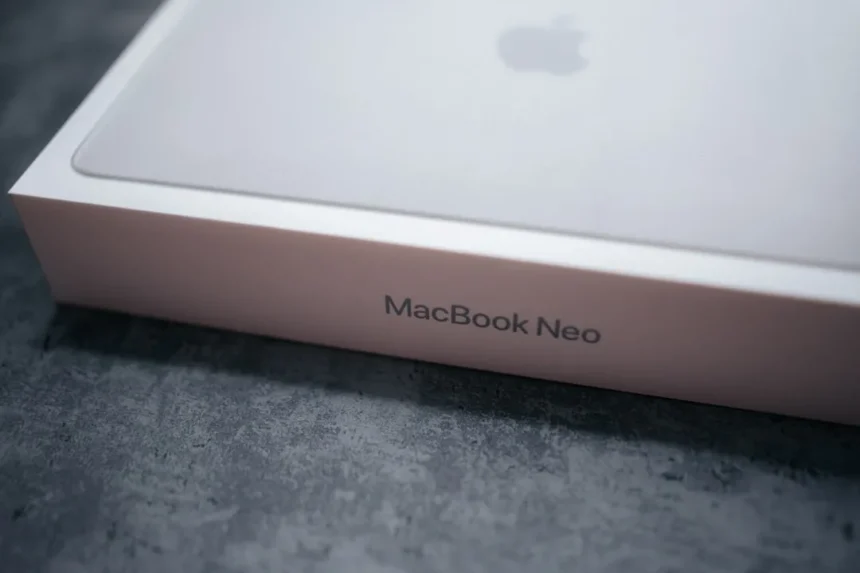
The MacBook Neo is Apple’s answer to a question it has spent decades refusing to ask: what if a Mac could cost $599? Announced March 4, 2026, this entry-level laptop fundamentally rewrites Apple’s playbook by delivering A18 Pro silicon, a premium 13-inch Liquid Retina display, and all-day battery life at a price that undercuts most Windows competitors. For a company that once positioned itself above the budget market entirely, the MacBook Neo represents a radical shift in strategy.
Key Takeaways
- MacBook Neo starts at $599 with 256GB storage, available now in four finishes
- A18 Pro chip delivers 50% faster everyday tasks, 3x faster AI workloads versus Intel Core Ultra 5 PCs
- 13-inch Liquid Retina display at 2408×1506 resolution with 500 nits brightness
- Up to 16 hours video battery life with fanless, silent cooling design
- Non-upgradable 8GB memory and 256GB base storage limit long-term flexibility
Why Apple Thinks Different About Entry-Level Pricing
For years, Apple’s cheapest Mac started around $999. The MacBook Neo obliterates that ceiling. At $599 for the base model, Apple has done something counterintuitive: it has not compromised on the core experience to hit that price. Instead, it has simply refused to add the premium tax that typically comes with the Apple logo on a consumer laptop. The 512GB variant with Touch ID costs $699, still undercutting most mainstream Windows laptops with comparable specs.
This pricing strategy directly challenges the Intel Core Ultra 5 market, which Apple claims the MacBook Neo beats by up to 50 percent on everyday tasks like web browsing and up to 3x faster on AI workloads such as applying advanced photo effects. Whether those claims hold up in real-world use depends on the specific Intel configuration, but the message is clear: Apple is not asking you to compromise on speed to save money.
The aluminum chassis, the durable construction, and the fanless design all suggest this is not a stripped-down budget machine. It is a full-featured Mac squeezed into an entry-level price point. That is the break from tradition.


MacBook Neo Display and Design: Compact Without Cutting Corners
The MacBook Neo weighs just 2.7 pounds and measures 0.50 inch thick, making it one of the most portable Macs Apple has ever built. The 13-inch Liquid Retina display hits 2408×1506 resolution at 219 ppi with 500 nits brightness and an anti-reflective coating. It lacks the advanced color gamut of Pro displays—no DCI-P3, no True Tone—but for a $599 laptop, the 1 billion color IPS panel is genuinely bright and sharp.
Available in Silver, Blush, Citrus, and Indigo finishes, the MacBook Neo signals that entry-level does not mean boring. The design language mirrors the rest of the Mac line: durable aluminum, minimal bezels (no notch), and a clean industrial aesthetic. This is not a budget laptop that looks or feels cheap.



Performance: A18 Pro Chip and Real-World Speed
The A18 Pro inside the MacBook Neo is the same chip powering the iPhone 16 Pro and Pro Max. That alone is remarkable—Apple is putting flagship phone silicon into a $599 laptop. The chip features 2 performance cores and 4 efficiency cores, a 5-core GPU with hardware-accelerated ray tracing, and a 16-core Neural Engine. Geekbench scores show single-core performance 43.2 percent faster than the M1 MacBook Air and multi-core performance 2.7 percent faster than the iPhone 16 Pro Max.
For everyday tasks—email, web browsing, document editing, light photo work—the MacBook Neo should handle everything without hesitation. The fanless design means it stays completely silent even under sustained load. Apple claims up to 50 percent faster performance on everyday tasks and 3x faster on-device AI workloads versus the bestselling Intel Core Ultra 5 PC. Those are manufacturer benchmarks, so real-world results will vary depending on the specific Windows laptop you are comparing against, but the architecture advantage is real.
Battery Life and Connectivity: Where Compromises Live
The 36.5Wh lithium-ion battery delivers up to 16 hours of video streaming or 11 hours of wireless web use. That is genuinely all-day performance, and the fanless design means zero thermal throttling or cooling noise to distract you. The MacBook Neo charges via USB-C with a 20W adapter, and it supports one external 4K display at 60Hz.
Connectivity is where the budget positioning becomes more apparent. You get two USB-C ports—one with 10Gbps DisplayPort 1.4 support, one USB 2.0—plus a 3.5mm headphone jack. Wi-Fi 6E and Bluetooth 6 round out the wireless story. There is no MagSafe, no Thunderbolt, no second high-speed USB-C port. For a $599 machine, that is reasonable, but users accustomed to the MacBook Air or Pro will notice the step down.



The Memory and Storage Trap
Here is where the MacBook Neo’s entry-level positioning hits hardest: the base 256GB model comes with 8GB unified memory, and neither is upgradeable. The 256GB drive reads at 1.6 GB/s, which is slower than the Pro models. If you want 512GB storage and Touch ID, you must pay $699. The 256GB base model gets a lock button instead.
This is a classic Apple move—lock buyers into their initial choice at purchase. For light users, 8GB and 256GB may be sufficient. For anyone planning to keep this laptop for five or more years, the lack of upgradability is a real limitation. You cannot add more RAM later. You cannot swap in a larger drive. You are buying the exact configuration you will use forever.
MacBook Neo vs. MacBook Air: Which Should You Buy?
The MacBook Air with M3 or M4 still offers better performance, more ports, and a larger screen. But it also costs significantly more. The MacBook Neo is not trying to replace the Air—it is trying to capture the Windows buyer who has never considered a Mac because of price. In that context, it wins decisively. You get Apple silicon, macOS, and the entire ecosystem for $599.
If you already own a recent Mac and are looking to upgrade, the Air remains the better choice. If you are a student, a casual user, or someone switching from Windows, the MacBook Neo is the most compelling entry point Apple has ever offered.
Is the MacBook Neo worth buying?
Yes, if you accept the non-upgradeable memory and storage constraints and plan to use the laptop for three to five years before replacing it. The performance is genuine, the display is excellent, and the price is unprecedented for an Apple machine. The fanless design and battery life seal the deal for portable, quiet computing.
Can you upgrade the MacBook Neo’s storage or RAM?
No. Both memory and storage are soldered to the logic board and cannot be upgraded after purchase. You must choose your configuration at the time of purchase.
How does the MacBook Neo compare to Windows laptops at the same price?
Most $599 Windows laptops ship with Intel Core Ultra 5 or Ryzen 5 processors and slower displays. Apple claims the MacBook Neo is up to 50 percent faster on everyday tasks and 3x faster on AI workloads. The Liquid Retina display is brighter and sharper than most competitors in the price range, and the battery life is competitive or better. The main advantage Windows machines offer is port variety and upgradeable components.
The MacBook Neo is Apple finally admitting that the budget market matters. It is a bold move for a company that has always positioned itself above price competition. Whether this marks a permanent shift in Apple’s strategy or a one-off experiment at a critical moment in the PC market remains to be seen. What is clear is that the MacBook Neo has reset expectations for what a $599 laptop should deliver.
Where to Buy
£569.97 at Amazon | £799 at Amazon | Check Amazon
Edited by the All Things Geek team.
Source: Creativebloq




