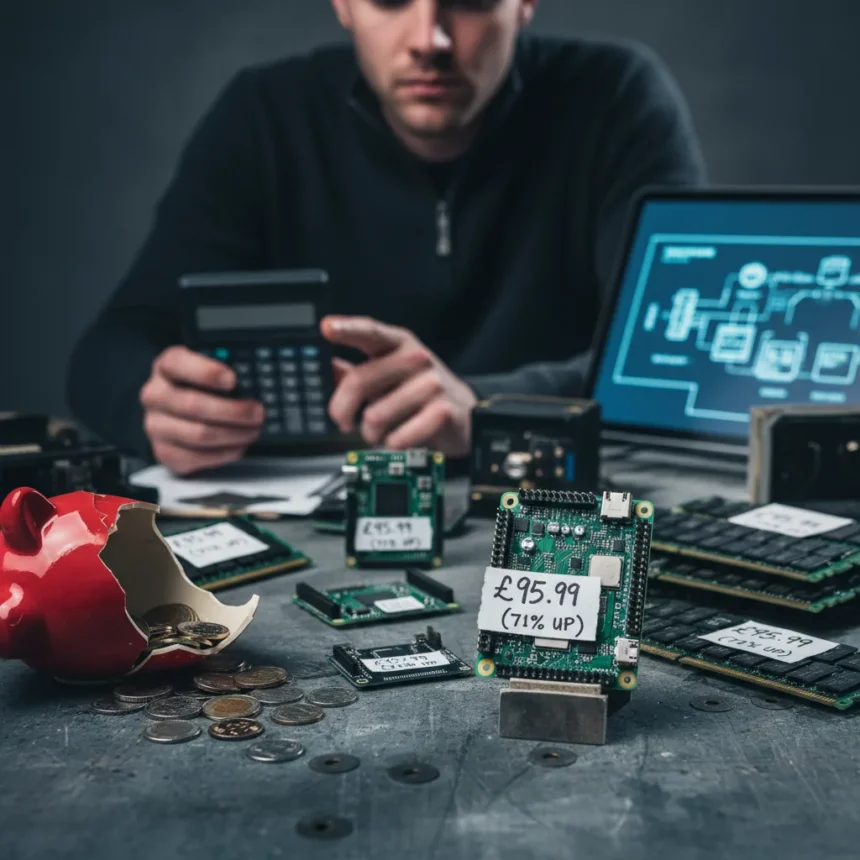
The RAM pricing crisis has returned with force, and Raspberry Pi is bearing the brunt. In February 2026, the company announced its third significant price increase in as many months, driven by an unprecedented surge in the cost of LPDDR4 memory. What was once the gold standard for affordable computing is now pricing out the hobbyists and makers who built its reputation.
Key Takeaways
- Raspberry Pi 5 8GB model now costs $125, up 56% from original $80 launch price in 2023
- 16GB variant jumped to $205, a 71% increase from original $120 MSRP
- Memory costs doubled in the last quarter entering 2026
- AI infrastructure competition for fab capacity is the primary culprit
- Mini PCs emerging as viable alternatives as Raspberry Pi loses its price advantage
How Bad Is the RAM Pricing Crisis for Raspberry Pi?
The numbers tell a brutal story. Uniform price hikes now apply across multiple Raspberry Pi models: 2GB variants up $10, 4GB up $15, 8GB up $30, and 16GB up $60. The Raspberry Pi 5—the company’s flagship single-board computer—exemplifies the damage. The 8GB model that launched at $80 in 2023 now costs $125, a 56% premium. The 16GB variant has climbed from $120 to $205, representing a staggering 71% increase. These are not incremental adjustments. They are fundamental shifts in what affordable computing means in 2026.
The Raspberry Pi Foundation attributes this directly to memory costs. In their official announcement, they described an unprecedented surge in LPDDR4 memory pricing, driven by competition for manufacturing capacity from the AI infrastructure rollout. Memory costs have more than doubled over the last quarter, and the foundation warns that 2026 looks likely to be another challenging year for memory pricing. This is not a temporary blip—it is the new market reality.
Which Raspberry Pi Models Are Hit Hardest?
Not all Raspberry Pi boards face equal pain. The foundation held the line on its lowest-memory variants: the Raspberry Pi 5 1GB remains $45, and the Raspberry Pi 4 1GB stays at $35. The Raspberry Pi 400 (4GB) also escaped increases, staying at $60. Meanwhile, models with 2GB of RAM or more absorbed the full impact. The Raspberry Pi 4 now costs $55 for 2GB (up from $45), $75 for 4GB (up from $60), and $115 for 8GB (up from $85). The Raspberry Pi 500 climbed to $130, and the Raspberry Pi 500+ now runs $260–$280 at retailers like Adafruit, up from $220.


Legacy models like the Raspberry Pi Zero, Pi 3, and Pi 400 remain stable because they rely on LPDDR2 memory, for which the foundation maintains years of inventory. This creates a strange bifurcation: if you want latest Raspberry Pi performance, you pay the RAM tax. If you want affordability, you step back to older hardware.
Why the RAM Pricing Crisis Threatens Affordable Computing
Raspberry Pi built its entire ecosystem on one promise: powerful computing at a price anyone could afford. A $35 entry point meant students, hobbyists, and makers could experiment without financial risk. That promise is eroding. When the 8GB Raspberry Pi 5 costs more than entry-level mini PCs, the value proposition shifts. Mini PCs—small form-factor computers that run full operating systems—are increasingly attractive to users who would have defaulted to Raspberry Pi just months ago. The RAM pricing crisis has inadvertently repositioned the entire affordable computing landscape.



The foundation introduced a new 1GB Raspberry Pi 5 as a cost-effective entry-level option, priced at $45. This move acknowledges the pricing pressure: they are essentially creating a lower tier to retain budget-conscious buyers. But a 1GB board in 2026 is a significant step backward from what makers expect. The foundation’s own statement—that 2026 looks likely to be another challenging year for memory pricing—signals no relief is coming soon.
Is Mini PC Now the Smarter Choice for Affordable Computing?
As Raspberry Pi prices climb, mini PCs are emerging as a genuine alternative for users seeking affordable computing power. Mini PCs offer full operating system support, wider software compatibility, and often comparable or better processing power at price points that now overlap with high-RAM Raspberry Pi boards. For tasks beyond hobbyist projects—light office work, media playback, home automation servers—a mini PC delivers more capability per dollar.
This does not mean Raspberry Pi is dead. The board’s ecosystem, GPIO support, and maker-friendly design remain unmatched for specific use cases. But the RAM pricing crisis has narrowed Raspberry Pi’s advantage. Users building a media center, a home server, or a general-purpose computing device now have reason to pause and compare. The affordable computing market is fragmenting, and Raspberry Pi’s dominance in that segment is no longer automatic.
When Will RAM Prices Come Down?
The Raspberry Pi Foundation offers no timeline for relief. Their statement that 2026 looks challenging for memory pricing suggests the crisis will persist through at least the first half of the year. The underlying cause—AI infrastructure competition for manufacturing capacity—shows no signs of abating. Data centers are bidding aggressively for LPDDR4 memory to support training and inference workloads. Until that demand cools, consumer products like Raspberry Pi will remain caught in the crossfire.



Should You Buy a Raspberry Pi Now?
If you need a Raspberry Pi for a specific project, the answer depends on your memory requirements. The 1GB and 2GB models remain relatively affordable, even with recent increases. The 4GB Raspberry Pi 4 at $75 is still reasonable for many applications. But if you were eyeing an 8GB or 16GB board for a media center, server, or ambitious project, pause and evaluate mini PCs. The price gap has closed enough that you might get better value elsewhere.
FAQ
Why is the RAM pricing crisis affecting Raspberry Pi so severely?
Raspberry Pi depends on LPDDR4 memory, which is in high demand from AI infrastructure companies building data centers. This competition for limited manufacturing capacity has driven memory costs up dramatically, and the foundation has no choice but to pass those costs to consumers.
Are older Raspberry Pi models immune to price increases?
Yes. The Raspberry Pi Zero, Pi 3, and other legacy models use LPDDR2 memory, which the foundation has stockpiled for years. These boards remain stable in price and are a genuine budget option if you can live with older performance.
Will Raspberry Pi prices drop in 2026?
The Raspberry Pi Foundation has not signaled any price cuts. They explicitly warned that 2026 looks likely to be another challenging year for memory pricing, suggesting elevated costs will persist.
The RAM pricing crisis has fundamentally altered the affordable computing landscape. Raspberry Pi remains a powerful platform, but it is no longer the obvious choice for every budget-conscious builder. The board’s price advantage has evaporated, and that shift matters. For the first time in years, users shopping for affordable computing have real alternatives to consider. The crisis is forcing a reckoning: Raspberry Pi must either find ways to stabilize costs or accept that it is no longer the gateway to computing for everyone.
Edited by the All Things Geek team.
Source: Windows Central