






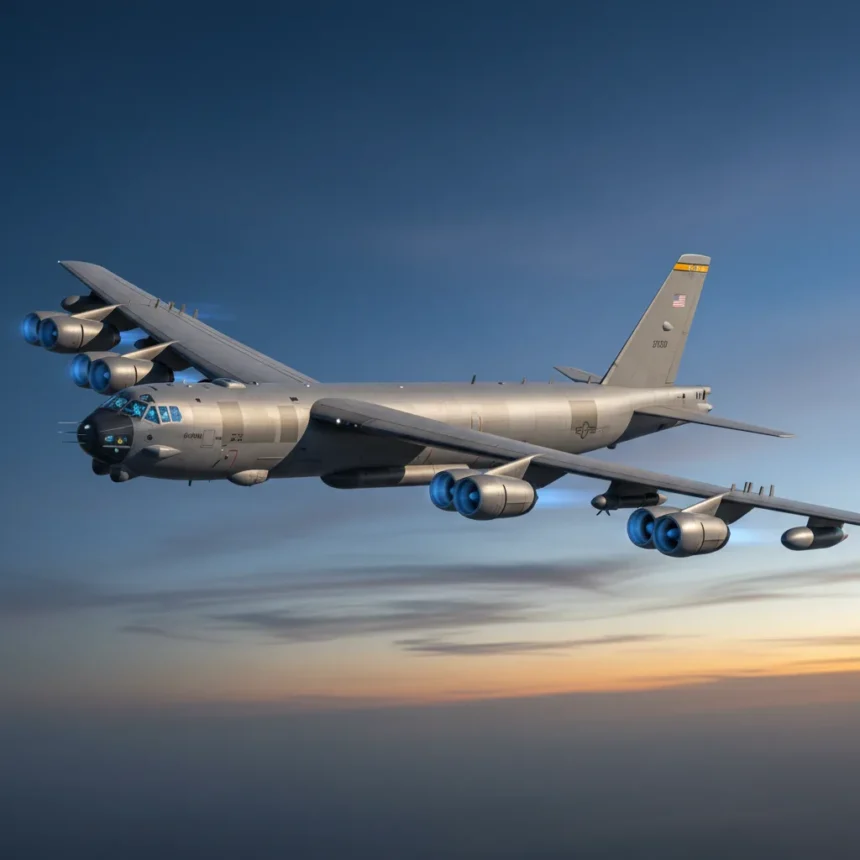
The B-52 Stratofortress modernization represents one of the longest-running military equipment upgrades in history. The US Air Force is investing billions to keep a bomber that first flew in 1952 operational through 2050 and potentially beyond, despite aging airframes and engines that frequently fail in service.
Key Takeaways
- B-52 Stratofortress modernization extends service life to 2050 (100 years from operational entry in 1955).
- Rolls-Royce F130 engines replace 1960s-era Pratt & Whitney TF33 turbofans with 20% better fuel efficiency.
- $2.6 billion avionics contract to Collins Aerospace upgrades radar, computers, and cockpit displays.
- Current TF33 engines have 40% mission failure rates; F130 projected to triple time between maintenance events.
- First re-engined B-52H expected operational in 2030; full fleet upgrade through 2033-2050.
Why the B-52 Stratofortress Modernization Matters Now
The B-52 Stratofortress modernization is not nostalgia—it is necessity. The oldest operational B-52H models were built in 1962, the same year Vladimir Putin was born. These aircraft carry 70,000 pounds of payload across 8,800+ miles unrefueled. The US Air Force operates 76 active B-52H bombers split between Minot Air Force Base in North Dakota and Barksdale Air Force Base in Louisiana. They remain the backbone of American long-range strike capability, used in every US conflict since Vietnam. With the B-21 Raider stealth bomber still years away from full deployment, the B-52 cannot retire yet.
The problem: the current TF33 turbofan engines date to the 1960s. These powerplants fail at a 40% rate during missions, according to US Air Force GAO reports from 2022-2024. Maintenance demands 1,000+ hours per flight hour. Parts vendors have gone out of business. Airframes show fatigue cracks and corrosion. The overall fleet availability rate sits at 55-65%, well below the 80% operational target. A $1.3 trillion lifetime sustainment bill through 2050 already assumes constant upgrades—without them, that cost spirals higher as failures multiply.
The Engine Upgrade: Rolls-Royce F130 Replaces Cold War Hardware
The B-52 Stratofortress modernization hinges on engine replacement. In 2024, the US Air Force awarded Rolls-Royce a $2.6 billion initial contract to develop and produce the F130 engine, part of a $4.5 billion total program covering the full fleet. The F130 is derived from the AE 2100 turboprop architecture, producing roughly 18,000 pounds of thrust—slightly more than the original TF33’s 17,000 lbf. The real gain is efficiency: Rolls-Royce projects a 20% fuel consumption reduction, extending range or reducing operating costs across a 30-year service extension.


Rolls-Royce claims the F130 will triple the time between unscheduled maintenance events, a dramatic improvement over the TF33’s unreliability. However, these projections rest on modeling and AE 2100 flight data, not yet on B-52 test flights. Ground testing began in 2024. First flight trials on a modified B-52 test airframe are scheduled for 2027-2028. Initial operational capability for the first re-engined B-52H is targeted for 2030. Full fleet conversion will stretch through 2033-2050, as each of the 76 aircraft cycles through depot maintenance.
The engine decision came after competition. General Electric’s F110 turbofan also competed for the contract. The F110 offered higher thrust but less fuel efficiency—a critical trade-off when extending an aircraft’s life means minimizing operating costs over decades. Rolls-Royce won the flyoff tests conducted by the Air Force in 2021-2023.



Avionics and Mission Systems Overhaul
The B-52 Stratofortress modernization extends beyond engines. Collins Aerospace, a unit of RTX, secured a $2.6 billion contract in 2023 to upgrade the radar, mission computers, data links, and cockpit displays. The new AN/APQ-366 radar replaces aging systems and integrates with modern air defense networks. Updated flight management computers and displays give pilots and weapons officers access to real-time battlefield data and modern targeting algorithms.
These avionics upgrades address a critical gap: the B-52 was designed for a Cold War enemy with fixed targets and predictable air defenses. Modern threats—China, Russia, regional adversaries with mobile air defense systems—demand sensors and processing power the 1960s-era cockpit cannot provide. The upgrade includes integration of the Conventional Tail Kit, which allows the B-52 to carry standoff weapons like AGM-86 air-launched cruise missiles and hypersonic systems at safe standoff distances.
Comparing B-52 Modernization to the B-21 Raider Alternative
The B-52 Stratofortress modernization faces an obvious question: why not replace the fleet with new bombers? The answer is cost and timing. Northrop Grumman’s B-21 Raider stealth bomber is entering service around 2027, but production is slow. The total B-21 program cost reaches $203 billion for 100+ aircraft—roughly $2 billion per unit including development. Fewer than 10 B-21s will be operational by 2030. The Air Force needs long-range strike capacity now. The B-52, despite its age, carries more payload than the B-21 and has proven reliability in combat. Keeping the B-52 flying through 2050 buys time for the B-21 fleet to mature while maintaining deterrence against China and Russia.
The B-1 Lancer, another long-range bomber, is being retired—the fleet is down to 45 aircraft from a peak of 100. The B-1 is faster than the B-52 but requires higher maintenance and carries less payload. Retiring the B-1 while modernizing the B-52 reflects a strategic choice: endurance and payload matter more than speed in the current threat environment.



Cost, Timeline, and Challenges Ahead
The B-52 Stratofortress modernization timeline is aggressive but realistic. The 2024 engine contract award commits Rolls-Royce to ground testing through 2026, first flight tests in 2027-2028, and IOC in 2030. Parallel avionics integration, already underway at Collins Aerospace, will be ready for the first upgraded aircraft. However, supply chain delays and inflation could slip these dates. The Air Force has already extended TF33 engine life through interim upgrades to buy time while new engines enter production.
The $1.3 trillion lifetime cost projection through 2050 includes not just upgrades but operations, maintenance, and sustainment for 76 aircraft over 30 years. That figure assumes inflation and includes all support costs. Critics argue the number is inflated; others note it is conservative given rising defense budgets and geopolitical tensions. Either way, the B-52 Stratofortress modernization is cheaper than replacing the entire fleet with new aircraft.
What Happens to the Old Engines?
The TF33 turbofans removed from B-52s will face disposal or possible reuse in non-military applications. No commercial airline uses TF33 engines anymore—they are too old and inefficient. Some military applications might absorb surplus engines, but most will be scrapped or stored. This represents a significant waste stream from a 70-year-old weapons system, though the alternative—flying unreliable engines—is worse.
Could the B-52 Reach 100 Years of Service?
Yes. The B-52 Stratofortress first entered USAF service in 1955. A 100-year service life extends to 2055. With the F130 engines, new avionics, and structural repairs, the Air Force believes at least some airframes can reach that milestone. A few exceptional aircraft might serve even longer, into the 2060s, if funding and geopolitical need persist. No other military aircraft has operated continuously for a century; the B-52 could be the first.
FAQ
When will the first upgraded B-52 fly?
The first B-52 Stratofortress with the new Rolls-Royce F130 engines is expected to reach initial operational capability in 2030, following ground testing in 2024-2026 and first flight trials in 2027-2028. Full fleet modernization will continue through the 2030s and 2040s.
How much fuel will the B-52 save with new engines?
Rolls-Royce projects the F130 engine will reduce fuel consumption by 20% compared to the current TF33 turbofans. This is based on modeling and testing of the AE 2100 derivative; actual in-service performance will be confirmed once the first upgraded aircraft begin operations.
Why not just buy new bombers instead of modernizing the B-52?
The B-21 Raider stealth bomber costs roughly $2 billion per unit and will take decades to fully deploy. The B-52 Stratofortress modernization keeps proven long-range strike capacity operational now while the B-21 fleet matures. The B-52 carries more payload than the B-21 and remains effective for many mission profiles, making modernization more cost-effective than wholesale replacement.
The B-52 Stratofortress modernization is a bet that legacy systems, when upgraded thoughtfully, can remain relevant longer than expected. Whether that bet pays off depends on whether Rolls-Royce delivers reliable engines on time and whether the Air Force can sustain funding through an increasingly uncertain budget environment. For now, America’s oldest active bomber is getting a new heart and brain—and a chance to fly into the 22nd century.
Edited by the All Things Geek team.
Source: TechRadar